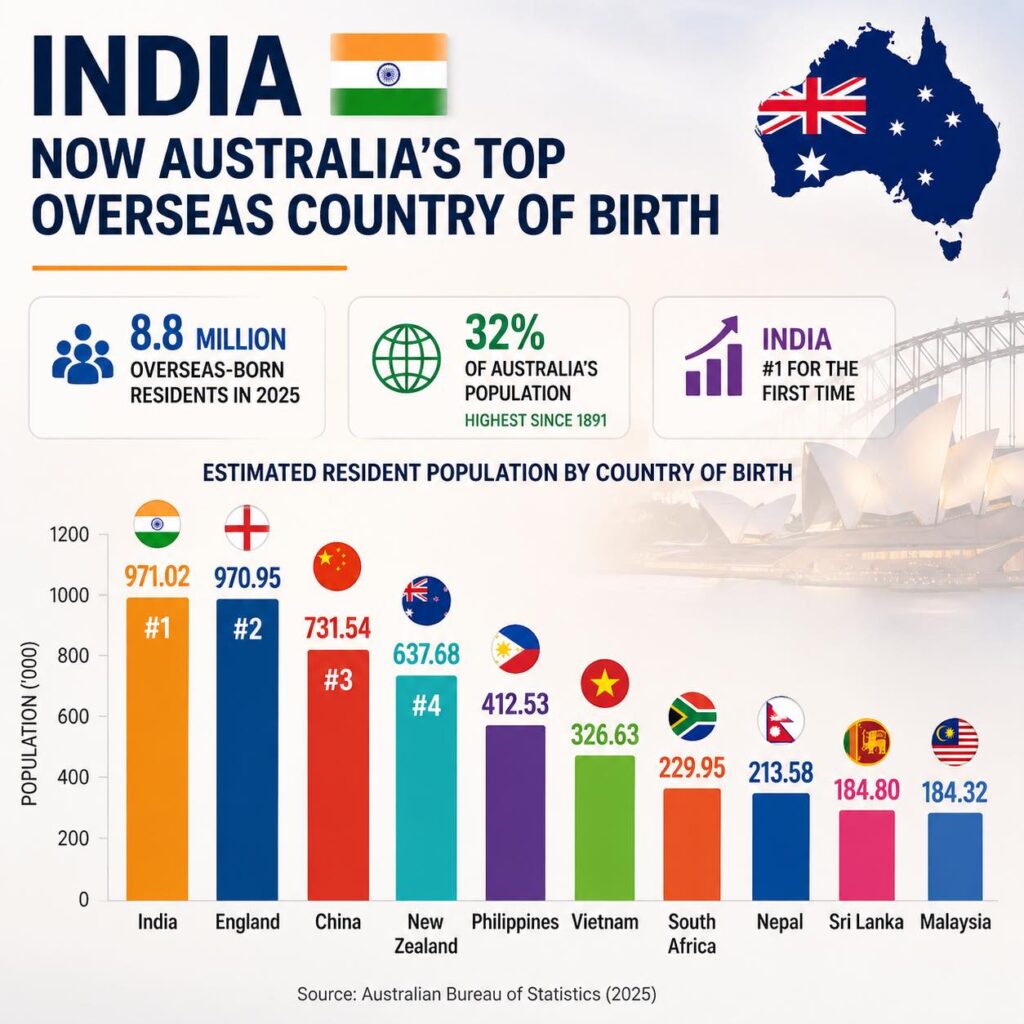
India has reached a new milestone in Australia’s migration story, with India now becoming the leading country of birth for people born overseas in Australia. According to recent data, India sits at the top with around 971,020 people, narrowly ahead of United Kingdom at 970,950, marking the first time India has overtaken England. This shift reflects the continuing evolution of Australia as one of the world’s most diverse and multicultural nations, where migration plays a central role in shaping society, the economy, and everyday life.

In 2025, Australia had approximately 8.8 million residents who were born overseas, compared to 18.8 million people born in Australia, meaning overseas-born residents now make up 32% of the total estimated population of 27.6 million. This proportion is approaching the highest level ever recorded, just below the 32.4% peak in 1891, highlighting how significant migration remains to the country’s growth and identity.

Over recent years, migration trends have gradually shifted, with India steadily rising as a major source of new migrants. Today, the top five countries of birth for overseas-born Australians are India, England, China, New Zealand, and Philippines. The growth of the Indian-born population has been particularly strong, increasing by around 522,000 people since 2015, the largest increase of any group. This growth has been driven by skilled migration pathways, international education, and family reunification, alongside Australia’s demand for professionals in sectors such as healthcare, information technology, engineering, and education.
At the same time, some earlier migrant groups are ageing, with people born in countries such as Italy and the United Kingdom recording declines since 2015. Both groups now have median ages of 60 and above, reflecting post–World War II migration patterns. Among all overseas-born populations, those born in Latvia are among the oldest, with a median age of around 80, while people born in Qatar are among the youngest, with a median age of approximately 15.
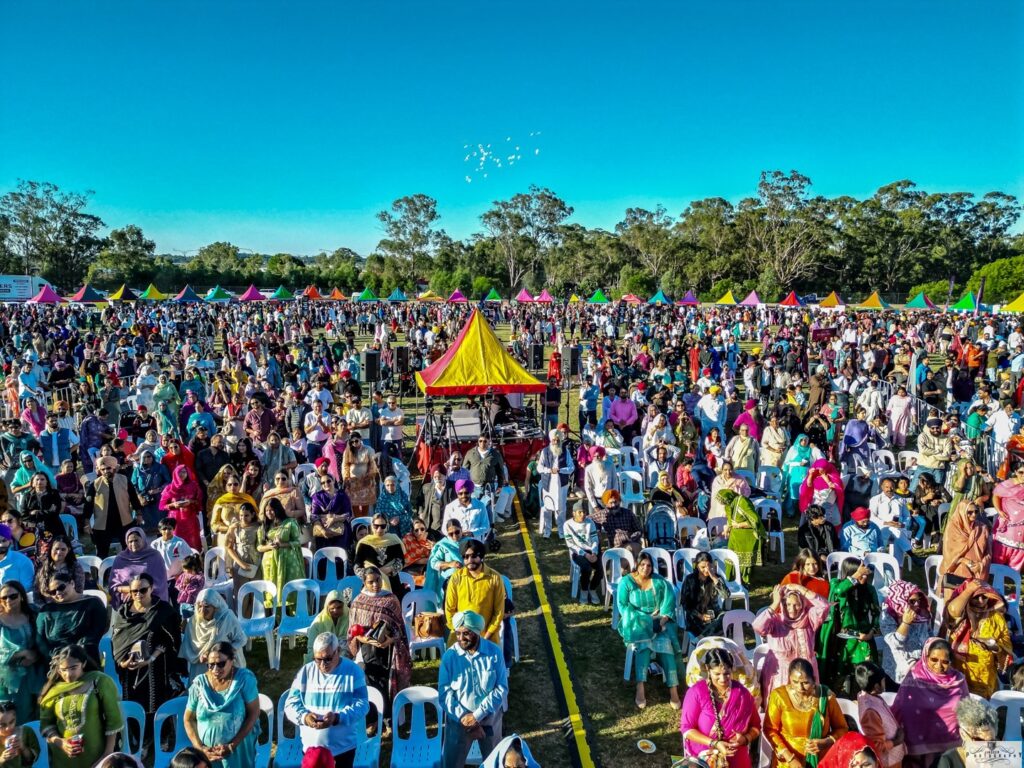
This development is closely tied to the growth of Australia’s broader Desi community, which has become an increasingly visible and influential part of the country’s social fabric. Indian Australians are contributing across a wide range of industries, from small business and entrepreneurship to essential services and corporate sectors, helping to fill workforce gaps and support economic growth. At the same time, the community is enriching Australia’s cultural landscape, with festivals like Diwali now widely celebrated, and Indian food, music, and traditions becoming part of mainstream Australian life.

Education has played a key role in this growth, with many migrants from India first arriving as international students before transitioning into skilled employment and permanent residency. This pathway has created a young, educated, and dynamic population that continues to contribute to Australia’s long-term economic and demographic sustainability.
Beyond economics and culture, this milestone also reflects strengthening ties between Australia and India. Migration has helped deepen connections in trade, innovation, and education, while diaspora communities serve as important bridges between the two countries. Rather than representing a shift of replacement, this moment highlights continuity in Australia’s long-standing migration story – one defined by waves of people from around the world contributing to the nation’s development.

Ultimately, India becoming the leading country of birth among Australia’s overseas-born population is a reflection of a broader truth: Australia continues to thrive as a diverse, outward-looking nation, where migration remains central to its identity and future growth.