
The measure of a successful budget is not how much it spends, nor how much it saves. Rather, it is whether it leaves society stronger than it found it.
By that standard, the NSW Government’s 2026-27 Budget contains much to commend.
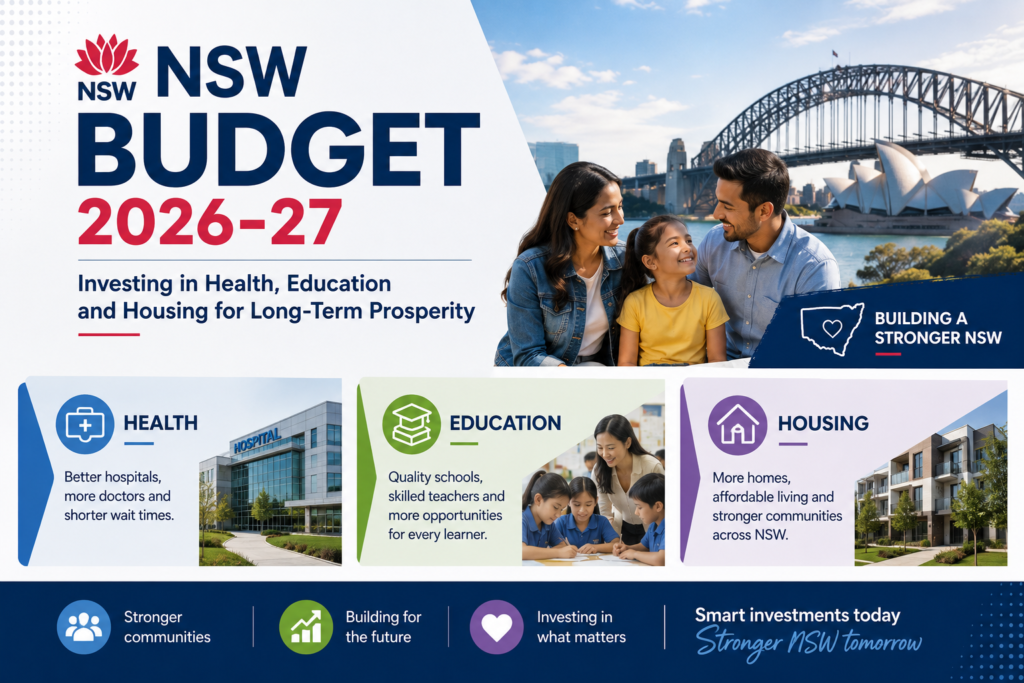
At a time when many households continue to face higher mortgage repayments, rising rents and ongoing cost-of-living pressures, the Budget delivers practical assistance where it is needed most. A $561 million Transport Affordability Package will help ease the burden on commuters through reduced vehicle registration costs, a lower weekly toll cap, frozen Opal fares for hundreds of thousands of daily passengers and the removal of toll administration fees.
These may not be headline-grabbing reforms, but they are the types of measures that make a meaningful difference to the daily lives of working families.
For residents across Western Sydney, tolls are often not a discretionary expense but a necessity of work, education and family life. Every dollar saved on transport costs can instead be directed towards groceries, school expenses, housing costs or family savings.
However, the true significance of this Budget extends beyond immediate cost-of-living relief.
The largest investments are directed towards the foundations of a prosperous society: health, education and housing.

A Historic Investment in Health
The Budget delivers an additional $10.3 billion in health funding over the next four years, supporting the recruitment of 9,000 additional healthcare workers and funding thousands of extra surgeries annually.
A further $11.9 billion has been allocated towards the construction and upgrade of 32 hospitals across New South Wales, delivering an additional 2,500 beds and treatment spaces.
Health spending is often discussed as a cost. In reality, it is one of the most important investments a government can make.
Healthy citizens participate more fully in the workforce, contribute more effectively to their communities and enjoy a higher quality of life. Every additional nurse, doctor, hospital bed and operating theatre strengthens the productive capacity of the state.
Strong economies ultimately depend on healthy people.
Education Remains the Great Equaliser
The same principle applies to education.
The Budget allocates $9.2 billion towards more than 260 new and upgraded schools across NSW, alongside $3.4 billion for skills development and TAFE, including $233 million to modernise campuses throughout the state.
If there is one area where governments should never lose ambition, it is education.
The benefits of educational investment are measured not in budget cycles but in generations. Every child who receives access to better educational opportunities carries that advantage throughout their life. Few public investments generate greater long-term social and economic returns.
For multicultural communities across Australia, education has long been viewed as the pathway to opportunity, social mobility and economic security. Continued investment in schools, vocational training and skills development is therefore an investment in the state’s future prosperity.
Housing: Progress, But More Work Ahead
Housing affordability remains the greatest challenge facing New South Wales.
The Government’s response includes $5.2 billion for water infrastructure and $3.5 billion for transport infrastructure across Western Sydney, investments that are critical to unlocking future housing supply.
Housing affordability is fundamentally a supply issue. Homes cannot be built where essential infrastructure such as roads, water, transport and community services do not exist.
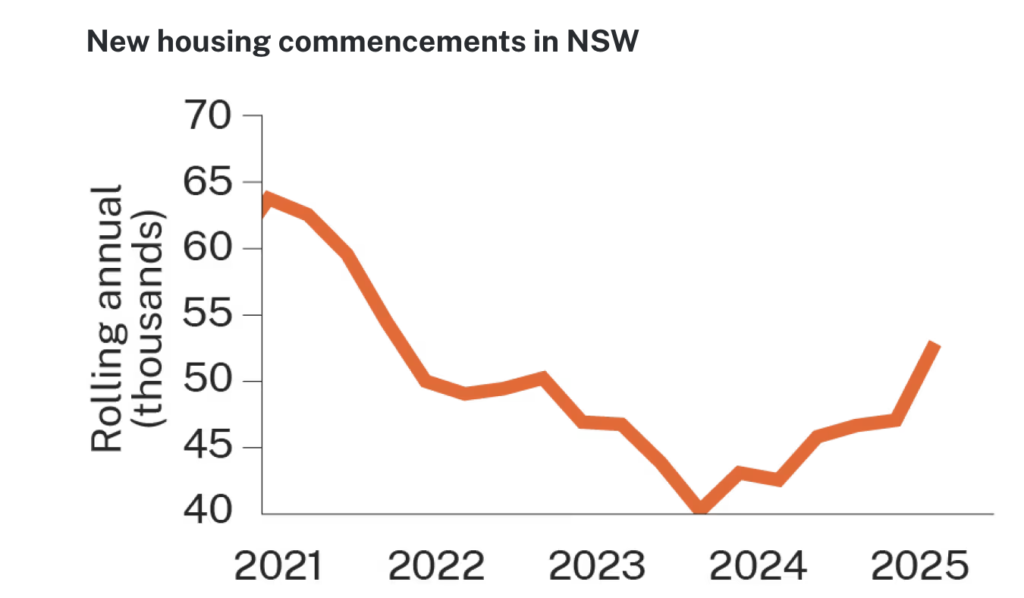
There are encouraging signs that housing construction is beginning to recover. Annual dwelling commencements in NSW increased from 40,300 in June 2024 to 52,900 by December 2025.
This improvement should be welcomed.
However, perspective remains important. Housing commencements stood at 63,800 in September 2021. Despite the recent recovery, NSW is still building approximately 11,000 fewer homes each year than it was four years ago.
At the same time, population growth remains strong, migration continues and household formation has increased.
The challenge facing NSW is therefore no longer one of decline, but one of pace.
The state is building more homes than it was a year ago, but still not enough homes to meet the needs of a growing population.
The strongest aspect of the Government’s housing strategy is not necessarily the assistance provided to homebuyers, but the investment in the infrastructure that enables more housing to be delivered. Roads, water, schools and transport are the often-overlooked foundations of housing affordability. Without them, housing targets remain aspirations. With them, supply can begin to catch up with demand.
Balancing Investment with Fiscal Responsibility
Encouragingly, the Budget seeks to pursue these priorities while maintaining fiscal discipline.
Following a projected deficit of $2.3 billion in 2026-27, the Government forecasts a return to surplus in 2027-28, followed by further surpluses in subsequent years.
Expense growth has been reduced to 1.8 per cent and is expected to average 2.7 per cent over the next four years. Gross debt is also forecast to be almost $10 billion lower than previously projected, generating significant savings in future interest costs.
This matters because every dollar spent servicing debt is a dollar that cannot be invested in hospitals, schools, housing infrastructure and essential public services.
Building the Foundations of Prosperity
The purpose of economic policy is not simply to maximise growth. It is to create the conditions under which people can flourish.
Strong public health systems create healthier citizens.
Strong schools create greater opportunity.
Affordable housing supports stronger families and communities.
Infrastructure drives productivity and economic growth.
Fiscal discipline preserves flexibility for future generations.
The most enduring prosperity is rarely built through grand promises or short-term fixes. It is built patiently through sustained investment in the foundations of society.
Viewed through that lens, the NSW 2026-27 Budget represents a serious attempt to strengthen those foundations and position the state for long-term success.
– max riaz
-Max Riaz