Indian Prime Minister Narendra Modi has arrived in Melbourne for a landmark three-day visit, marking another significant chapter in the rapidly expanding Australia-India relationship. The visit centres on the Australia-India Annual Leaders’ Summit, where Prime Minister Anthony Albanese and Prime Minister Modi are expected to unveil new initiatives across trade, defence, critical minerals, clean energy, education and emerging technologies.
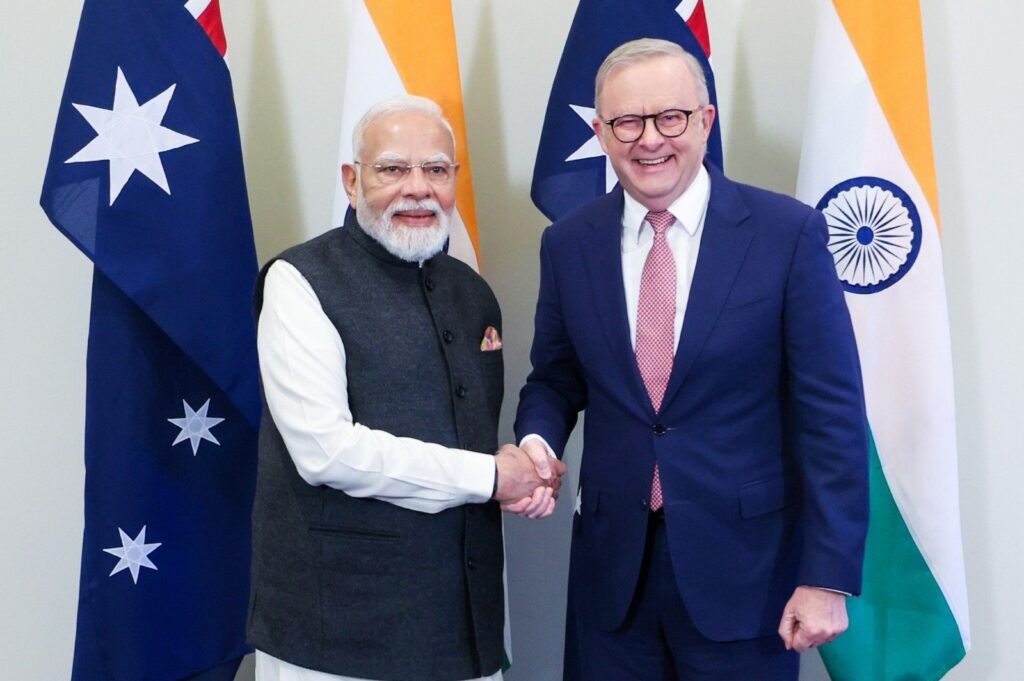
Prime Minister Modi was welcomed upon arrival by Victorian Premier Jacinta Allan, senior Australian ministers and Indian diplomatic officials. His visit has attracted enormous interest from government, business and the Indian-Australian community, reflecting the growing importance of bilateral ties between the two Indo-Pacific democracies.
Shortly after arriving, Modi joined Prime Minister Albanese at the India-Australia CEO Forum and the Economic Roadmap Business Reception, bringing together leading business executives, investors and industry leaders from both countries. The event focused on unlocking the next phase of economic cooperation and investment.
Addressing business leaders, Prime Minister Modi described Australia and India as “natural and trusted partners” whose relationship is built on shared democratic values, mutual trust and complementary economies. He said the partnership is evolving beyond traditional trade into innovation, advanced manufacturing, clean energy and technology-led growth.
Modi highlighted the success of the Australia-India Economic Cooperation and Trade Agreement (ECTA), saying it has significantly strengthened commercial ties between the two nations. He encouraged Australian businesses to expand their presence in India, describing the country as one of the world’s fastest-growing major economies with immense opportunities across multiple sectors.
Energy security emerged as a major focus of discussions. Modi outlined India’s ambitious plans to expand nuclear power generation while accelerating renewable energy production, noting Australia’s strengths in uranium, critical minerals and green technologies could support India’s long-term energy transition.
Prime Minister Albanese reaffirmed Australia’s commitment to deepening its strategic partnership with India, describing the relationship as one of Australia’s most important international priorities. He praised the contribution of the Indian-Australian community, calling it a living bridge that continues to strengthen people-to-people and economic ties.

Business confidence in India’s economic future was also on display, with major Australian investors reaffirming their commitment to the Indian market. The discussions highlighted growing collaboration in infrastructure, manufacturing, digital innovation, logistics and sustainable development as both countries seek to diversify economic partnerships.
Beyond trade, leaders are expected to discuss expanding cooperation in defence, maritime security and Indo-Pacific stability during the Annual Leaders’ Summit. Australia and India have steadily strengthened defence engagement through joint military exercises, strategic dialogue and regional security initiatives in recent years.
Education and research partnerships are also expected to feature prominently. Universities from both countries have significantly increased collaboration in quantum technologies, artificial intelligence, critical minerals research and advanced manufacturing, reflecting the growing knowledge partnership between Australia and India.
The visit carries particular significance for Australia’s Indian diaspora, now one of the country’s fastest-growing and most influential multicultural communities. Thousands of community members are expected to participate in a major public reception celebrating the strong friendship between the two nations.
Officials from both governments have indicated that several bilateral initiatives and partnership announcements are expected during the summit. Areas under discussion include critical minerals, supply chains, clean energy, digital technologies, higher education and increased business collaboration between Australian and Indian companies.
The visit comes at a time when Australia and India continue expanding one of the Indo-Pacific’s fastest-growing strategic partnerships. Bilateral trade has grown significantly since ECTA came into force, while negotiations continue towards a broader Comprehensive Economic Cooperation Agreement that could further strengthen commercial ties.
For both governments, the Melbourne summit represents more than a diplomatic meeting. It reflects a shared vision of closer economic integration, stronger regional cooperation and long-term collaboration in sectors expected to shape the future global economy, from clean energy and advanced manufacturing to innovation and digital transformation.
As Prime Minister Modi’s visit continues, attention will now turn to the formal Leaders’ Summit and the outcomes expected from high-level bilateral discussions. With trade, investment, defence and people-to-people connections at the forefront, the visit is widely seen as another milestone in the evolving Australia-India partnership and its growing influence across the Indo-Pacific region.