The Albanese Government will extend its freeze on the maximum cost of Pharmaceutical Benefits Scheme (PBS) medicines at $25 until the end of the decade, providing continued cost-of-living relief for millions of Australians who rely on prescription medications.
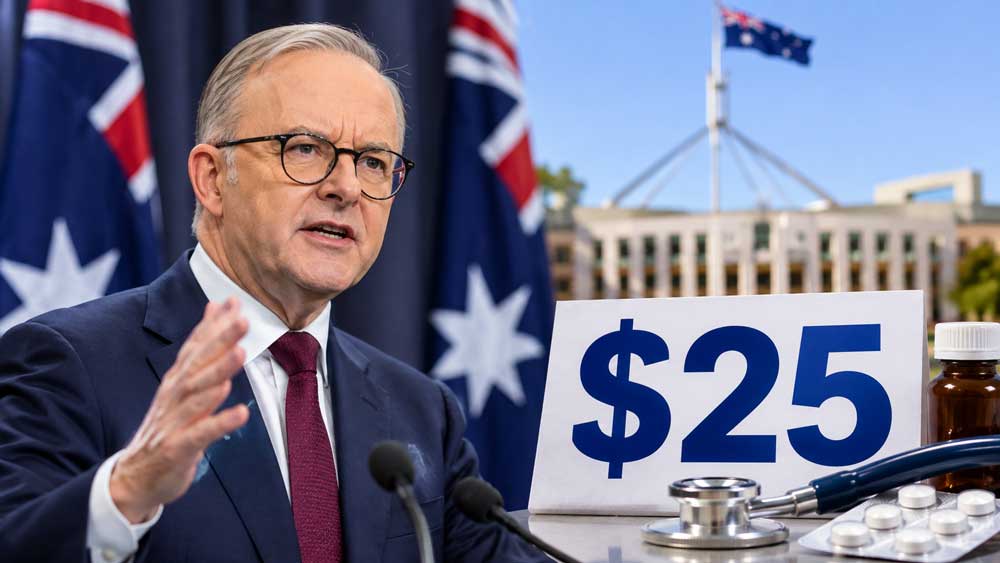
The $242.6 million investment will prevent annual indexation increases for general patients, ensuring the maximum PBS co-payment remains at $25 per prescription through to 2030. The Government has also confirmed that concession cardholders will continue to pay no more than $7.70 per prescription until the end of the decade.
Prime Minister Anthony Albanese announced the measure alongside Health Minister Mark Butler in Canberra, saying the policy would help households manage essential healthcare expenses while supporting a healthier Australia. The Government will introduce legislation to extend the freeze.
PBS Prescription Costs to Remain at $25 Until 2030
PBS co-payments are normally adjusted on 1 January each year in line with the Consumer Price Index. The Government’s decision will prevent these annual increases for general patients, keeping the maximum cost at $25.
According to the Government, PBS co-payments reached $42.50 under the former Coalition Government in 2022 and would have exceeded $50 per prescription by now if annual indexation had continued.
The last time general patients paid less than $25 for a PBS prescription was in 2004, according to the announcement.

The extension builds on the Government’s earlier decision to reduce the maximum general patient co-payment to $25 from 1 January 2026 and freeze concession cardholders’ co-payments at $7.70.
The Government says the measure is intended to ensure Australians do not have to choose between purchasing essential medicines and meeting other household expenses.
Cheaper Medicines Reforms Have Saved Australians $3.3 Billion
The latest announcement builds on a series of PBS reforms introduced by the Albanese Government since July 2022.
According to the Government, its Cheaper Medicines reforms have saved Australians $3.3 billion in out-of-pocket expenses across 500 million prescriptions.
Key measures include:
- January 2023: The largest reduction in PBS medicine prices in the scheme’s history.
- July 2022: A 25 per cent reduction in the PBS Safety Net threshold, helping more pensioners and concession cardholders access free medicines.
- 60-day prescriptions: Allowing eligible patients to obtain longer supplies of certain medicines with fewer pharmacy visits and lower costs.
- 2025: The first PBS co-payment freeze for concession cardholders.
- January 2026: Reduction of the maximum general patient co-payment to $25.
- Since July 2022: More than 500 new and amended medicines added to the PBS.
The reduction in the PBS Safety Net threshold has also enabled more pensioners and concession cardholders to access free prescriptions. The Government reported that more than 106 million prescriptions have been issued free of charge since July 2022 as a result of the lower threshold.
State-by-State Savings from Cheaper Medicines
The Government has released figures showing the savings generated by its cheaper medicines reforms across Australia since 1 July 2022, as at 31 October 2026.
| State or Territory | Reported savings |
|---|---|
| New South Wales | $1 billion |
| Victoria | $844.4 million |
| Queensland | $666.5 million |
| Western Australia | $358.3 million |
| South Australia | $241.5 million |
| Tasmania | $79.9 million |
| Australian Capital Territory | $68.9 million |
| Northern Territory | $18 million |
These figures reflect the reported savings from the Government’s broader cheaper medicines measures, rather than the cost of the newly announced co-payment freeze alone.
Albanese Says Freeze Will Ease Household Financial Pressure
Prime Minister Anthony Albanese said the policy was designed to provide practical cost-of-living relief while strengthening Australia’s healthcare system.
He said the Government understood that the cost of essential medicines could place significant pressure on household budgets, adding that keeping prescription costs down would help Australians access the treatments they need.
Albanese also highlighted the experiences shared by pharmacists, who had reported patients struggling to afford multiple prescriptions and having to decide which medicines they could afford to collect.
He said the Government’s reforms were intended to remove that difficult choice and ensure people could follow their prescribed treatments.
Health Minister Highlights Access to Essential Medicines
Health Minister Mark Butler said the Government had introduced successive measures to make healthcare more affordable, including cheaper medicines and improved access to bulk-billed GP appointments.
He referred to earlier Australian Bureau of Statistics findings that around one million Australians had reported being unable to fill prescriptions because of cost pressures.
Butler said the Government had already saved Australians $3.3 billion in out-of-pocket pharmacy expenses through its cheaper medicines policies.
He also highlighted the benefits for pensioners and concession cardholders, noting that the reduced Safety Net threshold had resulted in more than 100 million additional free prescriptions.
However, he said the Government recognised that Australians without concession cards were also facing financial pressure and needed affordable access to essential medicines.
Butler confirmed that the newly announced extension had been costed at approximately $242 million over three years to the end of the decade, with the funding to be reflected in the usual way in the Mid-Year Economic and Fiscal Outlook (MYEFO).
Pharmacists and Patients Welcome the Announcement
Pharmacy Guild Vice-President Simon Blacker welcomed the decision, saying the freeze would provide certainty for millions of patients who depend on regular prescriptions.
He said community pharmacists regularly spoke with patients about medicine costs, particularly those managing competing expenses such as rent, mortgage repayments, fuel and groceries.
Blacker said keeping the maximum prescription cost at $25 until 2030 would make it easier for patients to plan their household budgets and continue taking prescribed medicines when needed.
He also praised the Government for reducing the general patient co-payment twice, describing the changes as significant steps towards making medicines more affordable.
Patient advocate Jess, who currently takes nine medications, shared how the earlier reduction to $25 had changed her financial circumstances.
She said that before the price reduction, she had struggled to afford both medicines and basic necessities, including rent and food. At times, she had rationed her medication and experienced repeated hospital visits.
As a casual worker, she also faced lost income when her health deteriorated, creating further financial difficulties.
Jess said the $25 co-payment had given her greater certainty when budgeting for her medicines and removed much of the financial stress. She welcomed the extension, saying it meant patients in similar circumstances would not have to worry about prescription costs increasing over the next few years.
Albanese thanked Jess for sharing her experience and advocating for other Australians facing similar challenges.
Government Signals Further Budget Savings Ahead
During the Canberra press conference, Albanese also addressed the broader economic outlook and the upcoming MYEFO statement.
He acknowledged that the Government had limited capacity to introduce additional cost-of-living measures and said future decisions would need to support efforts to reduce inflation. He indicated that MYEFO would include substantial savings, with Treasurer Jim Chalmers expected to provide further details.
The Prime Minister and Health Minister also discussed ongoing Senate negotiations over other legislation, including proposed changes to private health insurance rebates for Australians aged over 65. Butler said the Government was negotiating with the Greens and hoped to have the legislation considered during the parliamentary sitting period.
The PBS co-payment freeze, however, remains a key part of the Government’s broader effort to reduce essential healthcare costs and improve access to medicines.
With the maximum general patient co-payment set to remain at $25 and concession cardholders’ payments capped at $7.70 until 2030, the Government says the extended freeze will provide greater certainty for Australians managing ongoing healthcare expenses.