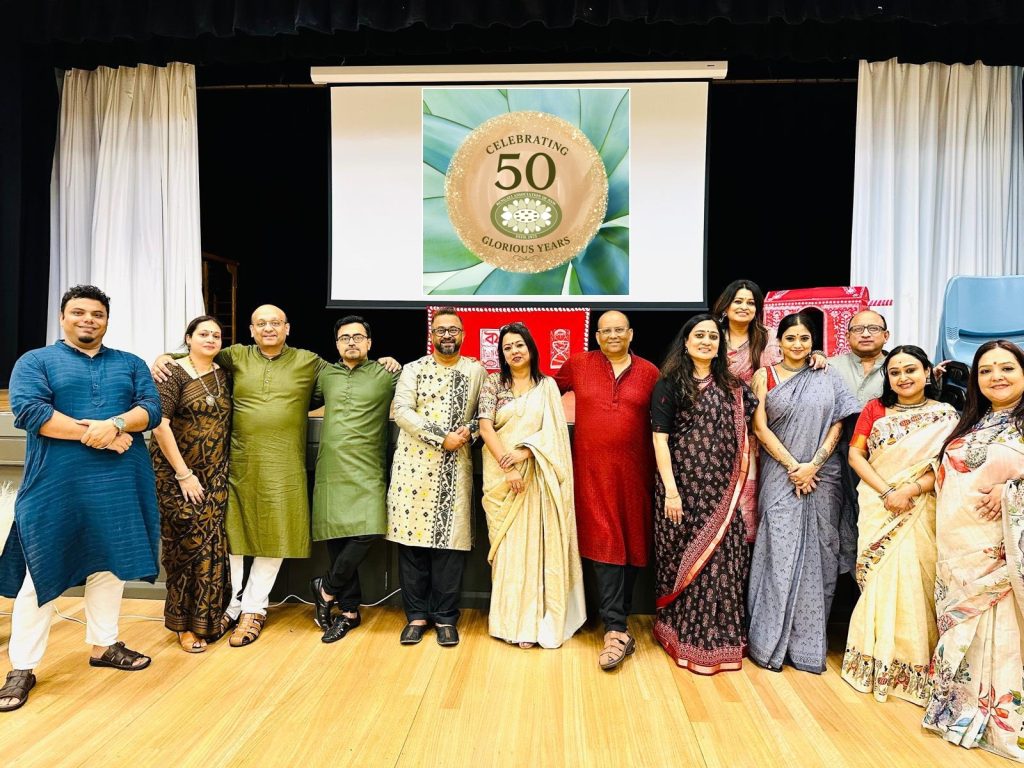
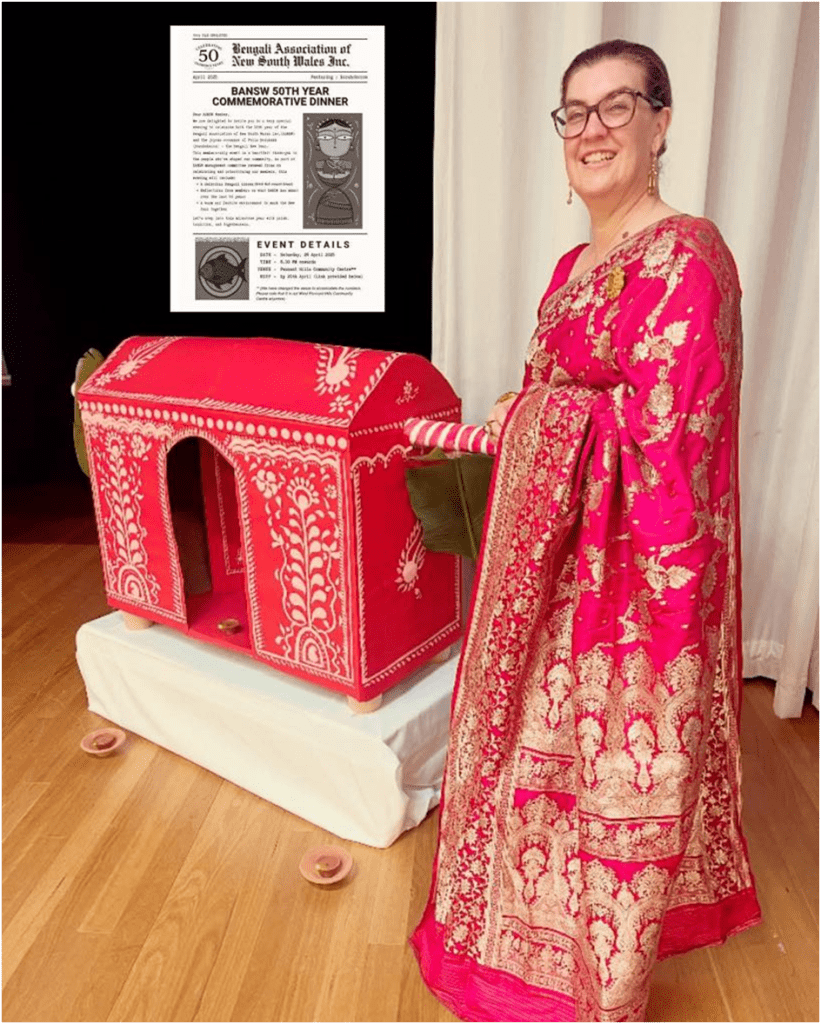
Dressed in my finest jewels, stepped into a grand hall bathed in soft light, with ceiling-high windows draped in majestic blue curtains. The space hummed with the vibrant energy of over 400 people, each one a bearer of memory, tradition, and celebration. Yet, what truly took my breath away was the sight on stage—a magnificent red palanquin. It stood regal and still, like a relic conjured from the pages of a forgotten epic, it’s red surface catching the light with a subtle shimmer.
It was more than décor; it was history materialized. The red that symbolised to me French Revolution, Bengal Renaissance and timeless vastness of the red Australian Outback. In the 17th and 18th centuries, palanquins were one of the chosen mode of transport for Bengal’s elite—a slow-moving poem of prestige, grace, and aristocratic elegance. This particular palanquin, exquisitely crafted by Rini Halder Chakrabarty with imagination, skills and sheer good taste. Not merely a tribute to the past but a beacon of cultural continuity and belonging, created to commemorate the golden jubilee of the Bengali Association of NSW (BANSW).
The Legacy of BANSW:
From modest beginnings in 1985—inside the quaint India Tea Board shop tucked away in Sydney—BANSW has grown into one of Australia’s most prominent Indian subcontinental organizations. What began as a dream among a few visionaries has since blossomed into a powerful cultural institution. Over the decades, BANSW has hosted a kaleidoscope of events: from spirited Durga Pujo celebrations that echo the vibrancy of Bengal, to intimate theatre festivals, friendly badminton tournaments, nostalgic annual picnics, and multifaceted cultural soirées. It has become a vessel through which Bengali traditions, stories, and values are preserved, shared, and passed down across generations. The organisation is planning for year long celebration of its golden jubilee. It is rumoured to publish a book of 50 stories for the milestone celebration.
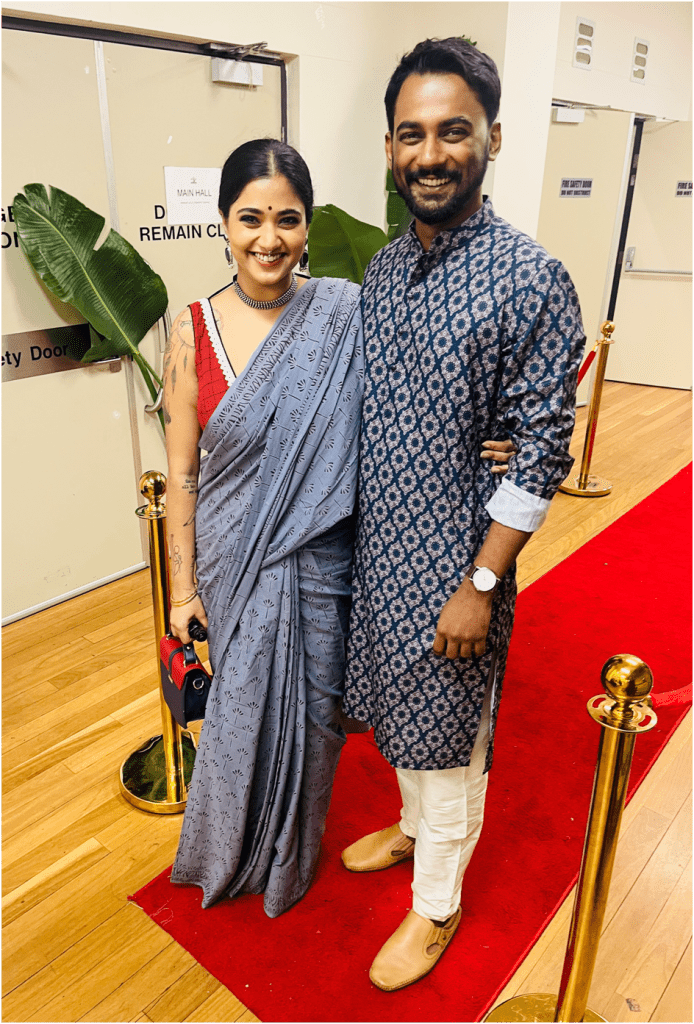
A Night to Remember: BANSW’s 50th Year Commemorative Dinner
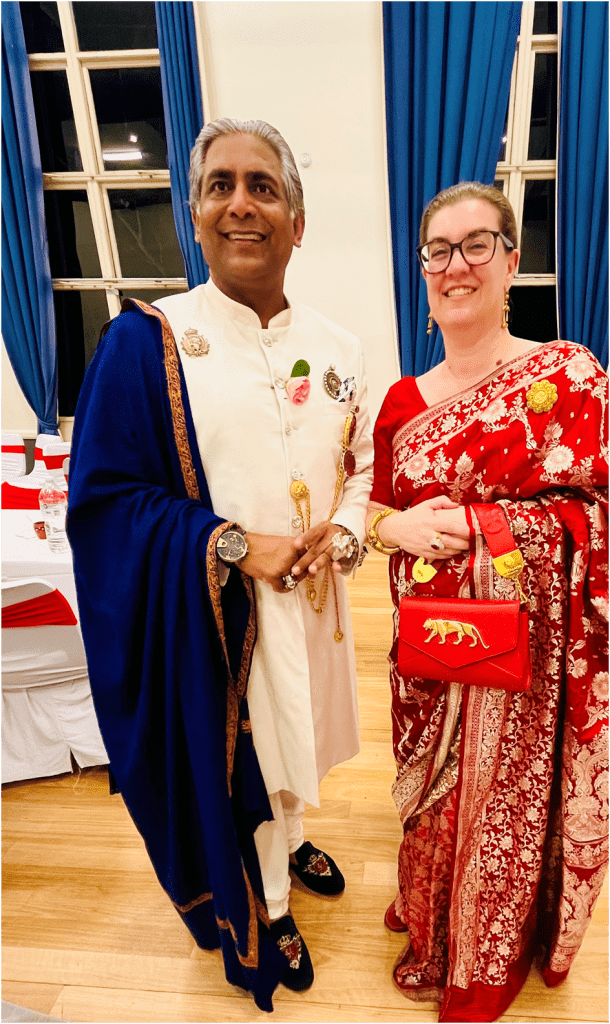
By the time we arrived with dramatic flare and maximalist style, the evening was already in full swing. Wearing a unique self designed jacket pin with a yellow topaz, Portuguese coin from Sri Lanka and a silver ship connecting Bengal to seafaring trade and commerce, I walked in with my multicultural wife, Jane Wilkins(Wilkins such as Charles Wilkins has strong connection to Bengal, designed the first Bengali type face to develop Bengali literature and literacy like what Gutenberg did for printing). She did turn more than a few heads in her stylish handwoven red Benarasi saree with zori weaves, accented with a sleek red Sabyasachi Mukherjee sling bag that had curved golden emblem of Royal Bengal Tiger with the word Calcutta embossed on the leather handle. After all such milestone celebration comes once in a lifetime.
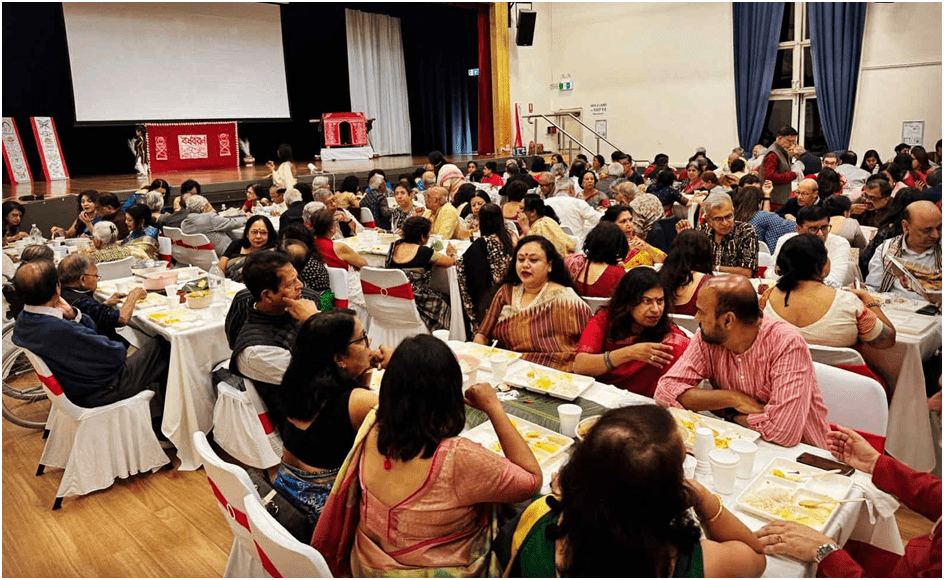
The room was a tapestry of laughter, movement, and reunion. Rini welcomed us with a graceful smile, as she adjusted a table centerpiece—an artful arrangement of a banana leaf, few pieces of lemon, and red/green chilies. Symbols of protection, fortune, and tradition—they were subtle reminders of home, lovingly placed.

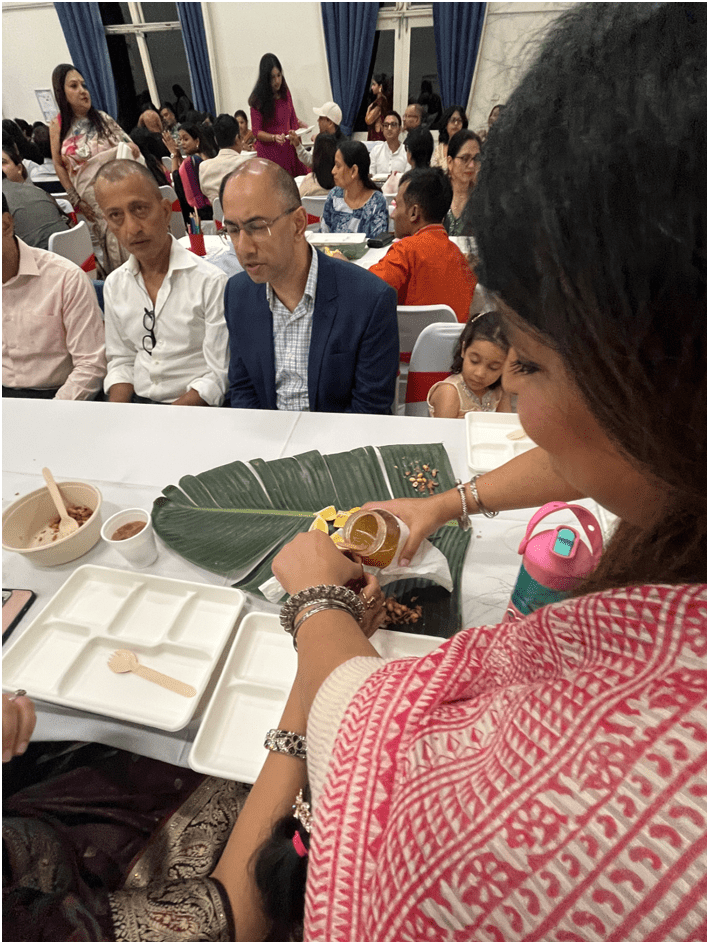
Rini found us temporary seats. Her husband, who was born in the affluent Sydney suburb of Kirribilli arrived with his longtime friend Amitava Dey. Both were storyteller’s charm, recounted the sheer dedication it took from dozens of volunteers like themselves and Sabyasachi Sarkar , Durjoy Dasgupta, Anindita Sain Mitra to bring the evening to life—a labor of love and legacy.
Guests had traveled from every corner of the city—from Point Piper’s harbor views to Rooty Hill’s vibrant suburbs, from the leafy Sutherland Shire to the family enclaves of Marsfield. We shared our table with the elegant Dr.Tanima Banerjee, at her request. Her silk saree shimmering like reflection of moonlight in a river, while we reconnected with Camelia, a Bengali international Ph.D. student from India at the University of Sydney’s Faculty of Medicine and Health.
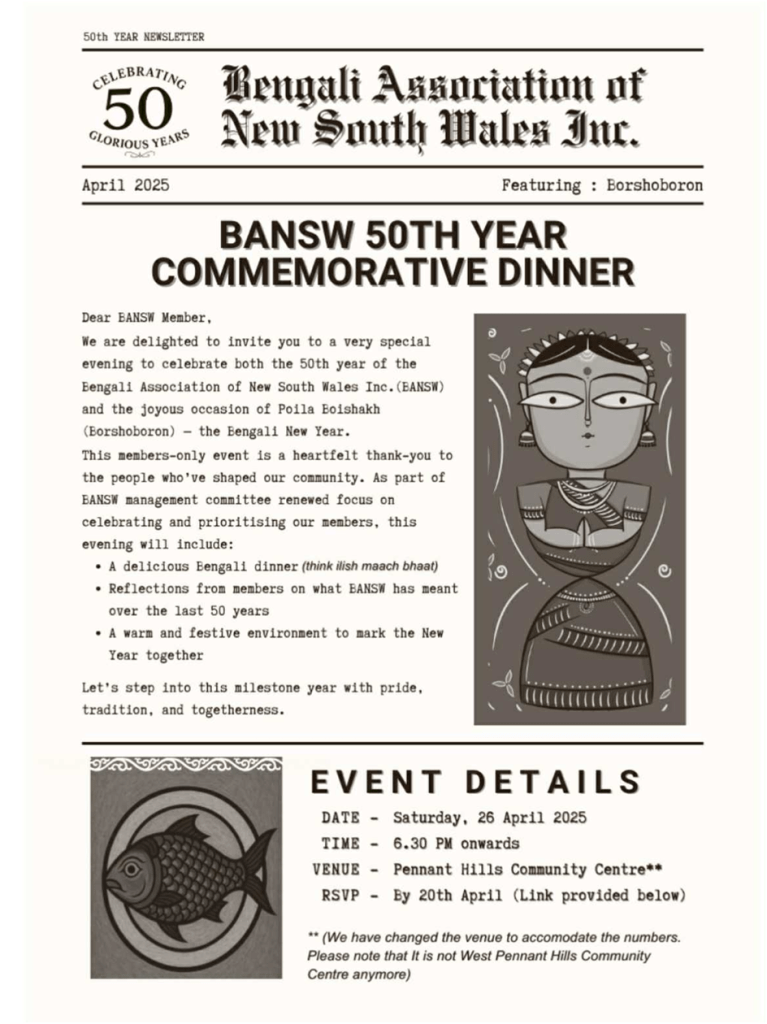
A live singer’s dulcet tones floated across the room as dinner was served. The menu was a rich homage to mouthwatering Bengali cuisine: delicate Hilsa fish steeped in mustard, perfectly crisped seasoned jhuri aloo bhaja, and snowy white rice drizzled with golden ghee. No one was worried, whether the Hilsa fish (“Queen of Fishes” ) was from- Padma river (Bangladesh) or Ganga-Hooghly rivers (West Bengal, India) or River Irrawady (Myanmar). Served with care and affection. The feast concluded with Bengali culinary classics—pioneer curry, misti doi, and syrup-soaked rossogolla- a sweet which celebrates Portuguese influence- that melted on my tongue. I couldn’t resist capturing the evening through my iPhone lens—snapshots of banana leaves, men and women in embroidered drapes, flickering dias, and of course, the stately red palanquin with elaborately hand painted white decoration, stood proudly like the newly built Jaganath Dham in Digha, West Bengal as a witness to history.

At the golden jubilee gala, we missed to share the progress of Bengali community with Senator Varun Nagarajan Ghosh (Australian politician and barrister), Satyajit Das(Australian former banker and corporate treasurer), Palash Nandy( CEO, Legrand Australia and New Zealand), Robin Khuda ( founder of $16 billion dollar AirTrunk, a data centre group), Prabal Chatterjee(Head Human Resources -TCS ANZ at Tata Consultancy Services), Sandeep Biswas(CEO of Newcrest, a gold mining company), Ahana Dutt (ex Firedoor and Raja chef, operating the new Kolkata Social restaurant in Newtown), Anaita Sarkar(Co-Founder and CEO of Hero Packaging, Author of Sell Anything Online, Speaker, E-Commerce Advisor), Mitu Bhowmik (CEO of Indian Film Festival of Melbourne and MindBlowing Films, Australia), Sheba Nandkeolyar (Founder and CEO of MultiConnexions Group), Bina Bhattacharya(award winning film writer and producer), Amitav Goswami (Director, Projectvision Consulting Pty Ltd), Narayan Ghosh(CEO of Bernard Petroleum) and billionaire Navneet Jindal (Kolkata/Sydney based, Bengali lover and owner of Wollongong Coal Mine Limited).
A Bengali Journey Through History in Australia:
This tapestry of Bengali migration, milestone and memory isn’t new. It has been chronicled in the compelling book Colonial Cousins: A Surprising History of Connections Between India and Australia by Joyce Westrip and Peggy Holroyde. In 1797, a shipwreck brought twelve Bengalis and five Englishmen to Australian shores—the ship, aptly named Sydney Cove. Centuries later, a 250 year old Bengali book discovered in Broken Hill would reveal another thread in this surprising, enduring relationship. And the Tagore statue in Macquarie University donated by ex Indian diplomat Dr Amit Dasgupta, strengthen this relationship for years to come.
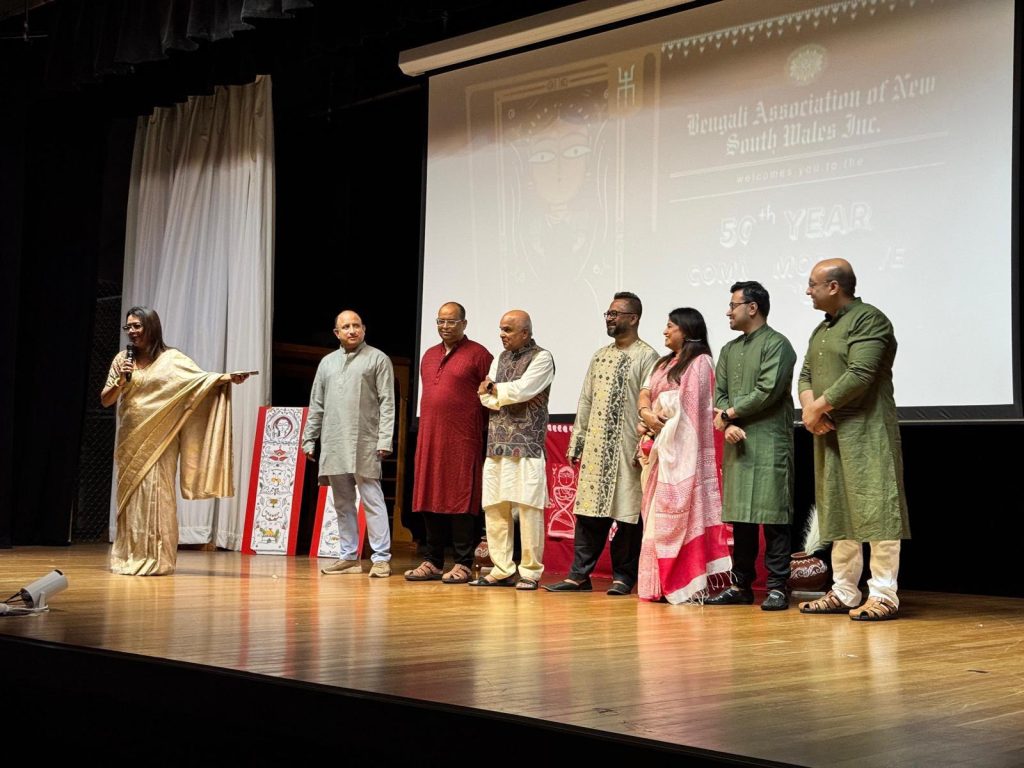
My connection to BANSW has been for thirty years. First time, I attended BANSW Durga Pujo was in 1994. In 2025, when I shared the event photos online, messages began pouring in from across the globe. One particularly poignant note came from Neela Roy Dasgupta in the United States: “Fifty years! What a proud moment! I vaguely remember the day the vote was taken at the India Tea Board shop in Sydney to form BANSW. Poddar Kaku—Dr. Poddar, who once headed the Department of Econometrics at the University of NSW—drafted the very first constitution.” We were delighted to meet her 80-year-old mother at the anniversary celebration, joined by her brother, Dr. P. Roy (cardiologist).
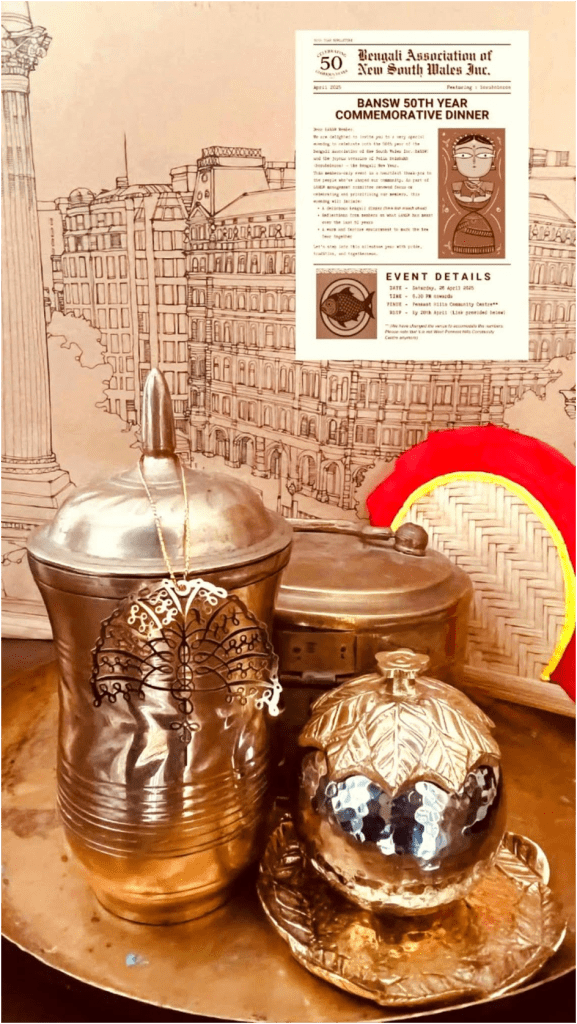
Despite the heavy rain, international tariff war and mammoth increase in cost of living, the hall was packed to the rafters with long-standing members and new faces alike—skilled migrants, international students, young professionals—each contributing their own verse to this unfolding story of Bengali community, heritage and belonging in Australia.
A Symbol in Scarlet : Palanquin
As the night drew to a close, Priya Chakrabarty had given her impactful bite for my social media update and the last notes of music faded into silence, I took one final snap. It was of Rini, proudly looking through her handcrafted red palanquin— as if she is looking through the journey of 50 year old organisation. That image now sits framed in my study, reminding me that the red palanquin is not just a relic or an ornament at the BANSW golden jubilee commemorative dinner, it is a vessel of resilience, triumph and belonging. It stands as an emblem of who we are—carriers of legacy, builders of bridges, dreamers in diaspora. This scarlet palanquin tells a story of inclusion and diversity that’s still unfolding. And it carries us, Bengalis in Australia forward, one impactful step at a time.