The UN at 80: Shaping Our Future Together Conference, held at the Sheraton Grand Sydney, brought together leaders, diplomats, and changemakers to reflect on the past 80 years of the United Nations – and to chart a path forward for the decades ahead.
Event Opening
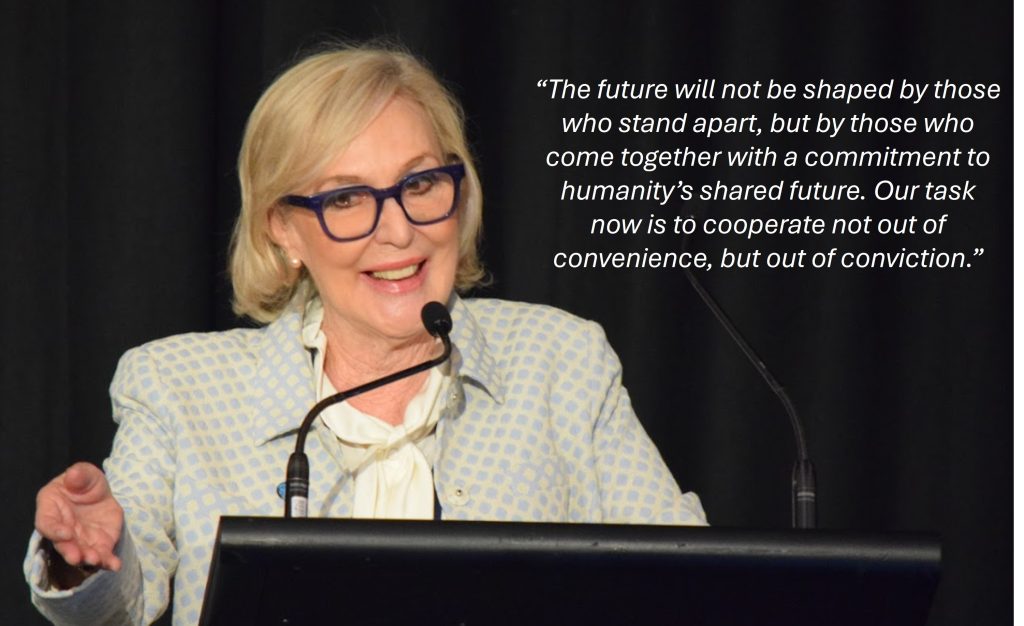
Dr Patricia Jenkings, UNAA NSW President, opened the conference by grounding the day in reflection and purpose. Drawing inspiration from Australia’s historical role in the UN’s founding, through figures like Dr H.V. Evatt and Jessie Street, Dr Jenkings framed the conference as a moment of renewal at a time of global uncertainty. She spoke of the erosion of trust in international institutions and the urgent need to rebuild cooperation through conviction, not convenience.
Her address set a tone of courage, optimism and shared responsibility – calling participants to think boldly about the next twenty years as the UN approaches its centenary.
Speaking on behalf of the United Nations, Miklos Gaspar, Director of UNIC Southeast Asia, brought both a sense of pride and realism to the conference. He began by premiering the Secretary-General’s official UN Day message – an inspiring reminder that the UN is “a living promise… spanning borders, bridging continents, inspiring generations.”
Gaspar’s remarks balanced celebration with candour. He acknowledged the financial and structural challenges the UN now faces but urged the audience not to lose sight of its historic achievements and enduring purpose. He reflected on Australia’s deep and ongoing contributions to the UN system – from its founding role under Dr H.V. Evatt and Jessie Street, to its leadership in peacekeeping and support for Pacific nations in addressing climate change.
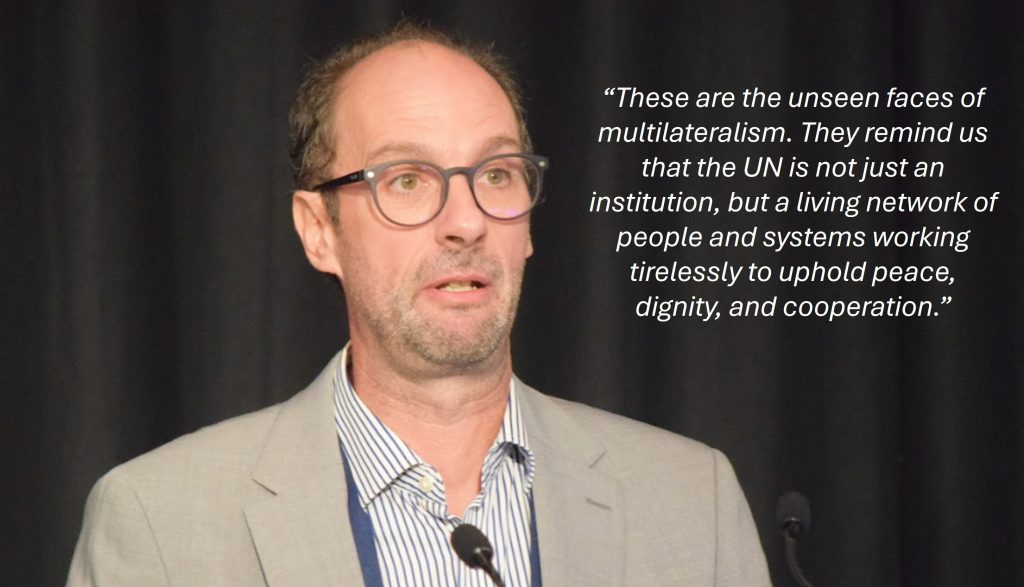
He also introduced the “Shared Life, Shared Future” photographic exhibition, showcasing the unseen human faces of multilateralism – the engineers, pilots, educators, and peacekeepers whose quiet work underpins the UN’s daily operations.

Delivering one of the day’s most compelling keynotes, Ambassador Gabriele Visentin, the European Union’s representative to Australia, offered both a celebration and a challenge – reminding delegates that the founding of the United Nations was “one of humanity’s most remarkable acts of hope,” and that multilateralism remains essential to global stability.
Ambassador Visentin traced the shared democratic values and deep partnership between the European Union and Australia, emphasising their mutual role as defenders of the rules-based international order. He spoke passionately about the need to strengthen global cooperation in the face of modern threats – from climate change and cyber warfare to disinformation and the erosion of trust in democratic institutions.
Drawing connections between the EU’s Indo-Pacific Strategy and Australia’s regional leadership, he highlighted the two partners’ shared commitment to peace, clean energy transition, and human rights. His remarks also praised Australia’s solidarity with Ukraine as “a reflection of its principled defence of the UN Charter,” while calling attention to the urgency of addressing the climate and digital crises that transcend borders.
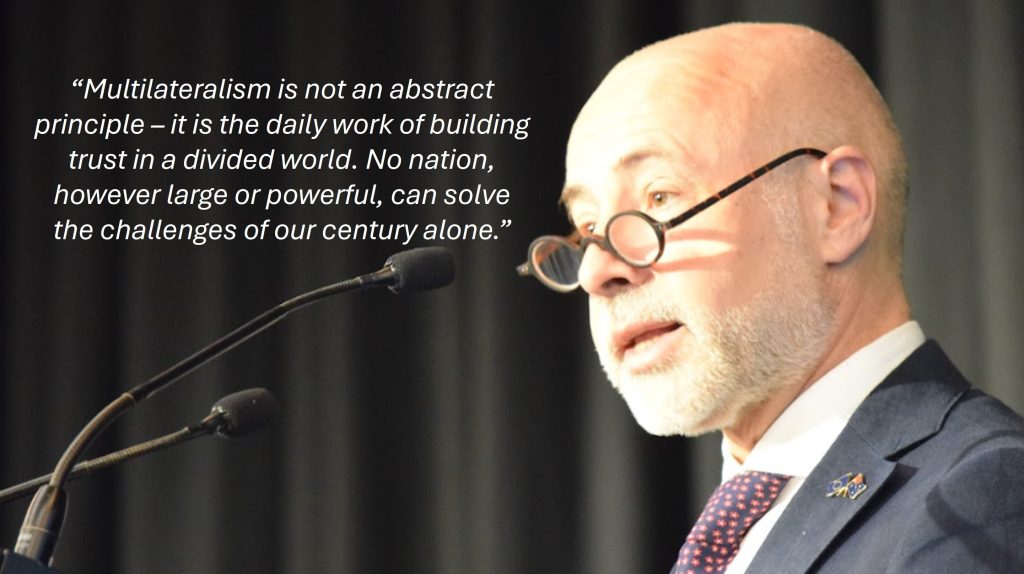
Ambassador Visentin’s message was a powerful reminder that cooperation – across nations, regions, and sectors – is not a relic of the past, but the only viable path to a shared future.
A Call to Recommit to the UN
Australia’s Foreign Minister, Senator the Hon. Penny Wong, delivered a deeply substantive and inspiring keynote that framed the day’s discussions with clarity, conviction, and purpose. Speaking candidly about the challenges confronting the United Nations, she underscored both the urgency of reform and the enduring value of multilateralism as the foundation of peace and security.
Minister Wong began by paying tribute to the late Lydia Moretti, a long-time UNAA South Australia leader and advocate for international engagement, reminding the audience that Australia’s commitment to the UN “is made real by the dedication of people like Lydia – citizens who believe in cooperation and act upon it.”
From there, she turned to the defining question of the decade: how the UN can remain relevant and effective in a world that is “becoming less equal, more unstable, and more dangerous.” Citing the UN’s 30% budget reduction and systemic fragility, she warned that “confidence is being undermined across all three pillars of the Charter – peace and security, development, and human rights.”
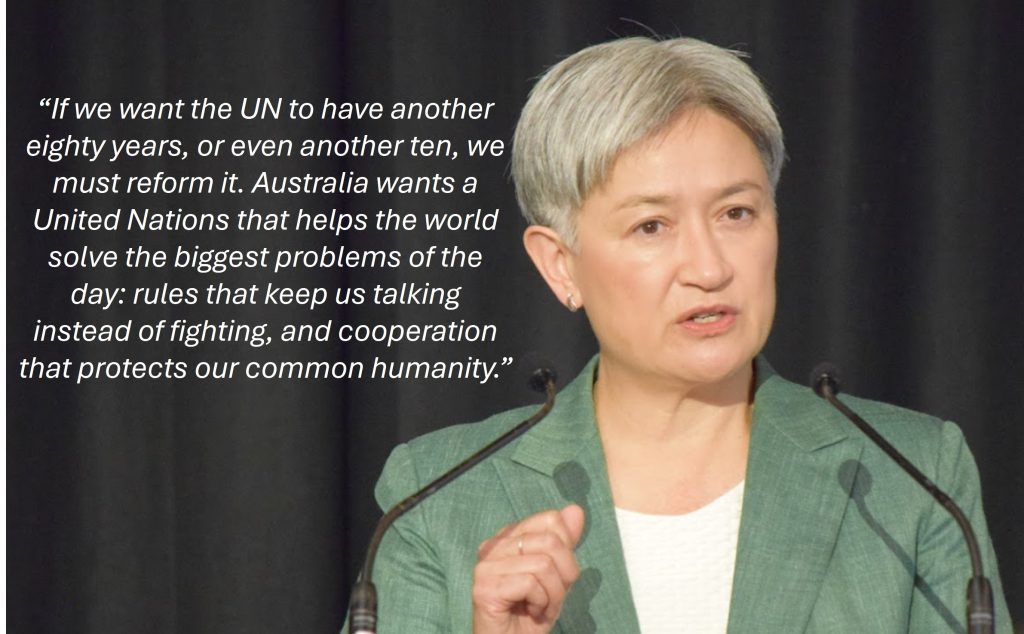
Minister Wong emphasised that while reform is vital, it must be anchored in purpose, not process. Australia, she said, is committed to working with partners to create a modern, functional, and forward-looking UN – one capable of addressing today’s challenges, from artificial intelligence and modern conflict to climate change and human displacement.
In a powerful articulation of Australia’s foreign policy vision, she described the rise of “amplified middle power diplomacy,” positioning Australia as an assertive advocate for collective action in an increasingly multipolar world.
She highlighted the success of Australia’s Declaration for the Protection of Humanitarian Personnel, signed by 104 countries, as an example of what principled middle powers can achieve when they lead with conviction.
Minister Wong’s address drew together the conference’s central themes – courage, cooperation, and conviction – urging Australia and its partners to not only defend the multilateral system but to renew it for the century ahead.
Upholding Dignity: 80 Years of Human Rights Progress Through the United Nations
Leanne Smith (CEO, Australian Human Rights Commission) grounded the human rights conversation in honesty and resolve. Acknowledging First Peoples and the lived reality of discrimination in Australia, she spoke candidly about “the great unravelling” many feel as rights regress in parts of the world. She then re-centered the audience on first principles: the universality, indivisibility and interdependence of human rights set out in the UDHR, and Australia’s historic role in advancing them.
Through a moving vignette about Adela Raz – from young Afghan assistant to her country’s first female UN ambassador – Smith illustrated how opportunities to enjoy rights can transform a life, a community, even a nation. She highlighted the pivotal role of National Human Rights Institutions as bridges between international law and domestic practice, especially as UN resources tighten, and urged renewed investment in multilateral human rights work and a national Human Rights Act in Australia.
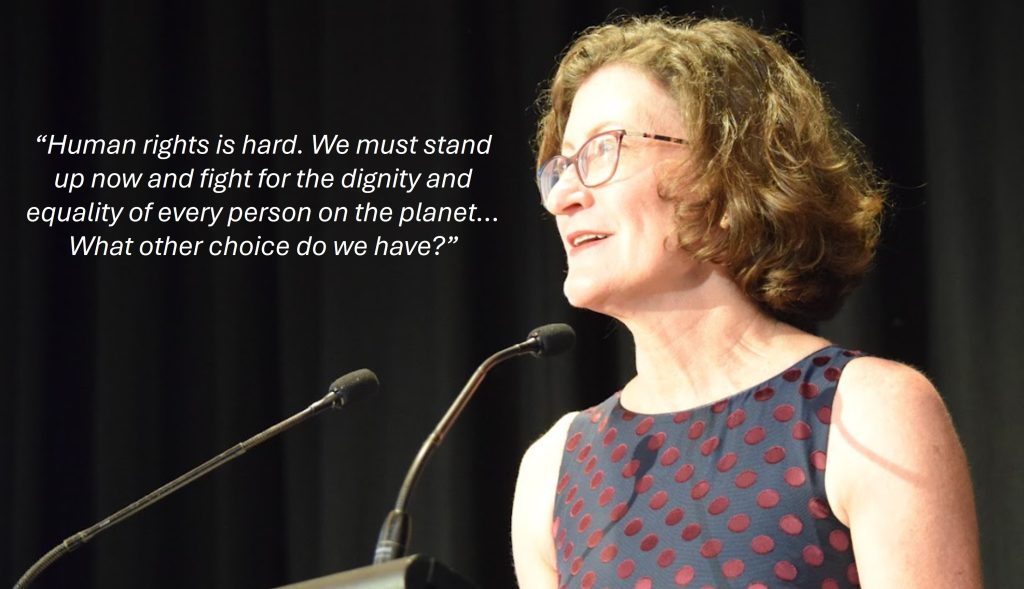
Her message was clear: Australia must pair principled international leadership with credible action at home – educating the public, defending universality against cultural relativism, and sustaining the institutions that protect dignity.
Peace Building in a Changing World: Australia’s Evolving Role
Major General (retd) Tim Ford AO set the stage with a frank situational brief: the world is experiencing the highest number of state-based conflicts since WWII, trust in institutions is fraying, and funding cuts are forcing hard choices across UN peace operations. He argued that while peacekeeping budgets tighten, the strategic value of peacebuilding has never been higher.
In her video address, Lt Gen Cheryl Pearce AM CSC (Acting Military Advisor) underscored that UN peace operations are “not a luxury” but a lifeline for millions amid more complex, multi-actor conflicts. She called for evolving from templated forces to modular, effects-driven capabilities, integrating technology (from drones to data analytics), and deepening partnerships with regional organisations, industry, and academia. Australia, she stressed, can shape the next chapter through thought leadership, capability innovation, training (including for women peacekeepers), and by rebuilding UN expertise at home.
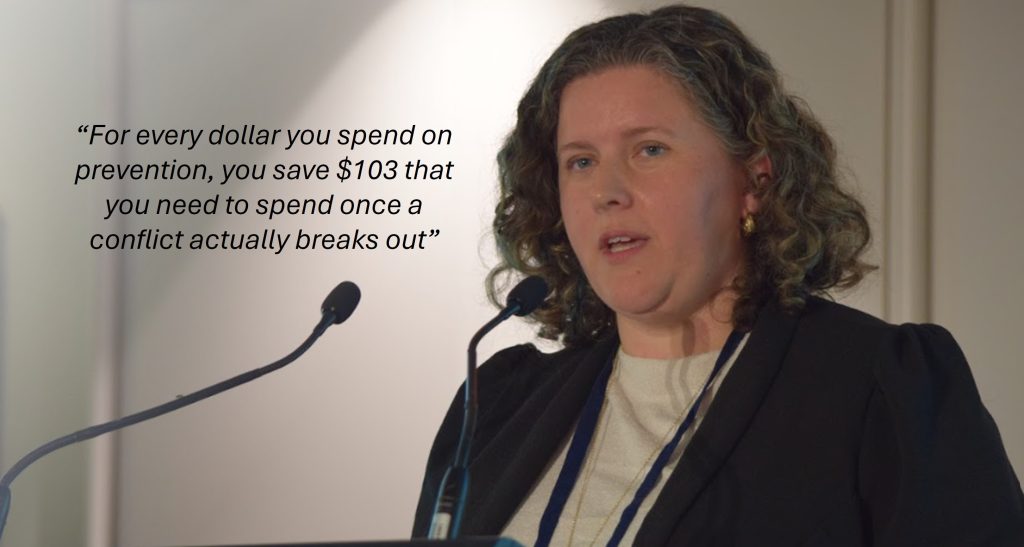
Angela Robinson (First Assistant Secretary, Multilateral Policy & Human Rights Division, DFAT) outlined Australia’s “step-up” on peacebuilding: getting into positions of influence (Peacebuilding Commission seat; tripled contributions and board seat on the Peacebuilding Fund), pushing prevention to the centre, advocating for the Indo-Pacific, embedding Women, Peace & Security and youth, and protecting civilians. She detailed practical initiatives, including a toolkit for national prevention strategies (to help countries start data-driven prevention plans), the new Declaration for the Protection of Humanitarian Personnel (over 100 signatories in ~2½ weeks), and securing US$50m from the UN regular budget for peacebuilding. Robinson was candid about headwinds: a recent 15% cut to peacekeeping translating to roughly 25% fewer boots on the ground, making upstream prevention and smarter architecture – what she called “radical incrementalism” – urgent priorities.
Truth Under Fire: Navigating Media Integrity in a Disinformation Age
This session cut to the core of media integrity: journalism as a process, not a label. Prof. Peter Greste (Professor of Journalism Macquarie University, Executive Director, Alliance for Journalists’’ Freedom) and Prof. Monica Attard OAM (co-director of the Centre for Media Transition at UTS) defined journalism by verified facts, transparent methods, ethics, independence, and accountability – not by platform or job title. Using the “Assange problem,” they argued that publication without an editorial process may be speech, but it isn’t journalism. They probed the tension between objectivity and impartiality: while subjective choices are unavoidable (what to cover, what to lead with), rigorous methods and accountable standards can minimise bias and protect public-interest reporting.
They warned that social media economics incentivise “angertainment” – anger-driven clicks that corrode trust – while newsroom withdrawals from platforms leave mis/disinformation unchallenged. Attard urged credible outlets to “flood the zone” with quality reporting rather than vacate the field. Both highlighted the need for diverse newsrooms (and retaining diverse talent) to broaden perspectives, and they defended robust, public media critique as essential self-scrutiny. The discussion also revisited ethics and the value (and limits) of journalism education as applied critical thinking.
What Role Do Universities Have in Shaping Global Citizens?
Universities emerged in this discussion as more than campuses and credentials – they’re anchor institutions with global networks, public purpose and a unique capacity to teach how to think in a fractured information environment. Prof. Simon Barrie (Emeritus Professor WSU, Chair of UNAA NSW Advisory Board) framed the session around the UN’s “we the peoples”: if a rules-based world needs citizens who can reason across borders and disciplines, what must universities do differently?
From government’s skills vantage point, Prof. Barney Glover AO (Commissioner of Jobs and Skills Australia) argued the shift already underway: labour markets are moving from proxy credentials to capability sets. Critical thinking, ethical reasoning, teamwork, and AI fluency now sit alongside subject expertise. In a world of generative and agentic AI, he said, universities must produce graduates who can interrogate sources, navigate misinformation and “learn to learn” – not simply pass exams.
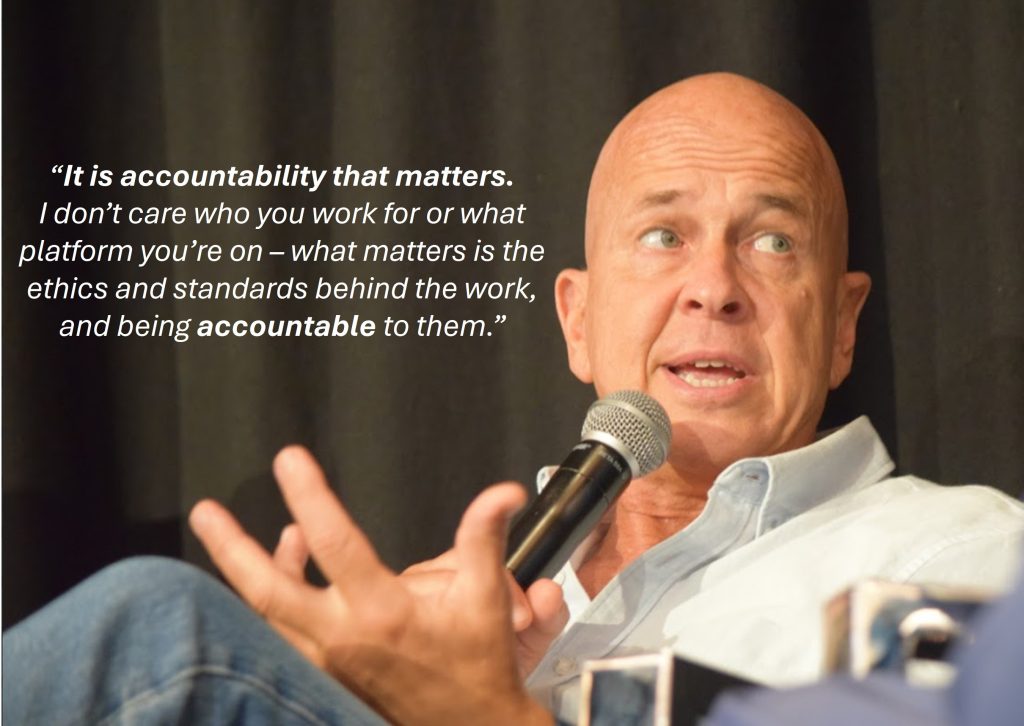
UNSW Vice-Chancellor and President, Prof. Attila Brungs reframed AI as an opportunity, not an existential threat. If machines can shoulder rote content, educators can double down on epistemic fluency – helping students deconstruct knowledge systems, connect learning to the SDGs, and apply judgement across contexts. He also reminded the room that universities have always been global institutions: their research, alumni and student mobility weave practical connections that bring the world to Australia and Australia to the world. “We are not a business. We’re an institution that goes through time,” he said – so decisions made today must hold up across decades.
The youngest voices pushed on trust and inclusion. Iris Brown (President, UN Youth Australia) questioned the phrase “global citizen” itself, calling for clarity about responsibilities beyond the nation-state and for universities to teach the ethics that sit beneath fast-moving technologies. Anthony Downhill (medical student and UNAA volunteer) spoke to campus culture: when protests are over-policed or student voices are proceduralised away, learning feels transactional. Both argued that genuine global citizenship requires safe, inclusive spaces and vibrant co-curricular life – clubs, volunteering, partnerships – where leadership and dialogue are actually practised.
Governance and social licence threaded through the Q&A. Universities, the panel agreed, must hold space for robust, civil disagreement – and evolve councils, forums and feedback loops so students and staff shape decisions that affect them. They also need to tell their story better: from Indigenous partnerships in regional Australia to health initiatives across the Pacific, the sector’s public value is real – but too often invisible.
The through-line: educate for judgement. Equip graduates to test claims, bridge divides, work with AI, and act with others – on campus, in communities, and across borders. If universities lean into that mission, they won’t just “tell the story of peace”; they’ll teach it – and graduate people ready to live it.
Health Without Borders: Diplomacy, Policy and the Future of Global Wellbeing
Speakers: Professor Esperanza Martinez (Head of Health and Human Security, ANU; former Head of Health, International Committee of the Red Cross) and Dr. Selina Namchee Lo (Executive Director, Australian Global Health Alliance)
In a world where pandemics, conflict, and misinformation transcend national boundaries, this session explored how health policy and diplomacy must evolve to meet the challenges of the 21st century. Professor Esperanza Martinez (Head of Health and Human Security, ANU; former Head of Health, International Committee of the Red Cross) and Dr Selina Namchee Lo (Executive Director, Australian Global Health Alliance) examined the meaning of “global health,” highlighting that true wellbeing is not a matter of international charity but of shared responsibility, interdependence, and equity.
Defining Global Health: “About All of Us, Not Some of Us”
Dr. Selina Namchee Lo began by reframing global health as “about all of us, not some of us.” Too often mistaken for “international aid” or overseas projects, she argued that global health is fundamentally about equity – ensuring equal access to health services, technologies, and outcomes both within and between nations. Health, she reminded the audience, is determined by more than hospitals and doctors: it is shaped by social, political, ecological, and commercial determinants, from education and climate change to corporate practices.
Professor Esperanza Martinez expanded on this systems view, noting that health is influenced by almost every UN agency – from the World Food Programme to the International Labour Organization – and by national ministries beyond health alone. She emphasised that humanitarian actors such as Médecins Sans Frontières and the Red Cross are vital to the global health ecosystem, particularly in times of conflict and crisis.
Successes, Setbacks, and Lessons from the Pandemic
Reflecting on progress, Dr. Lo cited major public health achievements – child and maternal survival, vaccination campaigns, and disease control initiatives such as GAVI and the Global Fund for AIDS, TB, and Malaria. These, she said, prove the value of multilateralism and collective action. Yet, she cautioned, “when we lose sight of these gains, or funding falters, progress can unravel fast.”
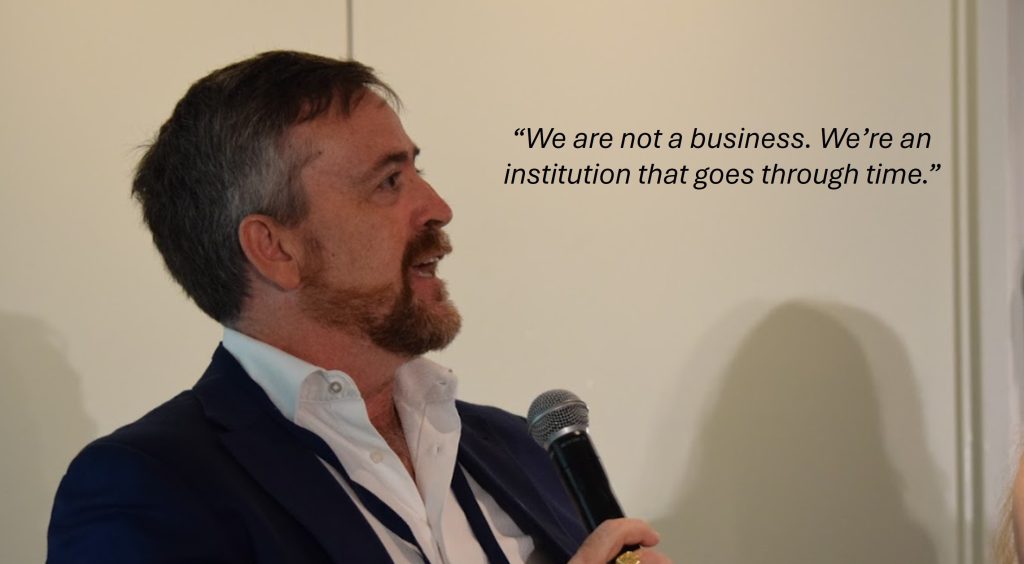
Professor Martinez agreed, noting that while global health indicators have improved overall, armed conflict is reversing gains in many regions. “Every 12 minutes, a civilian is being killed in armed conflict,” she said, underlining the intersection between war, health, and humanitarian crisis. “You cannot have prosperity with sick populations.”
Emerging Fields: Planetary and Human Security
The conversation turned to emerging paradigms like planetary health – the recognition that human wellbeing depends on the health of the planet itself. Dr. Lo observed that Australia, with its deep Indigenous knowledge systems and biodiversity, has a unique opportunity to lead in this space. “Planetary health is the health of human civilisation and the natural world on which it depends,” she said. “And that makes it everyone’s business.”
The Road Ahead: Reform, Equity, and Inclusion
Both speakers stressed the urgent need for UN reform to modernise the global health architecture. Professor Martinez warned that while reform is essential, it must be strategic, not reactive: “Decisions taken in panic are bad decisions,” she said, citing recent funding crises and the withdrawal of US contributions as destabilising forces. She called for reforms that empower local responders, uphold humanitarian principles, and ensure that health remains central to peace and security debates.
Dr. Lo concluded with a call for leadership rooted in science, inclusion, and diversity. Australia, she said, must champion the UN system, strengthen its regional partnerships, and invest in global health as a form of diplomacy and peacebuilding. “We need to cherish our diversity – human and planetary – and raise our ambition for global wellbeing,” she urged.
Innovation, Nature and the Public: The Many Faces of Sustainability
This fast-moving panel sat at the crossroads of science, storytelling and systems change. Fiona Reynolds (Chair, UN Global Compact Network Australia) set the frame: the UN doesn’t just convene nations – it convenes business. Through the UN Global Compact’s Ten Principles and the SDGs – “the world’s business plan” – companies have a clear playbook. Yet the ambition–action gap is real. A UNGC 25-year CEO survey shows 99% intend to maintain or increase sustainability commitments, but only 35% of SDG targets are on track; fewer than 14% of CEOs feel well prepared for global shocks, and just 26% are prioritising innovation. Her message: embed ESG and SDG risk in core strategy, not PR, and demand joined-up government policy so capital can move confidently.
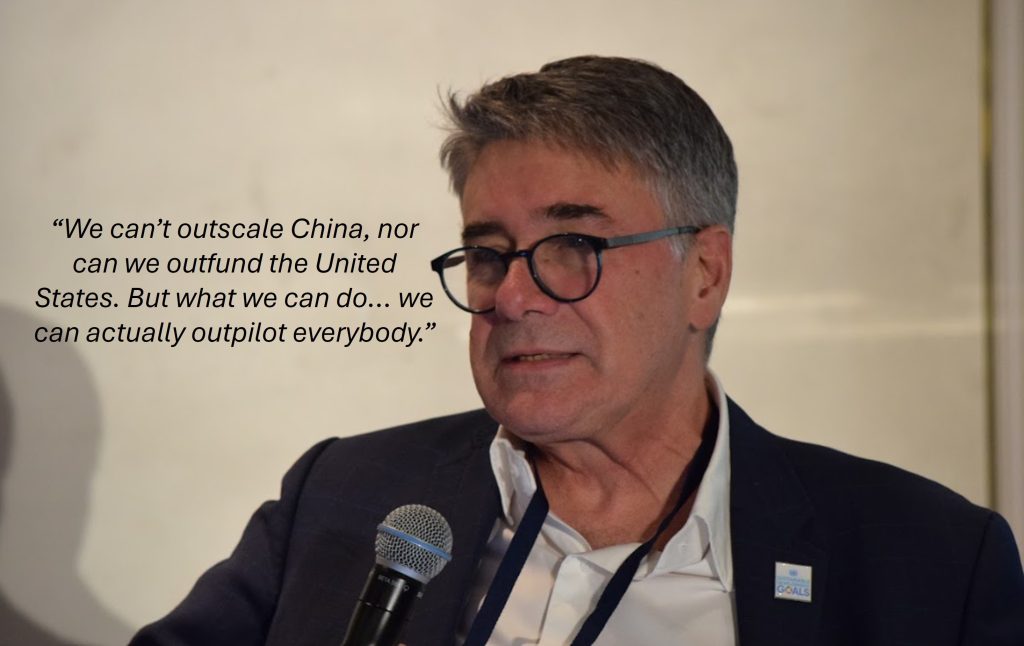
Professor Veena Sahajwalla AO (Director, Sustainable Materials Research & Technology Centre, UNSW) then made sustainability tangible. From UNSW’s basement micro-factories, her team manufactures green ceramic tiles from waste glass and textiles – meeting standards while running at ~200°C (not >1000°C as in traditional ceramics). The model flips “economies of scale” to “economies of purpose”: fit-for-place production that creates local jobs, proves circular value chains, and scales through communities as much as through plants. Science leaves the lab only when people can see, touch, and test the product in their homes.
Dr. Vanessa Pirotta (Chief Scientist, Wild Sydney Harbour; NSW Premier’s Woman of Excellence 2025) showed how nature drives public engagement and policy. Using whales as a flagship for SDG 14, she connects citizens to “our blue backyard” – from humpback migration and krill management to warmer waters keeping bull sharks in Sydney longer. Her work blends tech, citizen science and storytelling to inform regulators, meet national and global obligations, and even combat illegal wildlife trafficking. The ask: invest in Australian science leadership (including First Nations knowledge) and ensure researchers – not just the well-connected – sit at international tables, with Australia lifting its role across the South Pacific.
Looking ahead, the panel backed circular economy leadership, coherent climate-nature-industry policy, and Australian strengths in critical minerals, green manufacturing and pilots that travel. As Andrew Petersen (CEO, Business Council for Sustainable Development Australia) put it, Australia may be a “middle country,” but it can shape UN outcomes by exporting how to do things better – through practical models that others can adopt.
Global Trends in Peace and Conflict
Steve Killelea’s rapid-fire tour of the Institute for Economics and Peace’s latest findings painted a sobering picture of a world growing less peaceful – slowly, steadily, and at great cost. The Global Peace Index now counts 59 active conflicts, with 17 countries experiencing more than a thousand conflict deaths last year. Australia remains among the more peaceful nations at 18th, though it has slipped four places over five years. Behind the rankings sits an uncomfortable arithmetic: the economic cost of violence is now roughly 11.6% of global GDP – about US$2,455 for every person on the planet – borne most heavily by the poorest societies mired in conflict.
Killelea linked this deterioration to a broader geopolitical fragmentation. Influence, he argued, is dispersing beyond the familiar poles: the United States remains dominant; China, facing towering debt and collapsing inward investment, may be at its zenith; Europe’s sway is receding in several regions; and a cohort of assertive middle powers is reshaping regional dynamics. In such a world, decisive battlefield victories and comprehensive peace deals are rarer, “forever wars” more common, and peacekeeping resources paradoxically in retreat – even as conflicts multiply and intensify.
The presentation also traced the changing geography and character of terrorism. Where Iraq once defined the global epicentre a decade ago, the Sahel now bears the brunt. In the West, attacks have atomised: lone actors radicalise online in weeks rather than months, perpetrators skew younger, and detection is harder because plots are financed and planned in the shadows of encrypted platforms. Tensions from current wars are amplifying polarisation and hate incidents far from the front lines.
Yet Killelea insisted that pathways to resilience are known and measurable. The IEP’s “Positive Peace” framework – eight pillars spanning attitudes, institutions and structures – correlates strongly with stronger growth, steadier prices, greater investment, better ecological performance and higher wellbeing, and is already being adopted by governments and NGOs from the Philippines to Northern Ireland. He pointed to cross-border water governance as evidence that even bitter rivals can cooperate when stakes are existential: 184 international water treaties and, remarkably, not one has sparked war.
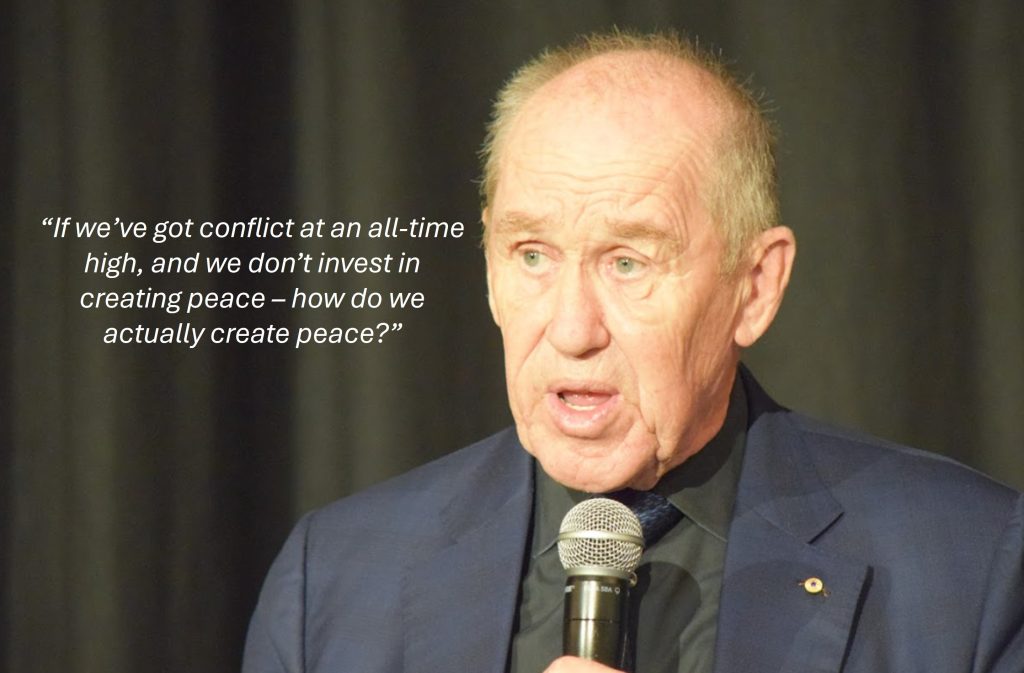
“If we’ve got conflict at an all-time high, and we don’t invest in creating peace – how do we actually create peace?” Killelea asked. The challenge, and opportunity, he suggested, is to shift resources and attention from reacting to violence toward systematically building the conditions that prevent it.
Human Rights at a Crossroads
Moderator Ben Lee (International Lawyer and Human Rights Mediator) set a frank tone: human rights are being tested by impunity, inequality and the fraying of international norms. From there, the panel traced both the headwinds and the levers for renewal. Hugh de Kretser (President Australian Human Rights Commission) argued that Australia’s own civic vocabulary – fairness, equality, respect – maps directly onto the Universal Declaration and should be used to bring people back together, not driven apart by “angertainment” and polarisation. He pointed to the Commission’s National Anti-Racism Framework and a long-overdue federal Human Rights Act as practical anchors to rebuild trust and accountability. Justine Nolan (Director, Australian Human Rights Institute) urged universities to do what they do best – incubate rigorous, uncomfortable debate and turn ideals into practice – while Thomas Mayo (Author and Indigenous Human Rights Advocate) pressed for everyday courage: resisting the incentives to retreat into silos, protecting the right to protest, and sustaining dialogue across difference.
The conversation also held up a mirror to Australia: a nation that often talks a strong multilateral game abroad but fails to “walk the talk” at home – on implementing UN recommendations, raising the age of criminal responsibility, and consistently applying protections for vulnerable communities. Solutions, the panel suggested, are necessarily coalition-based: government aligning policy and law with international commitments, civil society keeping pressure and hope alive, business using its leverage with clear guardrails, and educators cultivating a new generation fluent in both values and rights. Through it all, resilience – rooted in identity, solidarity and honest conversation – was presented not as sentiment but as strategy for the decade ahead.
The UN at a Crossroads: leadership, relevance, and the road ahead
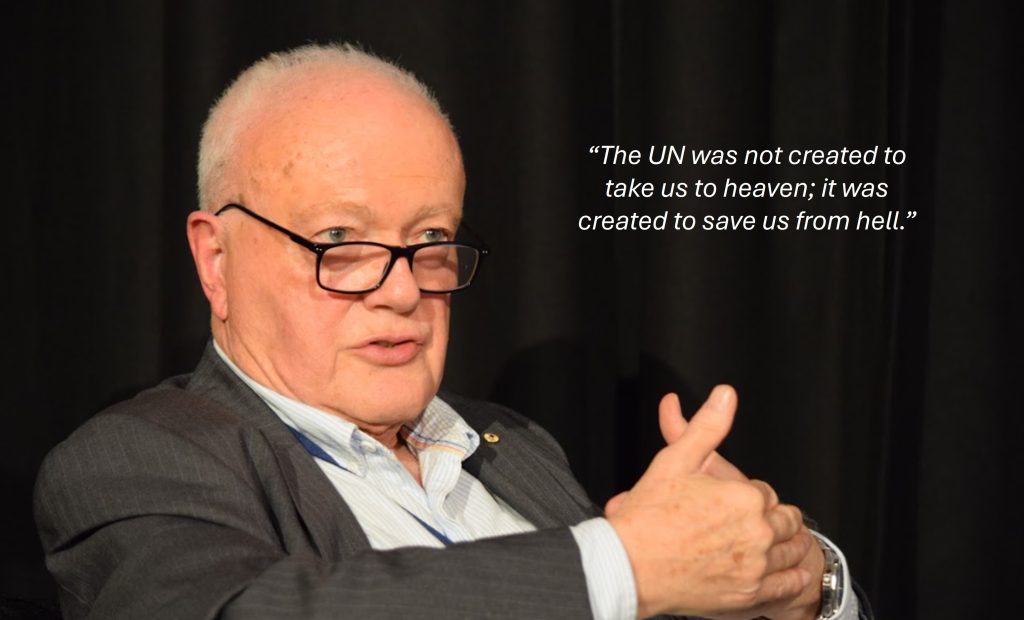
Gary Quinlan AO (former Australian Ambassador to the UN) set the stakes plainly: on the UN’s 80th anniversary, the political UN is gridlocked just as the functional UN – the agencies that keep aviation safe, deliver vaccines, police nuclear material and feed millions – faces a deepening liquidity crisis. With both the United States and China in arrears and great-power rivalry hardening, he warned that multilateral rules are being displaced by strategic opportunism. Yet he also reminded us why the UN remains indispensable: its universality, convening power and the simple Dag Hammarskjöld test – “not to take us to heaven, but to save us from hell.”
From there, the panel dissected what credible leadership looks like in this harsher world. The Hon. Arthur Sinodinos AO (Chair US Studies Centre and former Australian Ambassador to the US) argued that if the UN didn’t exist we’d have to invent it – and that its imperfections are a feature of an imperfect world. The era of a comfortable, U.S.-anchored “rules-based order” is over; an openly transactional great-power politics has arrived. His prescription was pragmatic: engage Washington on enlightened self-interest, rally coalitions of democracies and partners (including in the Indo-Pacific and the Global South), and exercise Australia’s agency rather than waiting for a reset in U.S. policy. Above all, broaden Security Council representation, however difficult, so more stakeholders have skin in the game.
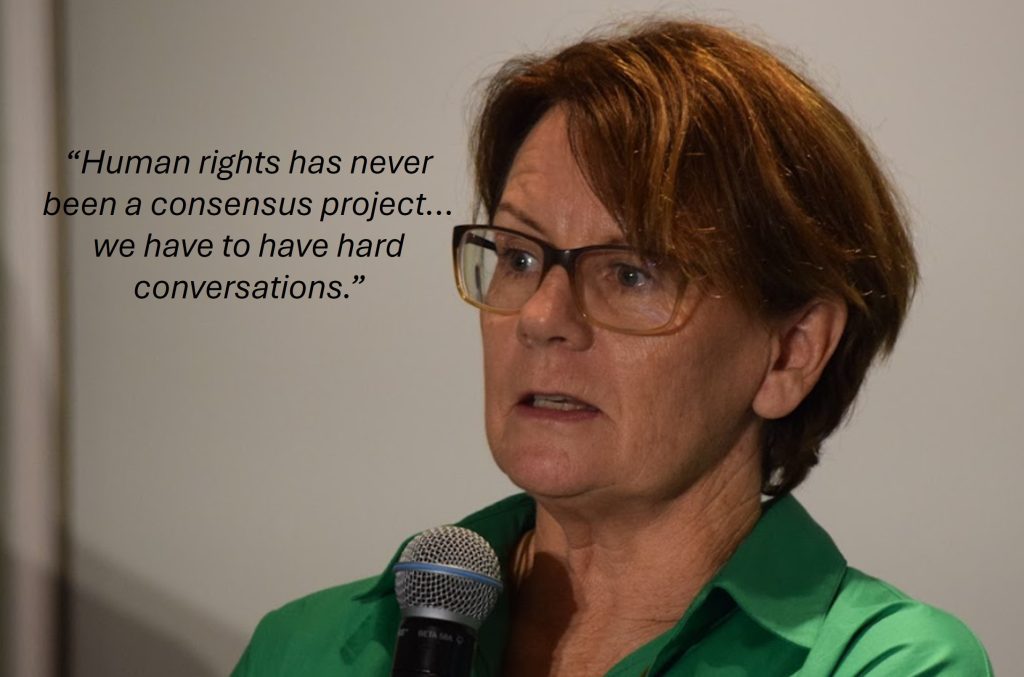
Leanne Smith (CEO, Australian Human Rights Commission) stressed that the UN’s first challenge is political support from member states, not bureaucratic tinkering. Choosing the next Secretary-General will be pivotal, and the Pact for the Future – agreed only a year ago – needs to be treated as a guiding vision, not a forgotten communiqué. Her human rights brief was sobering: only about one per cent of total UN expenditure supports the human-rights system, so across-the-board cuts risk gutting an already thin pillar. Relevance, she argued, rests on universality, independence and putting communities at the centre of decision-making – plus a hard-headed pragmatism that shows defence, development and humanitarian actors how a rights-based approach improves their outcomes in the field.
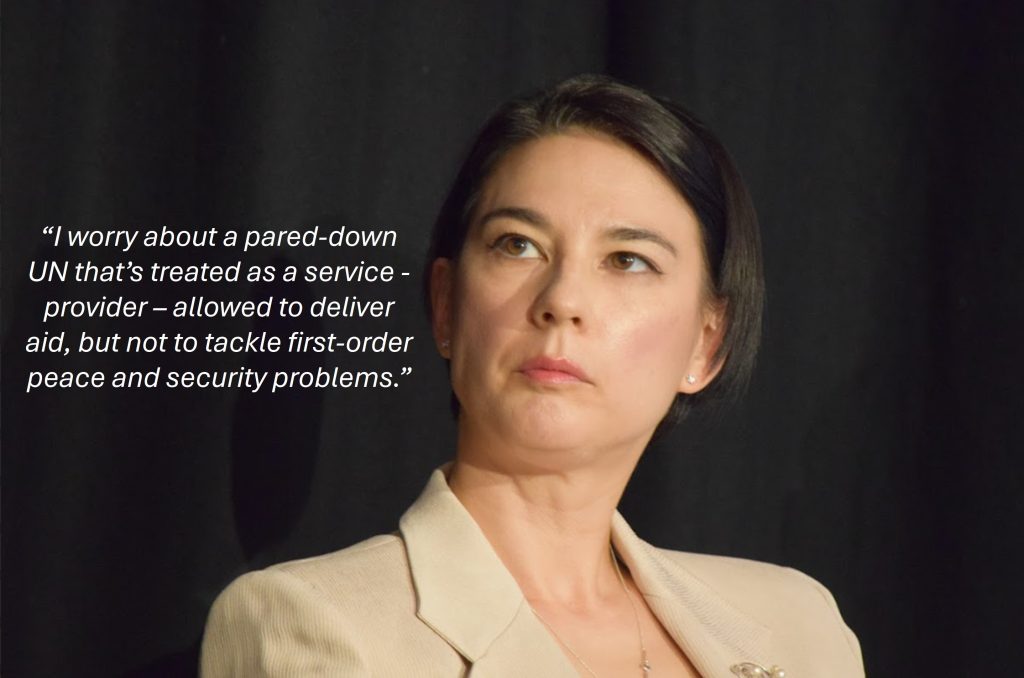
Dr Courtney Fung cautioned against a “new multilateralism” that quietly narrows the UN to a service provider: allowed to run convoys and count casualties, but not to tackle first-order peace and security problems. She detailed Beijing’s methodical engagement – group-of-friends caucuses, agenda-shaping initiatives and growing influence in special-procedures portfolios – paired with a state-centric reframing of rights that elevates security and development while downplaying individual liberties. Her practical warning was prosaic but powerful: follow the money. When the two biggest assessed contributors pay late, liquidity collapses – and so does the UN’s ability to act.
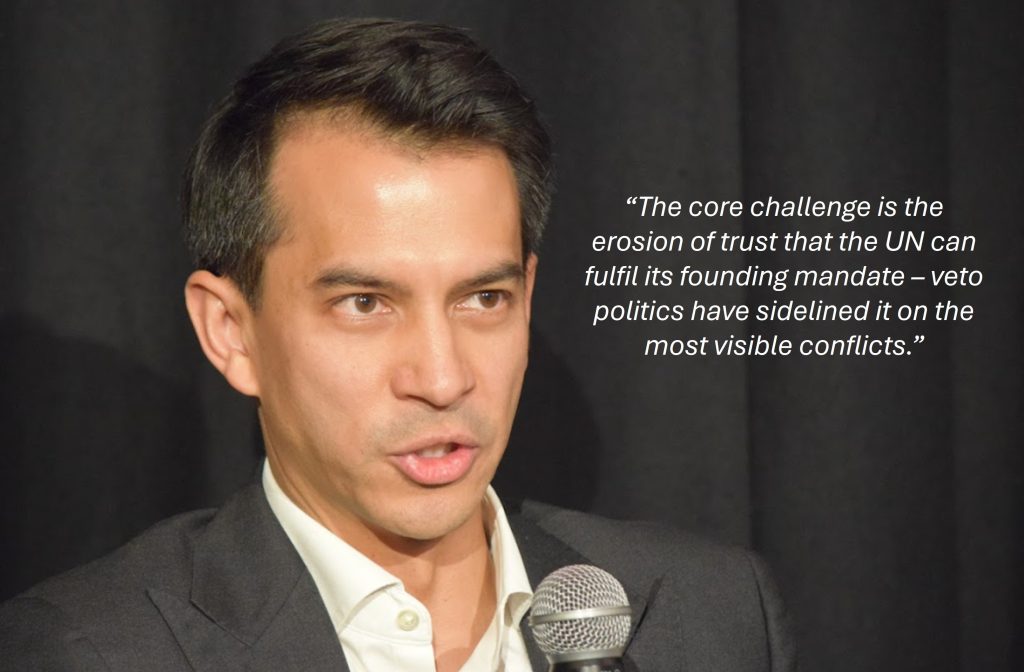
For Ryan Neelam (The Lowy Institute), the core problem is eroded trust that the UN can deliver on its founding mandates. Veto politics have sidelined the Security Council on Ukraine and Gaza, and unless the institution can carve out credible roles amid entrenched divisions, confidence will keep slipping. He pointed to feasible steps on the margins – like restraining veto use in mass-atrocity situations – and to places where Australia has comparative advantage: peacekeeping and peacebuilding (paired with an honest conversation on resourcing cuts that translate into fewer “boots on the ground” and more civilians at risk), climate leadership as we navigate our own energy transition, and the narrative work of explaining to domestic audiences why multilateralism still pays practical dividends.
Quinlan’s closing thread stitched the themes together. Reform must be matched by story: if the UN doesn’t narrate its value, others will define it as failure. A coalition-minded Australia can help do both – pressing for practical changes (including veto restraint and a more representative Security Council), shoring up the functional UN where lives depend on it, and making the case at home and abroad that, in an age of harder power, the quiet machinery of cooperation remains the difference between drift and direction.
A Resounding Success
From Penny Wong’s clear-eyed optimism to Gary Quinlan’s reflective closing, the conference achieved what it set out to do – to inform, inspire, and engage Australians in shaping the next chapter of the United Nations.
As the UN turns 80, the message was clear: leadership, cooperation, and courage are needed more than ever. Or, as Quinlan concluded:
“Action requires leadership. The UN was never created to take us to heaven – it was created to save us from hell.”
-chris dwyer