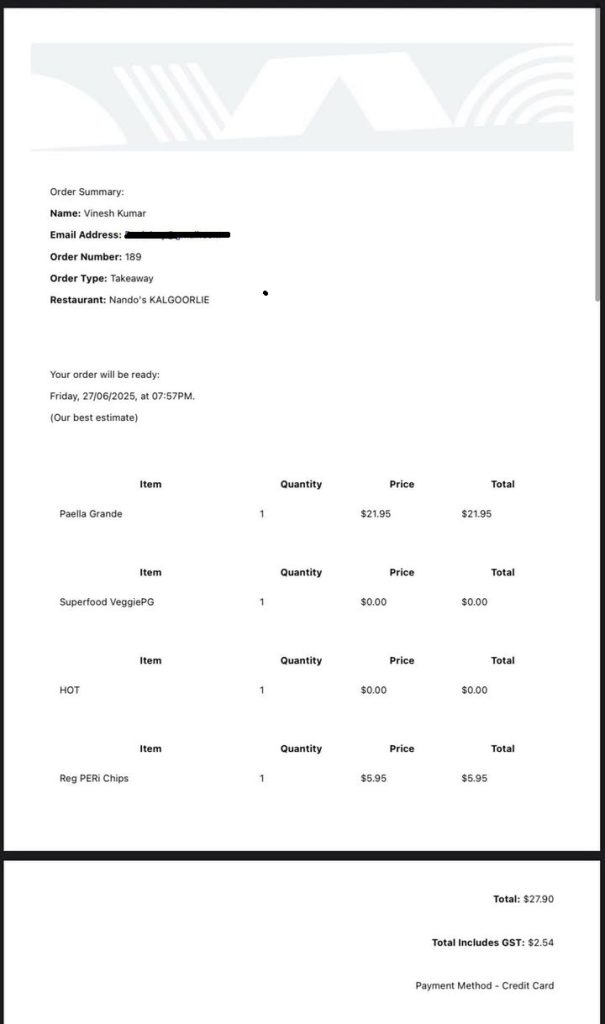
A distressing incident in regional Western Australia has raised serious concerns about cultural sensitivity and accountability in the food service industry. Kalgoorlie resident and mental health clinician Debasmita Roy has come forward to share her experience after her husband, Vinesh Kumar, a full-time WA government employee, was served chicken in a vegetarian meal from Nando’s Kalgoorlie on 27th June 2025 — the day of Jagannath Rath Yatra, a major Hindu festival.
Vinesh, who follows a strict vegetarian diet based on his Hindu faith, was shocked to find meat in a takeaway dish labelled Vegetarian Paella Grande.
“My husband has been a lifelong vegetarian, guided by his deep-rooted Hindu faith. Even after living in Australia for 16 years, he has remained unwavering in his commitment to a vegetarian lifestyle, honouring the spiritual and cultural values he was raised with,” Roy explained. “This incident caused him significant emotional and spiritual distress. For him, this was more than just a mistake — it was a deep violation of his religious beliefs.”
Roy, who also follows a vegetarian lifestyle for both ethical and religious reasons, said that they filed a formal complaint with Nando’s Australia, but have not received any apology to date.
A Deeper Issue: Cultural Awareness and Equality
Roy believes this incident speaks to a broader issue of limited cultural awareness and an underrepresentation of Hinduism in mainstream narratives around religious rights in Australia.
“If a devout Catholic were served meat during Lent, or a Muslim were served pork, it would likely prompt a public apology, media coverage, and mandatory retraining,” she said. “Why is Hinduism not treated with the same seriousness?”
“Is Hindu faith being taken less seriously in Australia?”
The couple emphasised that their concern is not only about a food handling error — but about the lack of acknowledgement and the absence of culturally inclusive practices in food service.
Faith, Not Just Food
For many Hindus, vegetarianism is not simply a dietary preference but a spiritual commitment rooted in the principle of ahimsa (non-violence). The unintentional consumption of meat can cause deep emotional and spiritual harm.
“This wasn’t just a slip-up. It was a breach of trust, a failure in food preparation protocols, and a complete disregard for religious sensitivities,” Roy said.
The incident occurred in Kalgoorlie, a growing multicultural town, where Roy believes businesses must take greater responsibility in serving diverse communities with respect and care.

Seeking Fairness for All
In her written account, Roy draws parallels to other faiths and traditions, urging that all religious beliefs must be treated equally:
- If an Aboriginal Australian were served meat from a sacred or totemic animal, it would rightly be considered a case of cultural harm.
- If a Muslim customer were unknowingly served pork, it would be taken very seriously and followed by immediate public accountability.
- If a Catholic were served meat during Lent, it would be widely condemned.
“The same level of understanding and respect must be extended to Hinduism, the oldest living religion in the world.”

A Call for Awareness and Change
Roy and her family are not seeking compensation — rather, they are calling for improved food safety standards, cultural sensitivity training, and genuine accountability across the food industry.
“We live by principles of peace and non-violence. But that does not mean our concerns should be ignored,” she said. “All faiths deserve equal respect, and mistakes that impact religious observance must be taken seriously — not just when it’s convenient.”
Roy has submitted photographic evidence of the contaminated meal along with proof of the original order, hoping that sharing their story will help raise awareness and inspire meaningful change.
“Respect is the foundation of multiculturalism,” she says. “Let’s ensure that all beliefs — including ours — are recognised and protected.”