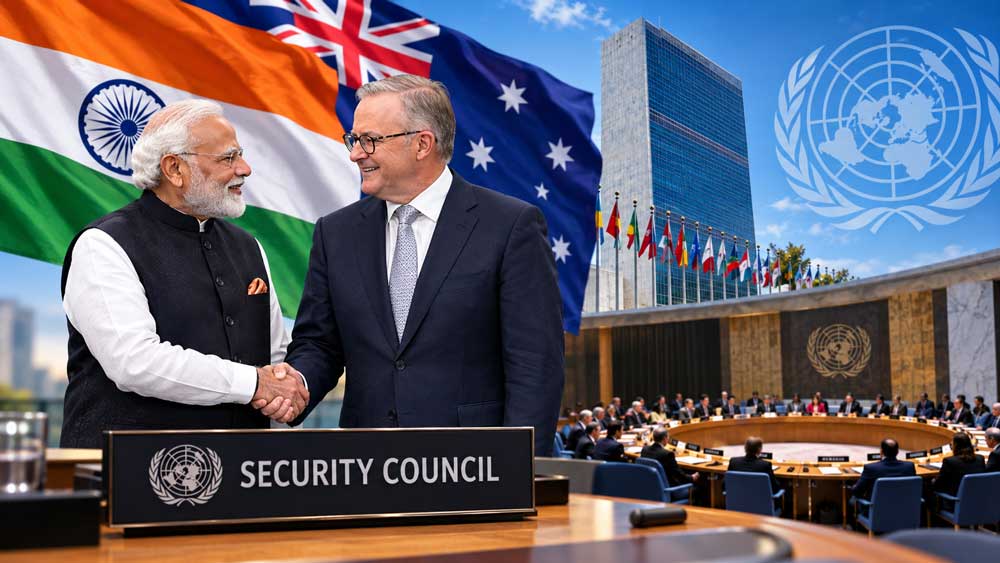
India has backed Australia’s bid for a non-permanent seat on the United Nations Security Council for 2029-2030, as Prime Minister Anthony Albanese and Foreign Minister Penny Wong formally launched Australia’s campaign during the United Nations General Assembly High-Level Week in New York.
The campaign places Australia’s bid within a broader effort to strengthen its role in international diplomacy and contribute to discussions on global peace and security. Canberra says its priorities will include preventing conflict, protecting civilians, advancing ocean and climate security, and supporting peaceful, resilient and inclusive digital futures.
India and Australia back each other’s UN ambitions
The support from India is part of an agreement reached at the Third Australia-India Annual Summit in Melbourne in July 2026. Prime Ministers Anthony Albanese and Narendra Modi reaffirmed mutual support for their countries’ respective Security Council candidacies.
Under the arrangement, India is seeking election to the Council for the 2028-2029 term, while Australia is seeking a place for 2029-2030. Australia has also reiterated its support for India’s long-standing campaign for a permanent seat on a reformed Security Council.
The two governments have linked their positions to a wider call for reform of the Security Council, arguing that its membership should better reflect contemporary geopolitical realities. Their joint statement also called for greater permanent and non-permanent representation.
The reciprocal support adds another dimension to the growing strategic relationship between the two countries. Australia and India have increasingly cooperated through bilateral and multilateral forums, including on defence, maritime security, critical technologies, cyber issues and the wider Indo-Pacific.
Australia launches its 2029-30 campaign
Australia is seeking a two-year non-permanent seat on the Security Council from 2029 to 2030. Albanese and Wong launched the campaign in New York as world leaders gathered for the annual UN General Assembly.

The Australian Government says the campaign is built around the principles of listening with respect, partnering as equals and protecting what matters most.
Australia has identified three broad areas for its proposed Security Council contribution: conflict prevention and civilian protection, ocean and climate security, and peaceful and resilient digital futures.
The campaign comes as international security discussions increasingly extend beyond traditional armed conflicts. Cybersecurity, artificial intelligence, climate-related security risks and threats to critical infrastructure are becoming increasingly important areas of international diplomacy.
Albanese says Australia wants a stronger voice on global issues
Launching the campaign, Albanese said a Security Council seat would provide Australia with an opportunity to participate directly in discussions affecting the country, its region and the wider international community.
He pointed to conflicts in Europe and the Middle East, cybersecurity and the continuing development of artificial intelligence as issues that demonstrate the interconnected nature of today’s world.
Albanese also highlighted climate change, particularly its significance for Australia’s Pacific neighbours, as an area where Canberra believes having a seat on the Council would allow it to contribute to international discussions.
The Prime Minister said Australia would use a potential Council seat to advance what he described as the safety and prosperity of Australia, the region and the broader international community.
Australia’s history at the United Nations
Australia has a long history of involvement in the United Nations and was one of the organisation’s founding members.
The country served as the first president of the UN Security Council in 1946 and has previously held a non-permanent seat on five occasions. Its most recent term was 2013-2014. If elected for 2029-2030, Australia would return to the Council for a sixth term.
Australia has also contributed more than 65,000 personnel to more than 60 UN and other multilateral peace and security operations since 1947, according to the Department of Foreign Affairs and Trade.
Canberra is using that history as part of its case for another term, presenting the country as a long-standing participant in multilateral diplomacy and international peace and security efforts.
What does a non-permanent Security Council seat mean?
The UN Security Council is the organisation’s principal body for maintaining international peace and security. It has 15 members: five permanent members with veto powers and ten non-permanent members elected by the General Assembly.
Non-permanent members serve two-year terms and participate in the Council’s deliberations and decisions on international peace and security matters.
Unlike the five permanent members, non-permanent members do not possess a veto. However, their participation gives them a direct role in Council negotiations, resolutions and debates during their term.
The election for the 2029-2030 term will take place in 2028, when UN General Assembly members vote by secret ballot. Australia must secure the required level of support from UN member states to obtain the seat.
Finland is also seeking a seat
Australia’s campaign is currently being pursued alongside Finland’s candidacy for the relevant Western European and Others Group seats.
The UN General Assembly will ultimately determine the successful candidates through its election process in 2028. The campaign period therefore gives Australia several years to engage with UN member states and explain its priorities for a potential term.
Albanese has indicated that Australia intends to rely substantially on its diplomatic relationships rather than conduct an unusually large or expensive international campaign.
He said Australia expects strong backing from Pacific countries and support from ASEAN neighbours, while also pointing to relationships Australia has developed across Europe, Africa and the Middle East.
India’s support carries significance for bilateral ties
India’s backing is particularly significant within the context of the broader India-Australia Comprehensive Strategic Partnership.
The two countries have expanded cooperation in recent years across defence and maritime security, trade and investment, critical minerals, education, cyber and critical technologies, and regional institutions.
During the July 2026 Annual Summit, the two leaders reaffirmed their commitment to a free, open, rules-based and peaceful Indo-Pacific and stressed the importance of cooperation through regional and multilateral institutions.
Their mutual support for Security Council candidacies is therefore part of a broader diplomatic relationship rather than an isolated announcement.
Australia also supports India’s permanent-seat campaign
The relationship works in both directions.
While India is supporting Australia’s bid for a non-permanent seat in 2029-30, Australia has reaffirmed its support for India’s candidacy for a permanent seat on a reformed UN Security Council.
The two countries have also called for reform of the Council so that its membership better represents current geopolitical realities.
India has long advocated expansion of the permanent membership of the Security Council. Australia’s support gives the issue an additional dimension within bilateral relations, particularly as both countries seek greater influence in international institutions.
Climate, oceans and technology among Australia’s priorities
Australia’s campaign is notable for the breadth of issues it intends to emphasise.
Climate and ocean security are particularly important to Canberra because of Australia’s geography and its close relationships with Pacific island countries. Australia says climate-related challenges have direct implications for the security and prosperity of the region.
Digital issues are another emerging priority. Australia intends to highlight its work on online safety, technology regulation and digital resilience, while the rapid development of artificial intelligence is expected to remain a major international policy challenge through the end of the decade.
This reflects the changing nature of international security discussions, where technological developments increasingly intersect with national security, economic stability and international governance.
A campaign focused on middle-power diplomacy
Australia is presenting its candidacy as that of an active middle power seeking to work with countries of different sizes and regions.
Foreign Minister Penny Wong said Australia wanted international affairs to be governed by rules and international law rather than power and force alone. She described Australia as a country with a practical contribution to make to international peace and security.
The campaign therefore places considerable emphasis on multilateral cooperation and Australia’s relationships with smaller and mid-sized countries.
That approach also aligns with the government’s broader Indo-Pacific strategy, which places importance on working with Pacific island countries, Southeast Asian nations and other regional partners.
What happens next?
Australia’s campaign will continue through the period leading up to the 2028 UN General Assembly election.
In the meantime, Canberra will engage with UN member states and promote its priorities for a potential 2029-30 term. India is expected to remain an important partner as both countries pursue their respective Security Council ambitions.
For Australia and India, the reciprocal backing also reinforces a broader diplomatic message: both countries are seeking a greater role in shaping international institutions while supporting reform of the Security Council itself.
If Australia is elected, its 2029-30 term would mark its sixth period as a non-permanent Security Council member and its first return to the Council since 2014. For India, its own 2028-29 candidacy and Australia’s support for its permanent-seat aspirations form part of a wider push for greater representation in the international system.