In the Creator–Creation Continuum series, artist Neena explores this dialogue in its most elemental form: the interplay of existence, essence, and emergence. Each painting is both a question and an answer, a spark illuminating the unknown. In her recent exhibition, Neena atMA (Mand) who is an Australian and British artist of Indian heritage based in Sydney, has showcased her works at the Art2Muse Gallery, Sydney, Australia.
Drawing on intuition, philosophy, and a lifetime of reflection, Neena atMA approaches creation as a continuum rather than a fixed outcome. She situates herself within layers of culture, experience, and study, yet allows serendipity to guide what emerges. Her work is informed by fundamental human questions: Where do we come from? Where do we go? What is the meaning of creation?
In discussing her works at the exhibition Neena elaborated on her pivoting from architecture to academia and now to art, “none of these moves were consciously linear, rather they were serendipitous – and only in hindsight do they appear as connected.”
She fell into art as you do with love:
….” It happens, It moves you, you feel energised by it and you become attentive in a new way, but what you were before doesn’t disappear. Architecture, research, and teaching are still with me. They shape how I see.
Architecture teaches you to observe before you make. Research teaches you to stay with questions. Teaching keeps asking: why should we care – and what do we pass on? All three sit quietly in the background of my art practice.
And for me, art is a way of holding questions – sometimes even conflicting viewpoints – without forcing them to resolve too quickly. It’s a way of staying in dialogue.”

Gallery Director, at Art2 Muse, Katrina Hampton in her collaboration with Neena notes that Neena’s “background as an architect and an academic plays a quiet but significant role in shaping her exhibition Primordial Pulse, informing both how the works are created and how they are experienced in space. While the exhibition moves away from architecture’s functional demands, it carries forward architectural ways of thinking, about structure, material, rhythm, and the relationship between body and environment.
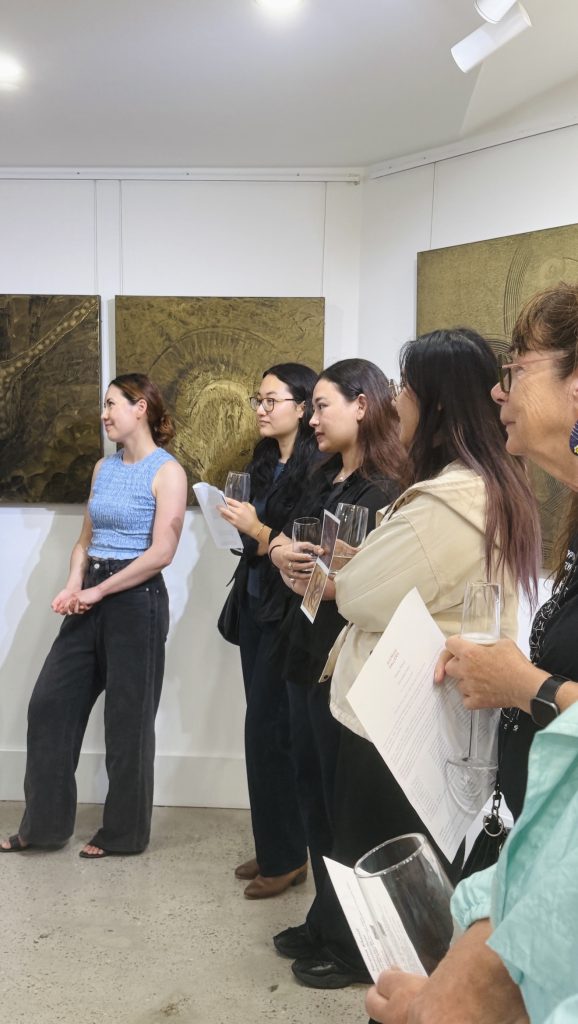
Through Primordial Pulse, Neena Mand translates architectural thinking into a more intuitive, sensorial language. Structure becomes rhythm, material becomes memory, and space becomes a site of reflection. Her experience as an architect does not dominate the work, but it quietly underpins it, allowing the exhibition to hold both solidity and flow, much like the primordial forces it seeks to evoke”.
The Primordial Pulse traces creation as a continuum – a vibration moving from formlessness to form. Each artwork is uniquely conceptualized and underpinned by years of research, intellectual analysis and abstract interpretations.
“The name Primordial Pulse comes from questions that have always been with us – and that still move us. For me, it doesn’t mean beginnings in a distant past.It means taking the pulse – checking in on what is still with us. Questions like:
How do belief systems and knowledge systems shape the worlds we inhabit? How do we relate to the world? How do we live together?
I’ve been drawn to these questions through reading across cultures and philosophies, but also through lived experience. This series is my way of living with them – not as definitive answers, but as an ongoing conversation.
Now, the exhibition has evolved around three ideas: Creator, Creation, and Continuum. I didn’t start with a theory. These distinctions appeared slowly as I worked.
The idea of a creator – when it becomes fixed or absolute – has often divided people. Different names – Different truths – Different claims.
Science, on the other hand, is very good at describing processes – but it doesn’t tell us how to live with what we know, and we are not just observers of the world. We participate in shaping it. So, for me:
Creator is not a figure. It’s a way of thinking about presence – something that cannot be owned and therefore cannot be used to separate.
Creation – across cultures there are many myths of beginnings – but for me creation is ongoing. It is the process by which form comes into relation: how things gather, separate, repeat, and reorganise across different scales. The Creation paintings stay close to those moments when structure is forming, but not yet fixed.
And Continuum asks a simple but difficult question: how do we live with what we’ve helped to create? How do we inhabit the world in ways that are ecologically, socially, and emotionally sustaining? The Continuum works – like Breath, Ambrosial dawn and Oceans of becoming – look toward ways of dwelling together through attentiveness and presence.”
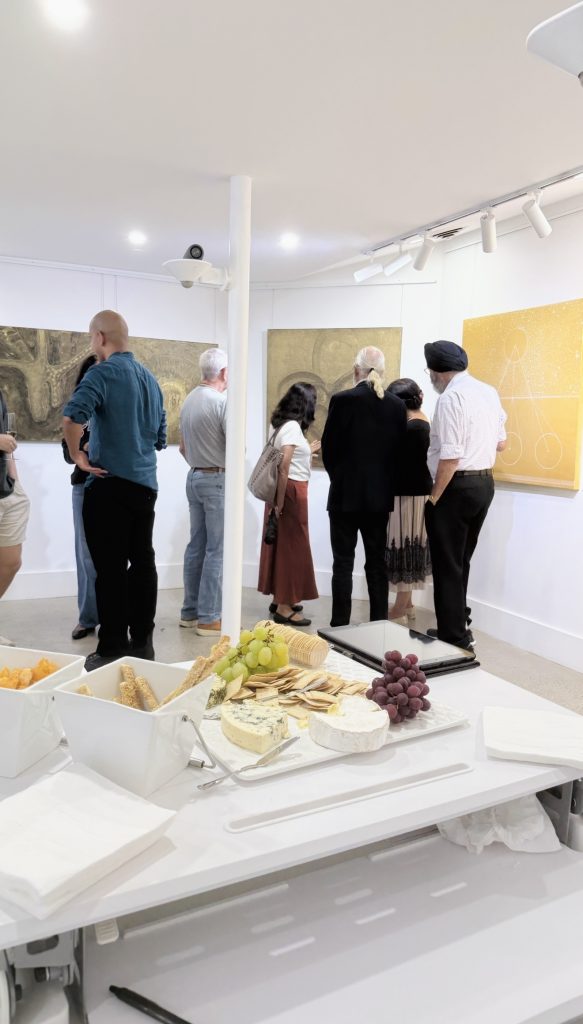
Katrina Hampton elaborates further that “The intended impact of Primordial Pulse is not didactic or declarative. It does not ask viewers to arrive at a single interpretation. Instead, it offers a shared space for reflection, where personal memory, sensation, and imagination can surface. The exhibition is accessible in its reliance on feeling rather than specialized knowledge, making it welcoming to a wide audience while still rewarding sustained engagement.”
At the core of Neena’s art inquiry lies vismād: a condition of wonder-struck awareness. Vismād describes an orientation of openness toward the world – one that resists mastery and remains attentive to what is unfolding. It functions across three registers: as an openness toward being, a mode of knowing grounded in attention rather than quick certainty, and a practice enacted through making and dwelling.
Neena expounds her thinking across the Creator–Creation–Continuum works, ….
“a question keeps returning for me: How do we relate – to the universe – to nature – to one another,and to ourselves – Rather than approaching this through narrative or illustration, the paintings operate through a state of attention.
The word that best names this for me is the Punjabi word Vismaad. Vismad is often translated as awe or wonder but not the fleeting kind.It is kind of wonder that makes you pause that makes us attentive – Vismād is not emotion.
It is not an aesthetic effect.
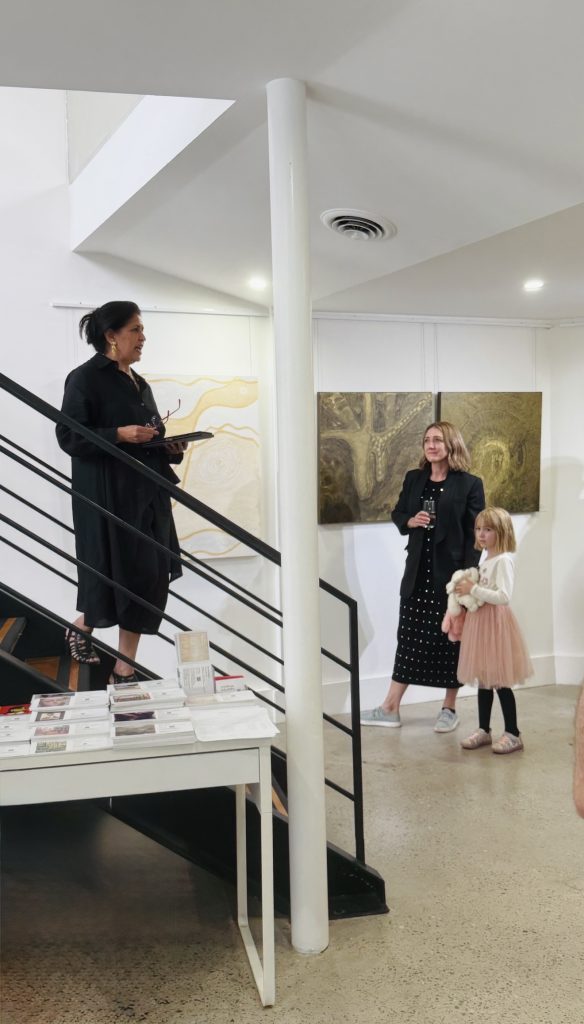
It is a threshold state – A moment before naming – before measuring – before conceptual framing. It is the pause where we truly notice what is here, before us. To experience vismād is to encounter the world not as an object, but as something already in an intimate relation with us.
Vismād does not rush toward explanation; It allows scale and mystery to be felt together – the vastness of the cosmos – the smallness of the human, without losing the wonder of simply being here.
In this sense, vismād is not opposed to knowledge. It precedes it. it is also for me what produces gratitude. A sense of fulness rather than lack. This orientation is what I keep myself open to how the work is made.
Neena has developed an aesthetic and conceptual framework called Dhvanic Abstraction. Rooted in the ancient Indian aesthetic principle of dhvani – the art of suggestion – extending this idea into a visual and spatial practice that engages abstraction, architecture, and cross-cultural philosophy.
“The paintings I have created do not represent things – They create conditions -for dialogue, for connection – Meaning is not delivered. – It is evoked – The work does not finish the thought. – It invites it.
This is why these paintings ask for time. – They ask not to be decoded,
but seen as companions to converse with and think alongside and also makes us aware how we feel and our relationship to the world.
The artworks are – ways of attending. – ways of returning – ways of being together. If you leave with a heightened attentiveness – to breath, to rhythm, to relation; then the work has done what it needed to do.”
Neena’s philosophy on audience engagement is fundamental to her work,… “painting is incomplete without the viewer. Meaning unfolds only when someone encounters the work. Their experiences, memories, and internal landscape shape what they see. I don’t want to prescribe a single interpretation. I want to open a space where the viewer can enter the continuum and find their own spark – their own moment of illumination.”
“Time dissolves while I paint. The work unfolds itself through process, intuition, accident, and reflection. I do not measure completion technically but how well it resonates with me – when the work speaks back and its resonance is alive. Even then, it remains incomplete until it enters dialogue with the viewer, whose memory, perception, and presence complete the continuum.”
One visitor reflected on the distinction between what a painting makes you feel and what it makes you think. She said that Creation: Recursive Stillness, when viewed on its own, felt calm, but also made her slightly uncomfortable – not emotionally, but intellectually – because it prompted sustained thought.
In contrast, she described one of the Creator works – Creator II – as visually unsettling due to its geometry and asymmetry, yet emotionally soothing. The composition disturbed her sense of balance, but the feeling it generated was one of calm.“I found this particularly interesting, as it showed how viewers were not simply reading form, but engaging with the tension between structure and affect….”
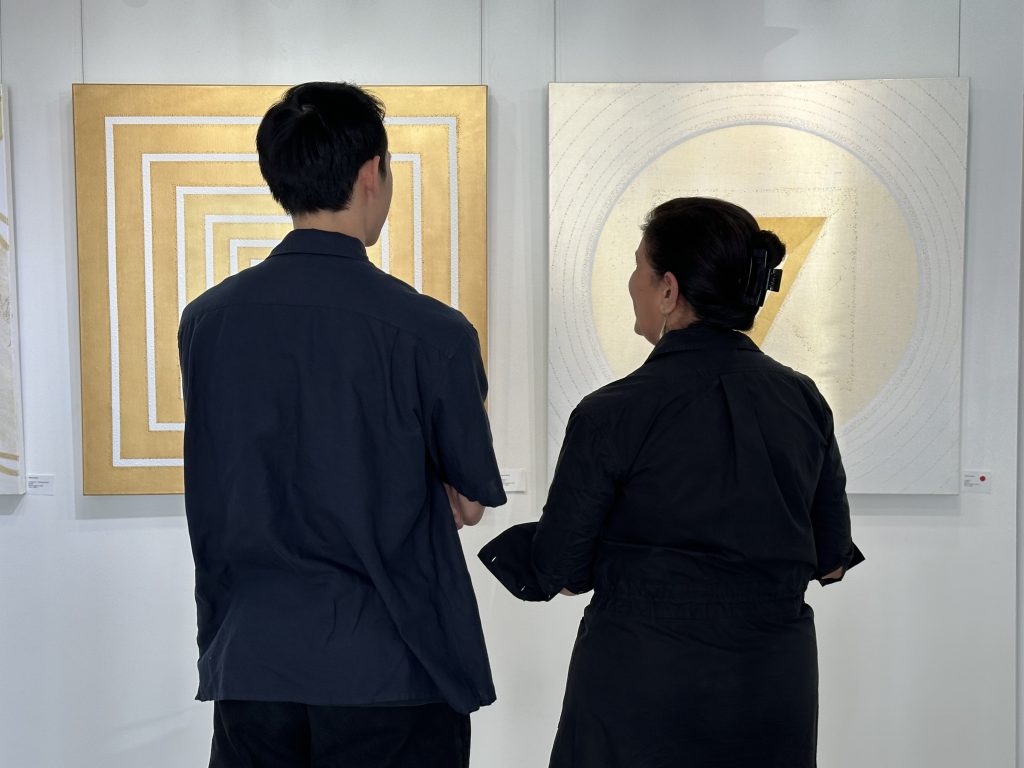
The conversation with various visitors revolves around emotional depth, use of gold and white, and the serene visual effects of her paintings. Specific pieces, such as Creation 3, Sansar Sagar and the Breath painting, are highlighted for their uplifting and inspiring qualities. The art is described as soulful, with a blend of organic shapes and geometric elements, and is appreciated for its depth, precision, and layering. The visitors also admire the architectural references and the sense of calmness evoked by Neena’s work.
The uniqueness of her art was been commented on by artist Ian MacGilvray………it is always good to see collected works in one space. In your case, I felt a real frisson between the works as they formed a whole, and spoke so eloquently to your theme of creation as a continuum.
,,,,,,,There is an immersive sense in your work which draws the viewer in. Contemplation and a fresh apprehension are called forth. There is a tantalizing lusciousness in your choice of white, black, gold…….I find that beautifully crafted pearlescence in the white/gold works opens a window into the transcendent. ……….You have managed to weave together marks that speak to me of wonder, genesis, glory, radiance and mythic edge.
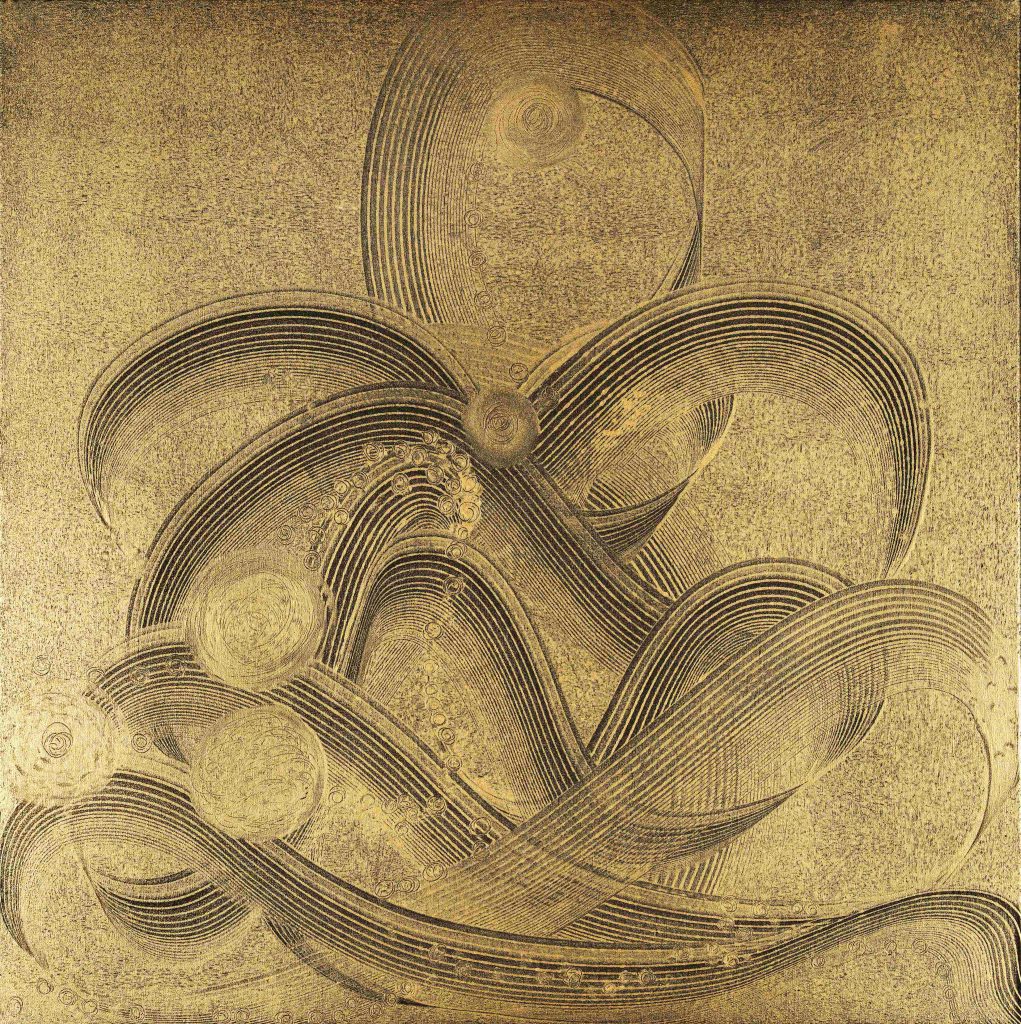
You also straddle both intentionality and intuition, geometric purity and organic evocation of emerging form. We were warned of the dangers of working with pure geometric form- and yet you have carried it off. Perhaps part of the reason is that you draw the viewer in to things known, and lure us with the tantalising sense that there is much more going on than we first realized. And you have kept a pared- back simplicity of expression, without over-burdening the imagery. ……..Keep it mean and ………….Your belief system (and the concept of Dhvanic Abstraction) clearly enriches and shapes your work, and for that we are all most grateful.
Ultimately, Primordial Pulse reminds us that beneath complexity lies a common rhythm, one that continues to shape us whether we consciously attend to it or not. By listening to that rhythm, even briefly, viewers are invited to reconnect with something fundamental: the pulse that links individual experience to the broader, ongoing movement of life itself. Katrina Hampton