India’s Unified Payments Interface (UPI) is set for its biggest pricing change in years, with a new Merchant Discount Rate (MDR) framework coming into effect from 15 October 2026. Under the revised system, specified person-to-merchant UPI payments above ₹2,000 will attract an MDR of 0.4 per cent, while millions of everyday low-value transactions and eligible small merchants will continue to operate under a zero-MDR structure.
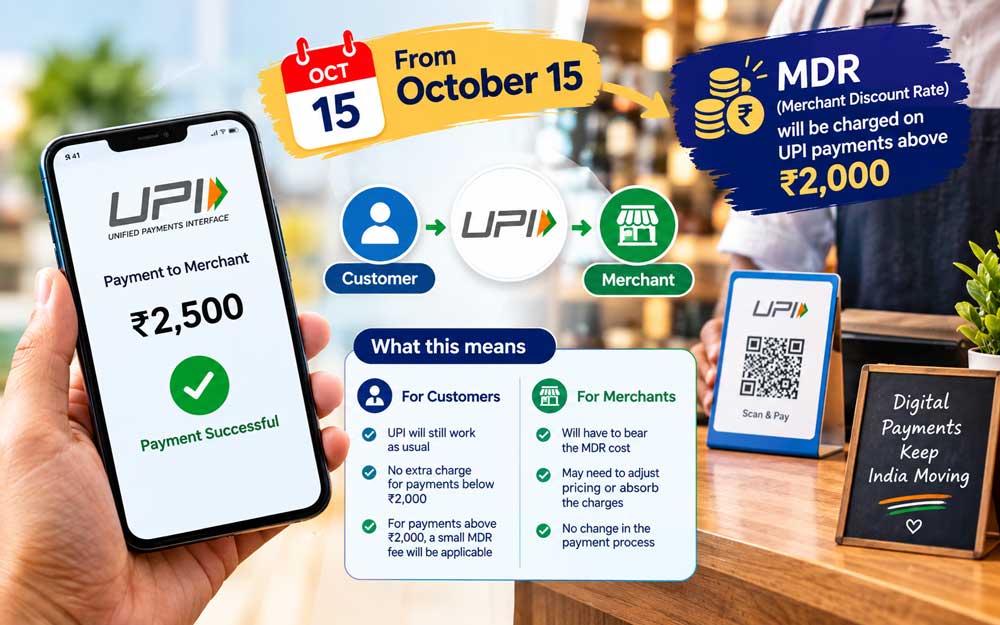
The announcement does not mean that consumers will suddenly have to pay a fee every time they scan a QR code. The new charge is directed at the merchant side of the payment ecosystem, and the Ministry of Finance has specifically stated that customers will not be required to pay MDR when making UPI payments. Banks have also been advised to ensure that merchants do not transfer the MDR cost to customers.
What exactly is changing?
Until now, UPI has operated for merchants largely without a conventional MDR on ordinary transactions. The new framework introduces a charge for specified Person-to-Merchant (P2M) transactions above ₹2,000.
From 15 October, the standard MDR will be 0.4 per cent of the transaction value, subject to a maximum of ₹300 per transaction. Therefore, the change is aimed primarily at larger merchant payments rather than routine purchases such as groceries, snacks, local transport or other everyday transactions that generally fall below the ₹2,000 threshold.
For example, if a customer makes a ₹2,500 UPI payment to a merchant covered by the standard MDR, 0.4 per cent works out to ₹10. On a ₹5,000 payment, the MDR would be ₹20, while a ₹50,000 transaction would generate an MDR of ₹200. Once the transaction reaches ₹75,000, 0.4 per cent would equal ₹300, meaning the cap becomes applicable. A ₹1 lakh transaction, for example, would not attract ₹400 in MDR; the maximum would remain ₹300.
Will customers have to pay the new UPI charge?
No. This is one of the most important points in the new framework.
The MDR is a charge within the merchant payment ecosystem and is not a consumer transaction fee. The Finance Ministry has explicitly stated that customers will not be required to pay MDR when using UPI. UPI application providers are also prohibited from imposing platform fees or hidden charges on individuals for these transactions.

This means that a customer buying a product worth ₹5,000 through UPI should not automatically see an additional ₹20 UPI fee added to the bill simply because the payment exceeds ₹2,000. The MDR is intended to be settled within the payment ecosystem rather than presented as a separate charge to the consumer.
The government has also clarified that person-to-person (P2P) UPI transfers remain completely free regardless of the amount. Sending ₹500 to a friend, transferring ₹10,000 to a family member or making another eligible individual-to-individual transfer will not become subject to this MDR framework.
What happens to payments of ₹2,000 or less?
Payments to merchants of ₹2,000 or below will remain free of MDR.
This is particularly significant because low-value transactions make up the overwhelming majority of merchant UPI payments. The government says more than 95 per cent of low-value P2M UPI transactions are below the ₹2,000 threshold, while its broader analysis indicates that MDR will apply to only about 4 per cent of merchant transactions once the small-merchant zero-MDR provisions are taken into account.
In practical terms, someone paying ₹350 at a shop, ₹900 at a restaurant, ₹1,500 for a purchase or exactly ₹2,000 to an eligible merchant will continue to use UPI without MDR.
Small merchants get a separate protection
The new system contains an important exemption designed specifically to protect India’s smallest businesses.
Small merchants receiving up to ₹1 lakh per month through UPI QR codes under the Person-to-Person-Merchant (P2PM) category will continue to enjoy zero MDR on all transactions, including transactions above ₹2,000. This means the ₹2,000 threshold should not be interpreted as automatically imposing MDR on every small vendor who receives a payment above that amount.
This provision is intended to cover businesses such as street vendors, neighbourhood shops and other micro-enterprises that rely heavily on QR-code payments but operate at relatively small transaction volumes.
For example, if an eligible small merchant receives a ₹5,000 payment but remains within the prescribed monthly UPI QR receipts threshold, that merchant can continue under the zero-MDR framework. The exemption is therefore based not simply on the value of an individual payment, but also on the merchant’s qualifying status and monthly UPI receipts.
Which transactions will attract the standard 0.4 per cent MDR?
The standard rate applies to specified P2M transactions above ₹2,000.
For ordinary covered merchant transactions, the calculation is straightforward: 0.4 per cent of the transaction value, subject to the ₹300 maximum.
A few examples make the system easier to understand. A ₹2,500 transaction would carry ₹10 MDR; a ₹10,000 transaction would carry ₹40; a ₹25,000 transaction would carry ₹100; and a ₹75,000 transaction would reach the ₹300 cap.
The merchant therefore does not face an unlimited percentage-based charge as transaction values rise. Any covered transaction of ₹75,000 or more has its MDR capped at ₹300 under the standard framework.
Some essential sectors will have a flat ₹5 charge
The government has also created a separate category for certain sectors where margins can be relatively narrow or transactions involve essential public and commercial services.
For specified transactions above ₹2,000 involving sectors such as railways, telecommunications, insurance, fuel and agricultural inputs, the MDR will be a flat ₹5 per transaction rather than the standard 0.4 per cent rate.
This creates a different calculation. A ₹3,000 eligible railway payment, for example, would attract ₹5 rather than ₹12 under a straight 0.4 per cent calculation. Likewise, a ₹20,000 qualifying transaction in one of these specified sectors would carry the ₹5 flat rate rather than ₹80.
What about stock markets, mutual funds and other capital-market payments?
The framework also provides a special rate for certain capital-market transactions.
Payments relating to areas including mutual funds, securities, stockbrokers and dealers will attract MDR of 0.02 per cent, with a maximum of ₹300 per transaction. This is considerably lower than the standard 0.4 per cent rate.
The lower rate is intended to support continued participation in formal financial markets while still creating a mechanism to contribute towards the costs of the digital payment ecosystem.
Where does the MDR money go?
Another important misconception is that MDR is simply a government tax.
The Finance Ministry has explicitly clarified that MDR is neither a tax nor a charge collected by the government or NPCI. Instead, the money is distributed among participants in the payment ecosystem, including banks, payment service providers and UPI application providers.
The wider purpose is to create a sustainable financial mechanism for the infrastructure that supports UPI payments, including payment processing, technology, security and continued expansion of the digital payments network.
UPI has grown into one of the world’s largest real-time payment systems, meaning that maintaining its infrastructure at enormous scale involves significant technology, security and operational requirements. The new framework is therefore designed to introduce a limited merchant-side revenue stream without imposing a general transaction fee on consumers.
Why has the zero-MDR model been changed?
UPI’s rapid expansion has been supported by a model in which customers have been able to make digital payments without directly paying transaction charges. That model has helped drive widespread QR-code adoption among merchants and consumers.
The new framework attempts to preserve the free nature of everyday and person-to-person payments while creating a charge for a relatively small portion of higher-value merchant transactions.
The government’s stated objective is therefore not to make UPI a paid service for ordinary users, but to establish a framework intended to support the long-term sustainability and expansion of the UPI ecosystem while protecting small merchants and low-value payments.
Will UPI itself become a paid service?
For ordinary consumers, the answer under the announced framework is no.
P2P transfers remain free, merchant payments up to ₹2,000 remain free, and eligible small merchants remain protected by the zero-MDR framework. The new MDR applies only to specified merchant transactions above ₹2,000.
The government has also clarified that individuals will continue to have unlimited free UPI usage, with no monthly quota or tiered cap introduced as part of this MDR framework. Daily transaction limits that banks and NPCI impose for security and risk-management purposes are separate from charges and should not be confused with the new MDR system.
What does this mean for a normal UPI user?
For most consumers, the immediate effect should be limited.
If a person normally uses UPI to pay small shops, restaurants, local vendors or service providers, most of those transactions will remain below ₹2,000 and therefore outside the standard MDR framework.
Even when a customer makes a larger payment, the new charge is formally a merchant-side cost. The Finance Ministry has instructed banks to ensure that merchants do not pass the MDR on to customers.
However, how individual businesses respond commercially could still matter. The formal framework does not permit the MDR to be passed on as a customer charge, but businesses may have broader pricing decisions to make as their payment costs change. Any such response would be a business decision rather than a new UPI fee imposed directly on consumers.
What does this mean for small shops and street vendors?
For small merchants, the announcement is significantly different from a blanket MDR on every UPI payment.
A qualifying merchant receiving up to ₹1 lakh per month through UPI QR codes under the specified P2PM category remains protected by zero MDR. The policy therefore specifically distinguishes India’s large digital merchants from micro-businesses that use QR codes for relatively small-scale transactions.
This is important because India’s UPI ecosystem includes millions of small businesses, roadside vendors, local stores and service providers. Applying a percentage charge to every transaction could have created a different cost burden for these businesses. The new framework instead attempts to shield the smallest merchants from MDR.
Is every payment above ₹2,000 affected?
No.
There are several separate categories to remember.
A payment from one individual to another remains free regardless of value. A merchant payment of ₹2,000 or less remains free. A qualifying small merchant covered by the P2PM zero-MDR framework remains exempt. Certain essential-sector transactions above ₹2,000 use a flat ₹5 rate, while specified capital-market transactions use a 0.02 per cent rate capped at ₹300.
The standard 0.4 per cent MDR therefore applies only to specified P2M transactions above ₹2,000 that do not fall within these special categories or exemptions.
Why is October 15 important?
The revised framework becomes operational on 15 October 2026, giving banks, payment aggregators, fintech applications and corporate payment systems time to modify their technology, accounting and billing systems.
The transition date is important for businesses because the MDR will need to be calculated and settled correctly depending on the type of merchant, transaction value and applicable category.
The bigger picture for India’s digital payments ecosystem
The new MDR framework represents an attempt to balance two competing objectives: preserving UPI’s attractiveness as a low-cost digital payment system while creating a sustainable mechanism to support the infrastructure behind increasingly large payment volumes.
According to the Finance Ministry, approximately 96 per cent of P2M transactions will remain unaffected, either because they are below ₹2,000 or because they fall under the zero-MDR framework for small merchants.
That means the change is considerably narrower than the phrase “UPI charges are coming” might suggest. The framework does not introduce a universal fee on UPI. Instead, it creates a targeted merchant-side charge for specified higher-value transactions while maintaining free P2P transfers and protecting low-value payments and qualifying small businesses.
For consumers, the most important takeaway is therefore simple: UPI is not becoming a paid service from October 15. Most everyday payments will remain free, and the new MDR is designed primarily around higher-value merchant transactions. For merchants, however, the change marks a significant shift after years of operating without a conventional MDR on UPI, particularly for businesses handling larger payment volumes.