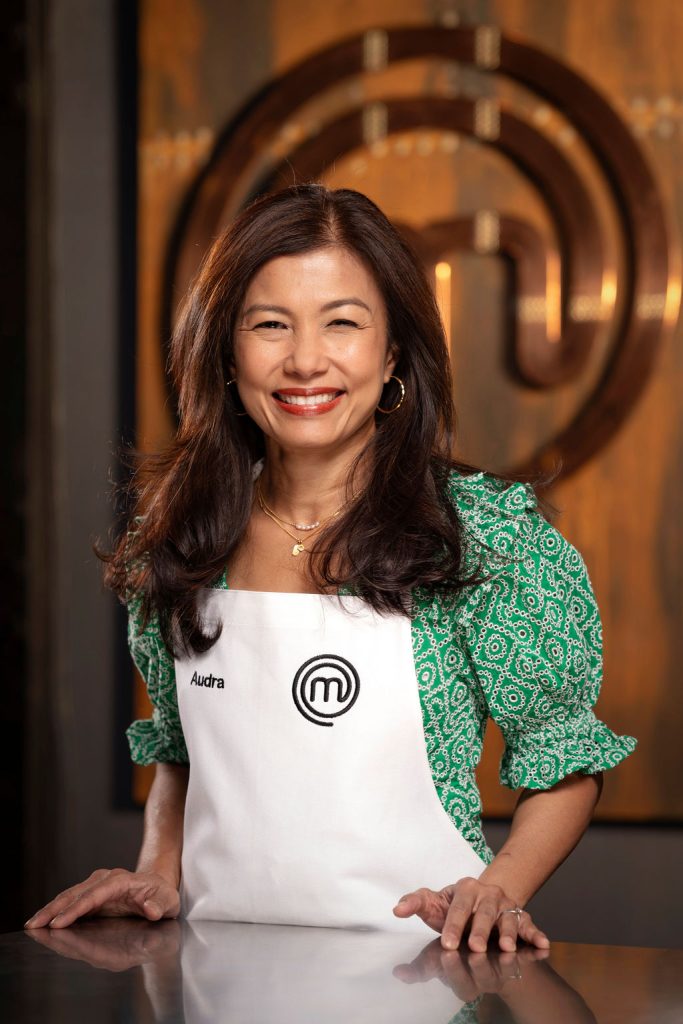
From MasterChef finalist to judge, TV presenter to culinary advocate, Audra Morrice has long been a voice for the authenticity and depth of Asian cuisine. Blending her Singaporean-Indian roots with global influences, Audra’s journey is as much about the stories behind each dish as it is about the flavours themselves.
A Childhood Stewed in Collagen and Culture
Ask Audra about a dish from her childhood that shaped her culinary identity, and she doesn’t hesitate. But surprisingly, these dishes rarely make it to her public menus.
“When I first introduced my cuisine to guests, there was always an element of familiarity in dishes that didn’t challenge the western palate too much. I wanted people to love it, I didn’t want to totally alienate them.”
Take, for instance, the legendary Singaporean fish head curry—a rich, gelatinous dish passed down by her mother. It never featured in its traditional form, and for a simple reason:
“The whole idea of a big fish head was still pretty daunting to many of my diners then. In doing this I failed to show them that all those gelatinous bits in the fish head was what made a good Singaporean fish head curry so delectable.”
Other comfort foods from her upbringing like pigs trotters in black vinegar soy braise, and Chinese-style pork belly, made subtle appearances through reimagined forms. Even the humble soups she grew up with were kept away from her menus for years, dismissed as “too home cooked.” But all of that changed.
“Over the years, I’ve realised that I was the one who was inhibiting showcasing and educating people about the authentic cuisine of my culture. Coming back to MasterChef Australia, I really wanted to share with the nation, and the rest of the western world, the importance I place on each and every dish that comes out of a country, a race, a family and a generation.”
Cultural Bias and the Palate of the World
Audra’s global experience judging both MasterChef Singapore and MasterChef Australia has given her a front-row seat to how different cuisines are perceived on screen.
“I think what might seem to be a ‘global cultural bias’ often comes from a lack of knowledge and understanding of a particular cultural cuisine, and an inherent generalisation of ‘the best’ cuisine in the world.”
She’s quick to point out that judging food is a deeply subjective process, often influenced by the judge’s background.
“Palates, likes and dislikes are all so subjective. Judging criteria from a heavily European-based palate will always differ to that of an Asian palate. Even within that Asian community… our flavour profiles are profoundly different.”
Still, it’s the synergy between judges—and the courage of contestants—that she believes makes the show more inclusive.

“Judges can disagree with their peers, it reflects different perspectives. And as a contestant, if you disagree with the judges, speak up and tell your story.”
Sustainability Before It Was Cool
Long before sustainability became a buzzword, Audra was raised with a respect for ingredients that bordered on sacred.
“Mom never wasted anything. She learnt this from her mother. She reared her own chooks… I watched her slaughter, cook and serve them. It’s so important we know the lifecycle of animals reared for consumption.”
From utilising every part of the animal to creatively reimagining leftovers, her mother’s kitchen was a masterclass in zero waste living.
“She also taught me how to use cheaper cuts of meat to cook up delicious meals – not necessarily because they were cheap, but because they had bags of flavour.”
These lessons continue to shape Audra’s life today.
“Although we live in urban Sydney, my family compost all our food scraps. We also grow a lot of ingredients that I use in my cooking at home… We’ve had an abundance of daikon/radishes this season. If there is an abundance of produce, we share it with the community.”
Breaking Stereotypes, On and Off Screen
Navigating kitchens and networks as a woman of colour hasn’t always been easy. Yet Audra reflects on her journey with quiet strength.
“I’ve received great respect from my male peers… Where it didn’t work was when egos existed and there is a lot of ego in kitchens. I don’t care for it, and I don’t have time for it.”
But it wasn’t only kitchens where she faced barriers. Her candid recollection of a meeting with a media executive speaks volumes:
“I was once told by a middle-aged white gentleman who held the key to commissioning TV programs ‘we have all the Asian we want on our channels’… That comment only fuelled me to find other ways.”
That “other way” is Eat, Roam, Relish: Sarawak Malaysia, her celebrated SBS series that shines a light on culture, community, and cuisine—not just the chef.
“This was my way of allowing audiences to connect with people of a different country and culture… We are now looking at producing the second series where we hope to explore India in a way that’s never been done.”
The Power of the Underrated
Ask her about a spice the world should know more about, and Audra doesn’t skip a beat.
“White peppercorns grown on the hillsides of the Betong region of Sarawak, Malaysia… When you’ve tasted the good stuff, nothing else compares.”
She’s just as passionate about cooking from whole spices.
“I am going to be bold and make this claim: everyone needs to know how to create spice mixes from whole spices… For convenience, we have diluted our knowledge of the value of spices by selling them ground.”
She champions humble Indian greens and soul-warming dishes like rasams and aloo ki subzi—often overlooked, but rich in history, flavour, and meaning.
“Are these simple home cooked dishes not worthy of making an appearance on restaurant menus? Well, frankly, I think it’s about time we showcased the essence of Indian cuisine… The only thing we should focus on is if the dish feeds your soul and brings great joy.”
More Than Just a Chef
Through her cooking, storytelling, and cultural advocacy, Audra Morrice is doing more than feeding people—she’s inviting the world to experience a legacy.
And as her next chapter unfolds, one thing is clear: for Audra, food will always be more than just sustenance—it’s a passport to identity, memory, and change.
MasterChef Australia: Back to Win. Watch + Stream Free Sundays at 7pm, and Mondays and Tuesdays at 7.30pm on 10.

As an experienced media and communications professional, I serve as Advisor to:
-Digital Journalists Association of India (DIJAI)
-Sansad Ratna Awards, which honour top-performing Indian MPs.
-PreSense, India’s oldest volunteer-run digital magazine.
In Australia, I host shows for Radio Bollywood Beats and Friends World TV, highlighting diaspora voices and changemakers.
I am the Global Head of Partnerships and Australian Ambassador for Mission ShakthiSAT—the world’s first all-female-led space initiative—I help empower over 12,000 young women across 108 countries, with a strong focus on mentoring students in science journalism.