Signed on 24 July 2025, the FTA promises to reshape trade, investment, and economic mobility between the two Commonwealth nations.
In a milestone moment for international trade relations, India and the United Kingdom have signed a landmark Free Trade Agreement (FTA), sealing a comprehensive pact that is being hailed as the most economically significant deal for Britain since its departure from the European Union.
The agreement, finalised on 24 July 2025 at Chequers in the presence of Indian Prime Minister Narendra Modi and British Prime Minister Keir Starmer, is expected to boost bilateral trade by an estimated £25.5 billion (USD 34 billion) annually by the year 2040.
The talks with PM Keir Starmer were outstanding, particularly in the wake of the successful signing of the Comprehensive Economic and Trade Agreement. In addition to economic cooperation, this agreement sets the stage for boosting shared prosperity. @Keir_Starmer… pic.twitter.com/PQD1f2zu2M
— Narendra Modi (@narendramodi) July 24, 2025
Redrawing the Trade Landscape
Under the new FTA, nearly all Indian exports to the UK—comprising textiles, leather goods, seafood, footwear, gems, and auto parts—will now enter the British market duty-free. This represents almost 100% of India’s export value to the UK.
On the other side, Indian tariffs on UK imports will see a dramatic reduction, with the average falling from 15% to just 3%. This is expected to bring down the prices of British products such as Scotch whisky, high-end cars, cosmetics, and medical devices. Tariffs on luxury automobiles—once exceeding 100%—will be capped at 10% under tightly controlled quota arrangements.
The alcohol and automotive sectors are particular standouts: import duties on whisky and gin will be slashed to 75% immediately, with a gradual reduction to 40% over the next decade. Car tariffs will also be phased down over a 15-year period, opening the Indian market more widely to premium UK automotive brands.
Our landmark trade deal with India is a major win for Britain.
— Keir Starmer (@Keir_Starmer) July 24, 2025
This is about putting more money in the pockets of hardworking Brits and helping families with the cost of living. pic.twitter.com/okDnO64oEG
Services, Mobility, and Professional Gains
Beyond goods, the agreement includes several provisions aimed at easing the movement of professionals and boosting services trade. A major win for India is the inclusion of the Double Contribution Convention, which will exempt Indian workers in the UK from paying social security contributions in both countries for up to three years. This is expected to directly benefit over 60,000 professionals in sectors such as IT, finance, consulting, and legal services.

While broader immigration reform was kept off the table, the agreement does allow for greater ease of business travel and short-term work-related visits. Meanwhile, negotiations on a Bilateral Investment Treaty—meant to provide investor protection—remain ongoing.
Sector-Specific Impact
India’s labour-intensive export industries are expected to see immediate benefits. Sectors such as textiles, footwear, processed foods, and leather goods—many of which are driven by MSMEs—could see export growth of 30–45% by 2030. These gains will likely support economic activity and employment in regional manufacturing centres such as Tiruppur, Moradabad, Ludhiana, and Surat.
Indian consumers stand to gain from access to higher-quality British products at lower prices, including chocolates, salmon, aerospace hardware, and luxury skincare.
For the UK, the deal opens the door to deeper inroads in one of the world’s largest and fastest-growing consumer markets. British exports—particularly in whisky, cars, healthcare technology, and high-end cosmetics—are projected to grow substantially, with estimated gains of up to £4.8 billion annually.
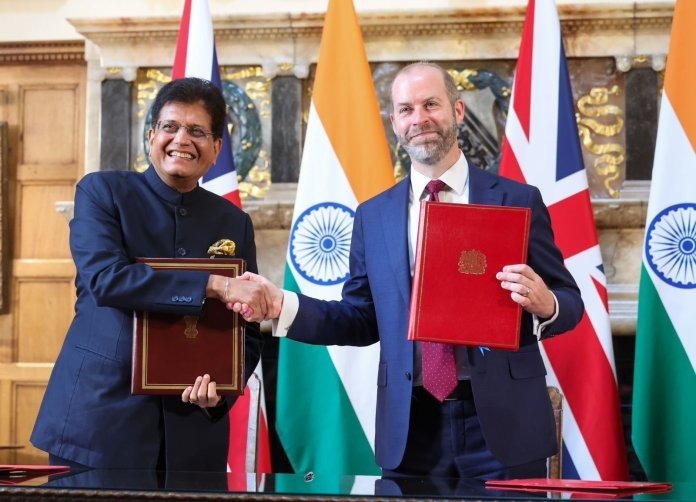
The negotiations began in early 2022 and concluded after several intense rounds of dialogue. The final agreement was preceded by an in-principle deal reached in May 2025. Leading the negotiations were India’s Commerce Minister Piyush Goyal and UK Business Secretary Jonathan Reynolds, with the final signing attended by both nations’ heads of government.
This FTA is particularly notable for being India’s first comprehensive bilateral trade pact with a major Western economy in more than a decade. For the UK, it represents the most ambitious post-Brexit trade deal to date, reinforcing its tilt toward the Indo-Pacific.
While the agreement has been broadly welcomed, some sectors have voiced concern. British automotive manufacturers, in particular, have criticised the slow pace of tariff reduction and restrictive initial quotas. Environmental advocates have also raised issues over the absence of carbon border measures and climate-aligned trade clauses, a gap expected to be revisited in future revisions.
Another sticking point remains the delay in finalising a bilateral investment treaty, which limits long-term investor confidence and cross-border capital flows.
The FTA is more than just an economic arrangement—it marks a new phase of geopolitical and strategic cooperation between two of the world’s largest democracies. For Indian-origin professionals and business owners across cities like Sydney, Melbourne, and Perth, the deal is a signal of shifting trade dynamics and future possibilities.
Whether it’s an exporter of spices from Kochi or a designer from Gujarat tapping into the British fashion market, or a professional in tech or law watching mobility rules evolve, the agreement opens up new pathways. The enhanced access, duty cuts, and future investment frameworks lay the foundation for a stronger, more connected India–UK economic partnership—one that is likely to resonate across borders, generations, and industries.