The ICC Men’s T20 World Cup witnessed a historic moment as the India national cricket team defeated the New Zealand national cricket team to claim the 2026 title and become the first team in history to win the tournament three times. The final, played on 8 March 2026 at the iconic Narendra Modi Stadium in Ahmedabad, saw India dominate with both bat and ball to secure a commanding 96-run victory in front of more than 86,000 fans.
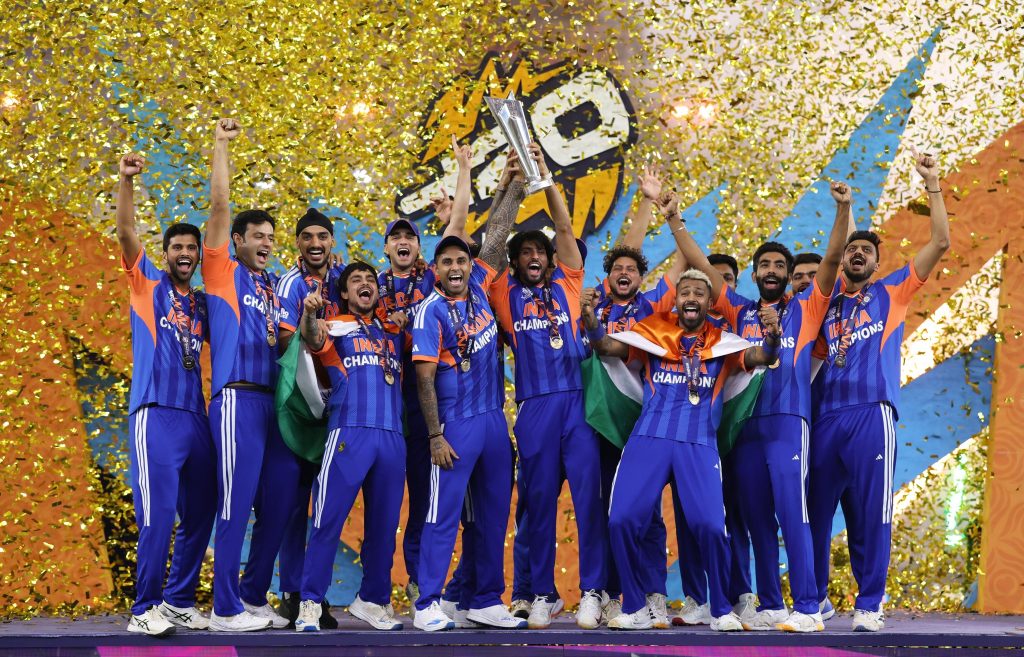
India’s triumph was not only about lifting another trophy but also about rewriting cricket history. The victory marked India’s third T20 World Cup title after their previous wins in 2007 and 2024, making them the most successful team in the tournament’s history. It also made India the first side to successfully defend the T20 World Cup and the first host nation to win the competition on home soil.
Not just a team. A family.
— Surya Kumar Yadav (@surya_14kumar) March 8, 2026
Not just a trophy. A dream for a billion of us.
PROUD to lead this group, PROUD to represent my India 🇮🇳🏆 A huge thank you to everyone standing beside me. You are the pillars of my strength 💙🙌🏼🫶🏻 pic.twitter.com/1fZ1DH3o5M
Batting first after New Zealand elected to field, India delivered one of the most explosive performances ever seen in a T20 World Cup final. The Indian batting line-up piled up a massive 255 for 5 in 20 overs, the highest total ever recorded in a men’s T20 World Cup final. The aggressive approach from the top order set the tone early and ensured that the scoreboard pressure was firmly on New Zealand from the outset.
The 𝐂𝐚𝐩𝐭𝐚𝐢𝐧 and his 𝐂𝐮𝐩 😍🏆 #T20WorldCup pic.twitter.com/YXFfCHgyaQ
— ICC (@ICC) March 8, 2026
The star of India’s innings was Sanju Samson, who produced a remarkable knock of 89 runs from just 46 balls. His innings, filled with powerful strokes and confident shot-making, became the highest individual score ever recorded in a T20 World Cup final. Samson’s form throughout the tournament was extraordinary, and he finished as the tournament’s top performer, earning the Player of the Tournament award.
Let the celebrations begin 🤩
— ICC (@ICC) March 8, 2026
India are #T20WorldCup 2026 champions 🏆 pic.twitter.com/zGgQtwODwH
India’s strong batting performance was further supported by aggressive contributions from the top order, including explosive half-centuries from players such as Abhishek Sharma and Ishan Kishan. Their attacking approach ensured India maintained a high scoring rate throughout the innings, allowing the team to post a record-breaking total that placed New Zealand under immense pressure in the final.
Champions!
— Narendra Modi (@narendramodi) March 8, 2026
Congratulations to the Indian team on winning the ICC Men’s T20 World Cup!
This remarkable triumph reflects exceptional skills, determination and teamwork. They have shown outstanding grit through the tournament.
This victory has filled every Indian heart with…
New Zealand’s chase never truly gained momentum as India’s bowlers produced a disciplined and clinical performance. Fast-bowling spearhead Jasprit Bumrah delivered a match-winning spell, taking four wickets for just 15 runs and dismantling the middle order. Spin all-rounder Axar Patel also played a crucial role with three wickets, ensuring New Zealand were bowled out for 159 in 19 overs.
Double delight for Gautam Gambhir – first to taste Men’s #T20WorldCup success as a player and a coach 🏆⭐ pic.twitter.com/hsYuGaGleD
— ICC (@ICC) March 8, 2026
Despite a fighting half-century from New Zealand opener Tim Seifert, the chase never threatened India’s dominance. Regular wickets and mounting scoreboard pressure prevented New Zealand from building any meaningful partnerships. Bumrah’s exceptional performance earned him the Player of the Match award for his decisive contribution in the championship clash.

MS Dhoni congratulates India on their third #T20WorldCup title with a special message for coach Gautam Gambhir and Jasprit Bumrah 😄 pic.twitter.com/rGKEFq8wFB
— ICC (@ICC) March 8, 2026
The victory carried emotional significance for Indian fans as well. The final took place at the same venue where India had suffered heartbreak in the 2023 ODI World Cup final. This time, however, the stadium witnessed redemption as the team celebrated a historic triumph on home soil, sparking celebrations across the country and among the global Indian diaspora.
𝐓𝐇𝐑𝐄𝐄-𝐓𝐈𝐌𝐄 𝐂𝐇𝐀𝐌𝐏𝐈𝐎𝐍𝐒 🏆
— ICC (@ICC) March 8, 2026
A milestone home #T20WorldCup triumph for India 🙌 pic.twitter.com/jBk9UWsOh8
Beyond the numbers and records, the triumph symbolised a new era for Indian cricket. With fearless batting, tactical depth and world-class bowling, the team demonstrated the evolution of its T20 strategy. The win also confirmed India’s dominance in international cricket, adding yet another major ICC trophy to a golden run that has seen the team consistently perform at the highest level.