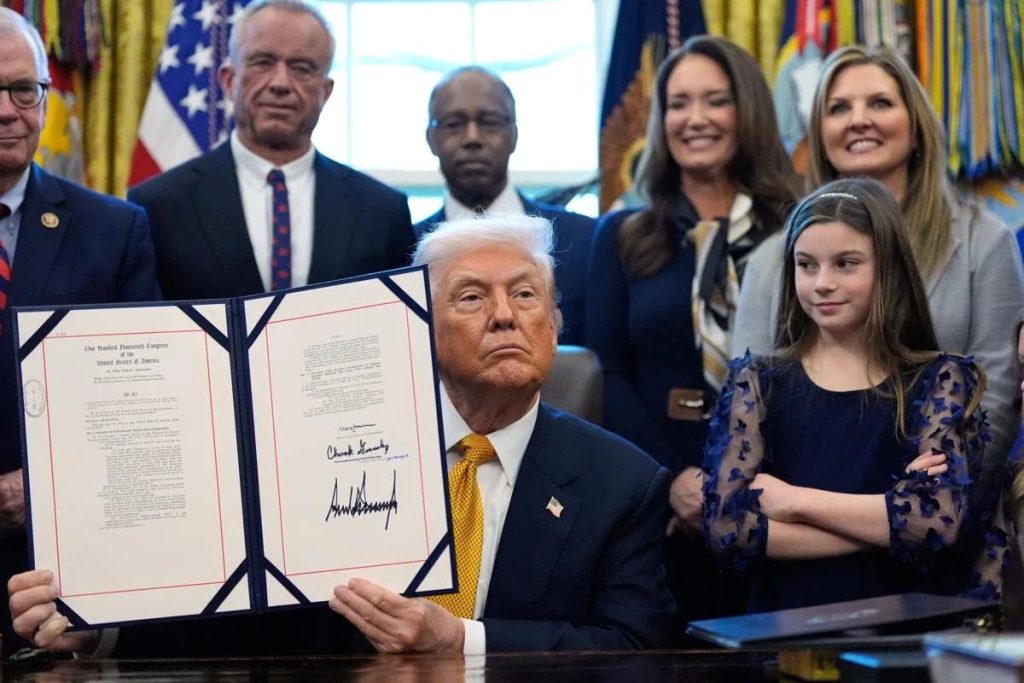
The United States has taken a notable turn in school nutrition policy with the reintroduction of whole milk in public school meal programs, following the signing of the Whole Milk for Healthy Kids Act by President Donald Trump. The new law reverses restrictions on higher-fat dairy that were part of an Obama-era nutrition standard, reshaping how milk is served to millions of children across the country.
For nearly 15 years, federal guidelines rooted in the Healthy, Hunger-Free Kids Act of 2010 limited school meals to low-fat and fat-free dairy products as part of an effort to curb childhood obesity. These requirements, backed by former first lady Michelle Obama, were intended to reduce saturated fat and calorie consumption among students.
Make Whole Milk Great Again.🥛 pic.twitter.com/l14FZhZDgw
— The White House (@WhiteHouse) January 15, 2026
Under the newly signed law, schools participating in the National School Lunch Program can once again offer whole milk and 2% milk alongside existing options such as 1% and skim milk. The policy also expands choices to include nondairy alternatives that meet federal nutrition standards, and allows them to be offered with a parental note rather than strict medical documentation.
The legislation has drawn support from lawmakers, nutrition experts and the dairy industry, who argue that whole milk provides essential nutrients and can be more appealing to children. Many students historically disliked low-fat milk options, leading to reduced consumption and increased food waste. Some research suggests that children who drink whole milk may be less likely to develop obesity than those who drink only low-fat varieties, though experts emphasise that diet quality depends on broader nutritional patterns.
🖊️ INTO LAW: President Donald J. Trump signs the Whole Milk for Healthy Kids Act, ensuring millions of children have access to high-quality milk in schools.
— The White House (@WhiteHouse) January 14, 2026
MAKE AMERICA HEALTHY AGAIN 🥛🐄 pic.twitter.com/VUI36QKgnU
Speaking at the White House signing ceremony, President Trump described the change as a positive step for children’s nutrition and the dairy sector. Agriculture officials have noted that the new guidelines align with recently updated dietary recommendations, which include full-fat dairy as part of balanced eating for school-age children.
The shift will initially affect nearly 30 million students who participate in school meal programs, as schools adjust supply chains and menu planning for the 2026–2027 academic year and beyond. While implementation timelines vary by district, the overall change is expected to be phased in gradually as cafeteria providers respond to demand.
Whole milk is BACK!🥛
— Secretary Brooke Rollins (@SecRollins) January 14, 2026
@POTUS has signed the Whole Milk for Healthy Kids Act, bringing whole milk BACK into America’s schools for the first time in decades. This is a HUGE win for kids’ health and American dairy farmers. 🇺🇸 🐄 ⁰ #DrinkWholeMilk pic.twitter.com/k8VLiMtNfR
Critics of the policy change, including some public health advocates, caution that reintroducing higher-fat dairy may complicate efforts to address long-term health concerns such as obesity and cardiovascular risk. They argue that broader nutritional support and education remain key to improving child health outcomes. However, supporters maintain that offering a variety of milk options helps ensure children receive adequate nutrients such as calcium while enjoying meals they will actually consume.

WHAT THEY ARE SAYING: Trump Administration Puts Real Food First in Dietary Guidelineshttps://t.co/Pfih2Oltm8
— Karoline Leavitt (@PressSec) January 9, 2026
This reversal represents a significant shift in U.S. school nutrition policy, illustrating how changing scientific perspectives and political priorities can influence national standards that affect everyday lives – from farm producers to families and schoolchildren across the country.