
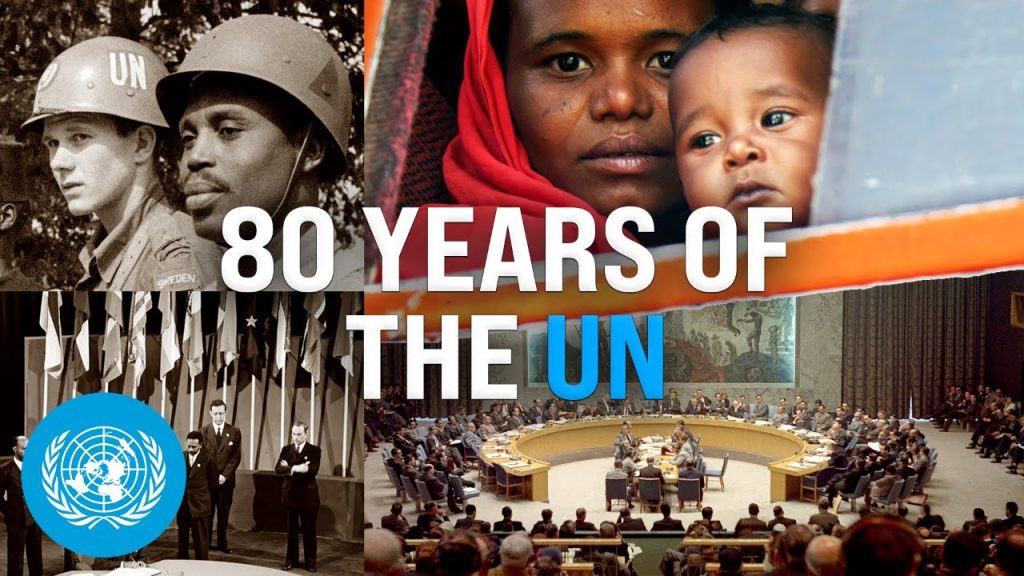
As the United Nations approaches its 80th anniversary, the world finds itself in a paradox. We have never been more connected – nor more divided. The technologies that enable instant communication have also accelerated disinformation. The prosperity that once promised stability now sits uneasily beside widening inequality. And the institutions built to safeguard peace and cooperation are struggling to operate in a world that often seems to have lost faith in both.
Yet perhaps the problem is not the failure of those institutions, but our failure to remember why they exist.
The UN was born not from idealism alone, but from necessity. In 1945, humanity emerged from the wreckage of global war and declared, with unprecedented conviction, that cooperation was the only sustainable defence against catastrophe. It was an act of pragmatic hope: a recognition that peace is not the natural state of affairs, but a project that must be continuously built, protected and renewed.
Eighty years on, that project is being tested again. The world faces not a single crisis but a convergence of them: war, climate, inequality, displacement, mistrust. What binds these challenges together is not only their scale, but the reality that none can be solved in isolation.
If there was ever a time to rediscover the courage to cooperate, it is now.
Beyond Cynicism: Rediscovering the Purpose of the UN
It has become fashionable to dismiss the UN as slow, bureaucratic or powerless. Yet these criticisms often mistake the symptom for the cause. The UN is not a government; it cannot compel action by decree. It is a mirror of its members – a reflection of our collective political will, or lack thereof.
When nations act with purpose, the UN becomes a powerful engine for progress. When they retreat into self-interest, it becomes paralysed. The measure of its success, then, is not found in its flaws, but in the willingness of the world to make use of it.

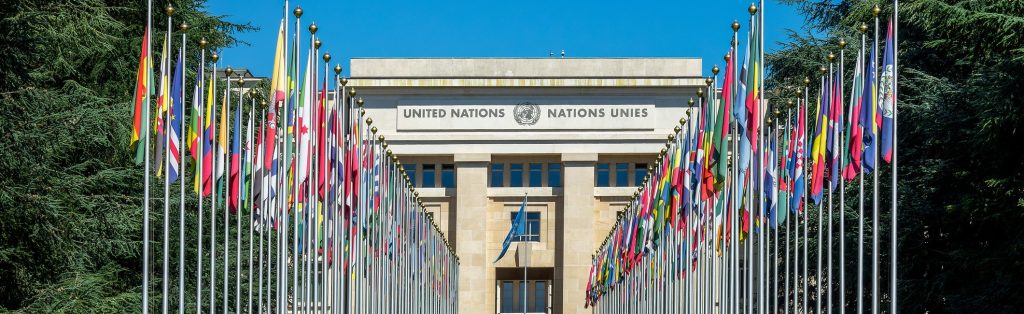
The truth is that much of what holds the modern world together quietly bears the UN’s imprint: from humanitarian law to vaccination programs, peacekeeping operations, refugee protection, climate frameworks, and the Sustainable Development Goals. These achievements were not accidents of history, they were the result of cooperation that held, even when trust was fragile.
The question before us is whether we still believe in that kind of cooperation – and if not, what we think will replace it.
The Fragility of Discourse
Our capacity to solve shared problems depends on our ability to talk to one another. Yet in too many places – from parliaments to social media feeds – conversation has been replaced by combat. We shout past each other rather than listen. Complexity is met with slogans; disagreement with contempt.
This erosion of discourse has consequences far beyond politics. It weakens the social trust that underpins democracy and fuels the suspicion that makes global collaboration impossible. The more divided we become, the less able we are to act – even on the issues that threaten us all.
Rebuilding that trust requires more than civility; it demands humility – a recognition that no single ideology, nation, or generation holds all the answers. Dialogue, when done well, is not an act of weakness but of strength. It is the foundation upon which peace, policy, and progress are built.
Leadership in a Time of Interdependence
Leadership today is no longer defined by dominance, but by interdependence. The most pressing challenges of our time – climate change, migration, artificial intelligence, global health, the integrity of information – cross borders faster than our laws or politics can keep up.
In this context, leadership means something different: the ability to convene, to bridge divides, to hold space for cooperation when it is most inconvenient to do so. It means shifting from the zero-sum logic of competition to the shared logic of survival.
This is not easy leadership. It requires patience in the face of populism and vision in the face of fear. But it is precisely this kind of leadership that the coming decade will demand: from governments, businesses, educators and citizens alike.
A Moment for Renewal
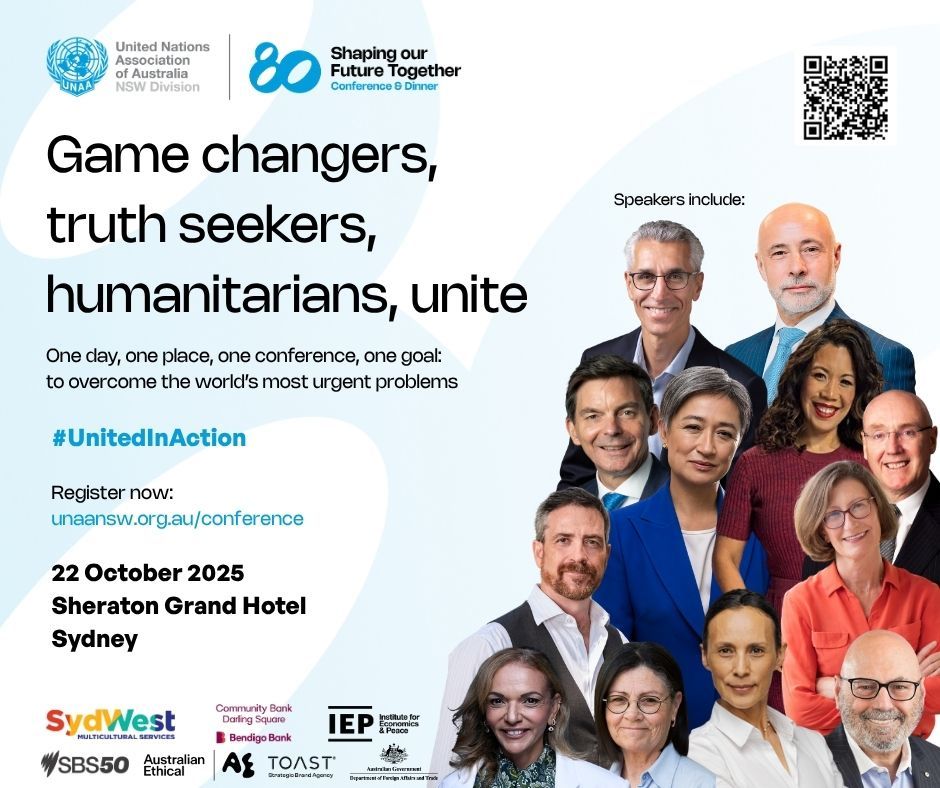
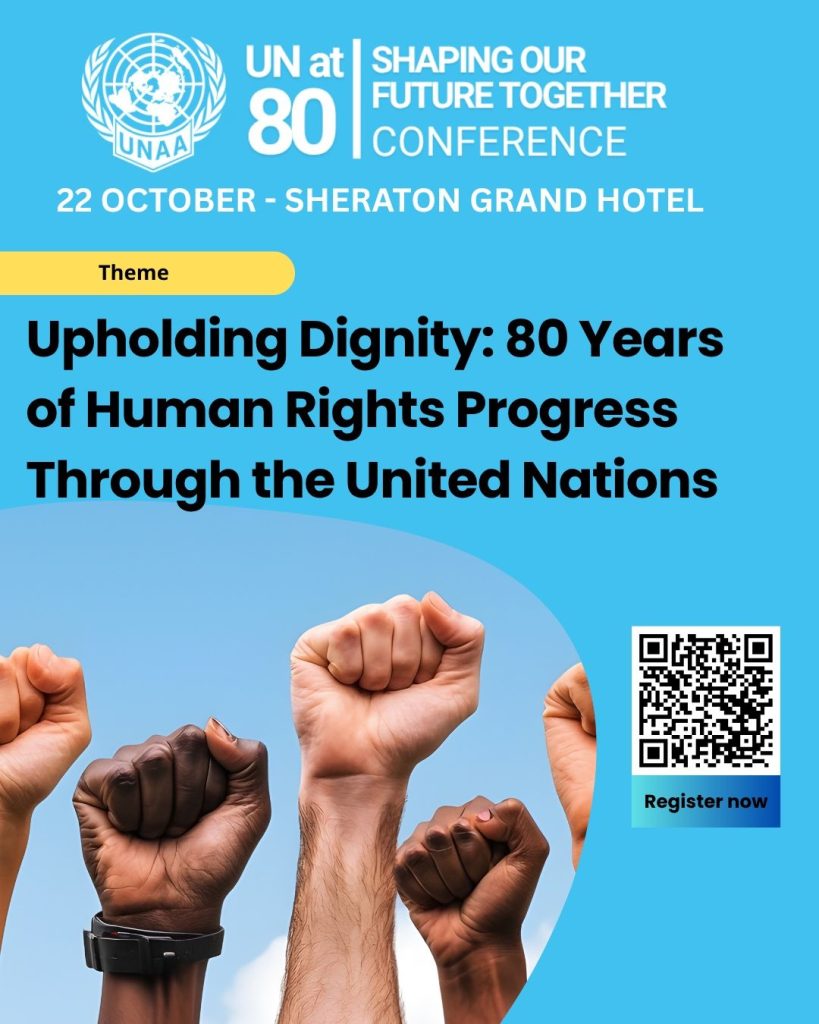
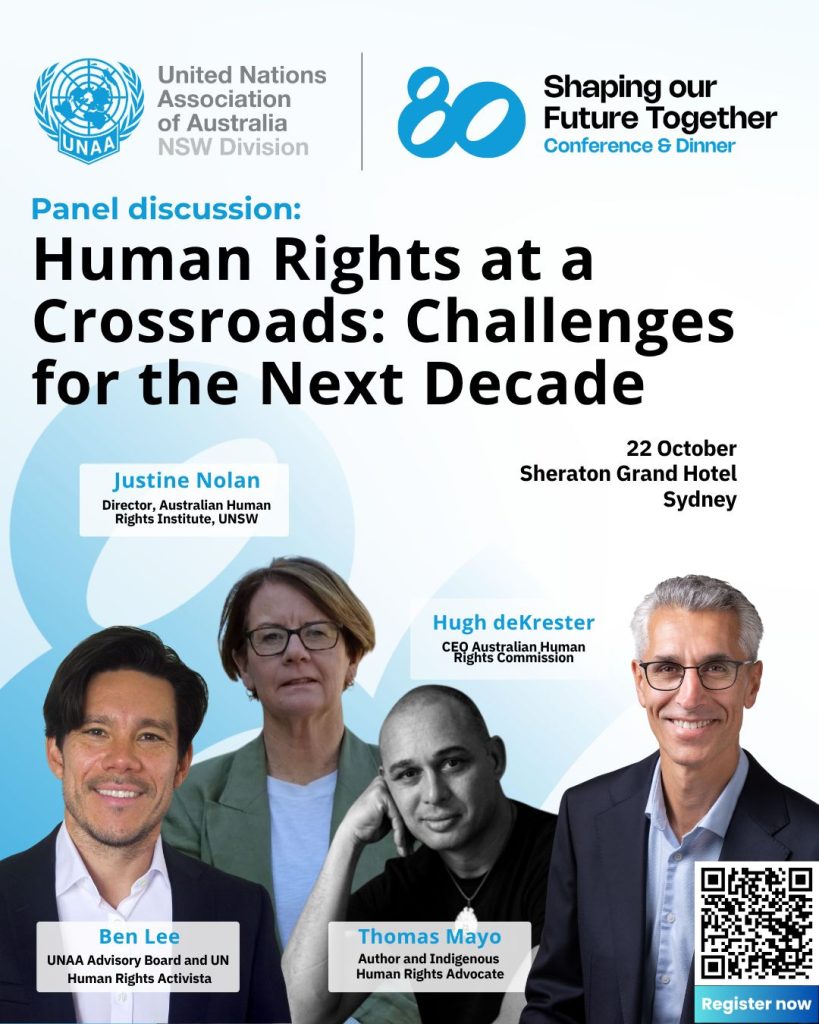
That is why the upcoming UN at 80: Shaping Our Future Together Conference and Gala Dinner (22 October 2025, Sheraton Grand Hotel, Sydney) is more than a commemoration. It is a moment of renewal. It is a call for Australia to re-engage with the ideals and practical realities of multilateralism in an age that too often dismisses it.
The conference will gather diplomats, academics, human rights advocates, sustainability experts, business leaders and youth voices to explore how Australia can contribute to the UN’s next chapter across four vital pillars: Peace and Security, Human Rights, Sustainable Development, and Global Citizenship.
But its significance lies less in who will speak than in who will listen – and what they might do next. It is an opportunity to move beyond rhetoric and toward shared purpose: to ask what peace looks like in a digital world, how human rights can survive in an age of automation, and what sustainability truly means when prosperity itself must be redefined.
This is not about defending the UN as an institution, but about defending cooperation as a principle. The alternative – fragmentation, cynicism, disengagement – is not a path to peace but a recipe for decline.
The Courage to Hope
Hope can seem naïve in an age of cynicism. Yet history tells us that progress has always depended on it. The abolition of slavery, the expansion of rights, the fall of apartheid, the creation of the UN itself – all began as hopes ridiculed by those who preferred the comfort of despair.
To hope is not to ignore the world’s challenges, but to confront them with the belief that they can be changed. Hope is courage in motion, and courage is contagious.
Eighty years ago, the UN was founded on that conviction: that humanity, for all its flaws, could learn from its own suffering and choose cooperation over chaos. That belief is not obsolete; it is unfinished.
An Invitation to Engage
The UN at 80: Shaping Our Future Together Conference is an invitation – to reimagine what global citizenship means, to rekindle the discipline of dialogue, and to contribute, in whatever way we can, to the renewal of cooperation.
Whether you attend as a policymaker, business leader, educator, volunteer, or simply a concerned citizen, your presence matters. Because shaping our future together is not the task of governments alone – it is the responsibility of all who believe that humanity’s best days still lie ahead.
The world we leave behind will depend not only on what we criticise, but on what we choose to build.
And the work of building, of listening, engaging, and imagining together, begins here.
Learn more or register: unaansw.org.au/conference
-chris dwyer