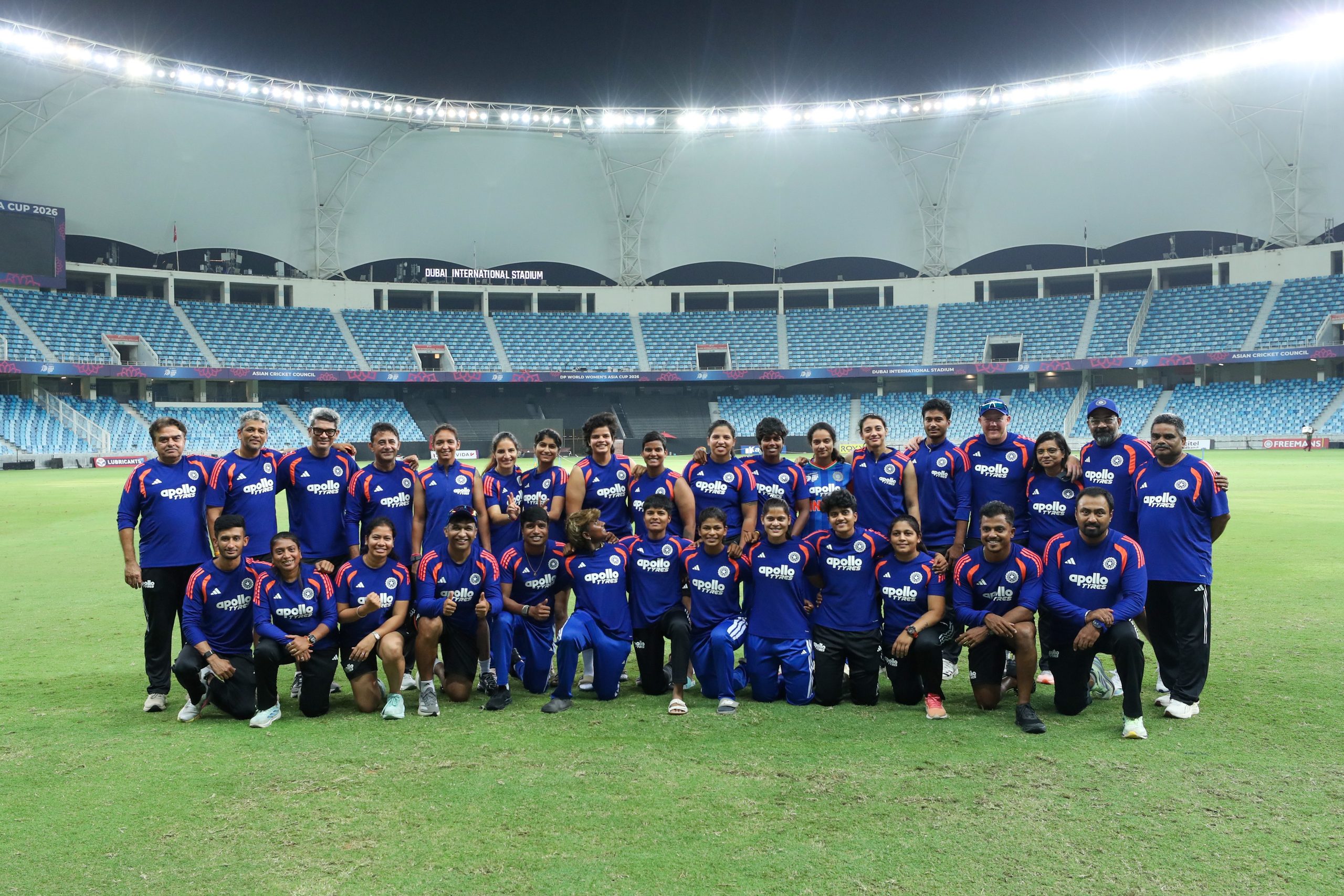
India have added another chapter to their dominance of women’s cricket in Asia, defeating defending champions Sri Lanka by 72 runs in Dubai to win the Women’s Asia Cup for a record-extending eighth time. The emphatic victory was built around a powerful opening partnership and a clinical bowling performance, although the celebrations were overshadowed by a fresh controversy surrounding the trophy presentation.
Batting first after winning the toss, India posted 183 for five at the Dubai International Cricket Stadium. The foundation was laid by openers Smriti Mandhana and Shafali Verma, who combined for 129 runs and put Sri Lanka under pressure from the opening overs. Mandhana contributed 59 while Shafali produced an aggressive 68.
Shafali was particularly destructive during the powerplay. The 22-year-old reached her half-century from just 24 deliveries, setting the fastest fifty recorded in the Women’s T20 Asia Cup. Her achievement surpassed Mandhana’s previous tournament record of a 25-ball fifty, which had been set in the 2022 edition.
Mandhana provided the other half of India’s commanding start, bringing up her 36th T20I half-century as the opening pair maintained an aggressive scoring rate. Their 129-run stand came in 12.5 overs and gave India a platform from which the middle order could attack, even though Sri Lanka managed to restrict the scoring during the final stages of the innings.
India eventually finished on 183 for five, leaving Sri Lanka with a demanding target of 184. The defending champions needed a strong beginning to stay in contention, but India’s bowlers quickly ensured that the chase never developed into a serious threat.
Sree Charani emerged as the standout bowler, using her left-arm spin to dismantle Sri Lanka’s batting line-up and finish with four wickets. Deepti Sharma also played a significant role as India maintained control throughout the innings and repeatedly prevented Sri Lanka from building partnerships.
Sri Lanka ultimately finished on 111, leaving India with a 72-run victory and another Asia Cup title. The result extended India’s record in the competition and denied Sri Lanka the opportunity to defend the championship they had won in the previous edition.

For Sri Lanka, the defeat ended a campaign in which the team had shown enough resilience to reach the final. The defending champions had beaten Pakistan in the semi-final to set up the title clash with India, with captain Chamari Athapaththu and the Sri Lankan bowling unit playing important roles during their knockout-stage progress.
While India’s performance on the field was emphatic, attention quickly shifted to the post-match presentation. The Indian team did not participate in the expected trophy presentation involving Mohsin Naqvi, the President of the Asian Cricket Council (ACC) and chairman of the Pakistan Cricket Board (PCB). The incident revived the controversy from last year’s men’s Asia Cup final.
The possibility of another dispute had been discussed before this year’s final because Naqvi was expected to attend the closing ceremony. That concern was rooted in the events of the 2025 Men’s Asia Cup, when India defeated Pakistan in the final but declined to accept the tournament trophy from Naqvi. The presentation was delayed and India ultimately celebrated without receiving the trophy on the podium.
That earlier episode had become particularly sensitive because Naqvi holds several senior positions. Alongside leading the ACC and PCB, he is a senior Pakistani political figure. The 2025 controversy unfolded against the backdrop of heightened India-Pakistan tensions following the Pahalgam attack and subsequent military confrontation between the two countries.
The 2026 women’s final has now produced a similar scene. Following India’s victory, the players did not collect the Asia Cup trophy from Naqvi, and the team did not take part in the trophy presentation in the usual manner. The development has resulted in the trophy dispute carrying over into a second consecutive Asia Cup.
BCCI secretary Devajit Saikia subsequently explained India’s position, saying the women’s team’s decision represented solidarity with the men’s team and the broader position adopted by Indian cricket authorities. Reports also indicate that the decision was viewed as a response to the continuing geopolitical circumstances between India and Pakistan rather than as a personal issue with Naqvi.
India women’s head coach Amol Muzumdar also backed the position taken by the BCCI. He said the team remained united behind the board’s stance while emphasising that the players were champions after their performance on the field. His comments underlined that the squad remained focused on its achievement despite the controversy surrounding the closing ceremony.
The latest incident has inevitably drawn comparisons with the men’s Asia Cup final of 2025, when India also celebrated without the trophy after declining to receive it from Naqvi. At that time, the presentation was delayed by more than an hour, and India ultimately celebrated on the podium without the silverware.
The controversy has therefore created an unusual situation in which India’s sporting achievement and the tournament’s administrative ceremony have become two separate stories. On the field, India produced a commanding performance to defeat Sri Lanka and secure another continental title. Off the field, the trophy presentation once again became a focal point in the wider India-Pakistan sporting relationship.
For Harmanpreet Kaur’s team, however, the significance of the result remains substantial. The victory gives India an eighth Women’s Asia Cup crown and further strengthens their position as the most successful side in the history of the competition. The performances of Shafali, Mandhana, Charani and the wider squad were central to a final in which India controlled the contest across both innings.
Shafali’s record-breaking half-century was one of the defining moments of the final, while Mandhana’s composed contribution ensured India had the platform required to post a challenging total. Charani then completed the job with the ball, ensuring Sri Lanka never came close to the required run rate during the chase.
The result also provides another significant achievement for a generation of Indian women’s cricketers who have continued to establish the team as a major force in Asian cricket. Yet the unusual ending means the images associated with India’s latest title are likely to include not only celebrations after a 72-run victory, but also the absence of the traditional trophy presentation.
India have therefore finished the tournament as undisputed champions on the scoreboard, while the circumstances surrounding the trophy ceremony have ensured that the 2026 Women’s Asia Cup will be remembered for a story that extends well beyond the boundary rope.