
The timeless teachings of the Bhagavad Gita came alive in Sydney as students, families and teachers from the Sydney Sanskrit School gathered for the school’s annual Bhagavad Gita Competition, combining Sanskrit learning, cultural traditions and spiritual reflection.
Held on 29 September, the event centred on the fourth chapter of the Bhagavad Gita, Jnana Karma Sanyasa Yoga, which explores the relationship between knowledge, action, duty and spiritual liberation. For the students taking part, the competition offered an opportunity to engage with teachings that have continued to hold meaning across generations.
The Bhagavad Gita’s setting on the battlefield of Kurukshetra represents more than a physical conflict. The dialogue between Lord Krishna and Arjuna also explores questions of duty, attachment, uncertainty and inner conflict. These themes continue to provide students with a framework for reflecting on challenges and responsibilities in their own lives.
For students at Sydney Sanskrit School, the annual competition combines this philosophical learning with the practical disciplines of memorisation, Sanskrit pronunciation and public presentation. The preparation also encourages young participants to become more familiar with one of India’s most influential spiritual texts while growing up in Australia’s multicultural environment.
Exploring the Teachings of Chapter Four
This year’s gathering focused on Jnana Karma Sanyasa Yoga, a chapter that examines how knowledge can transform action and lead an individual towards Moksha, or enlightenment.
The chapter describes the ancient parampara, or tradition through which spiritual knowledge has been passed down, while also explaining the purpose of divine avatars in restoring dharma. It explores the deeper concepts of karma, akarma and vikarma, while emphasising that spiritual discipline does not necessarily mean abandoning one’s responsibilities.
Instead, the teachings encourage individuals to perform their duties with knowledge and devotion, without ego or attachment to the results of their actions. This message provided the philosophical foundation for the day’s celebration.

One of the best-known verses from the chapter was also highlighted during the event:
Yadā yadā hi dharmasya glānir bhavati bhārata
Abhyutthānam adharmasya tadātmānaṃ sṛjāmy aham
Paritrāṇāya sādhūnāṁ vināśāya ca duṣkṛtām
Dharma-saṃsthāpanārthāya sambhavāmi yuge yuge.
The verse describes the divine manifestation whenever dharma declines and adharma rises, expressing the principle of protecting righteousness and restoring balance.
A Traditional Welcome to the Scripture
The program began with a Nagarasankeerthana-style welcome for the Bhagavad Gita. Two students carried the scripture into the hall, followed by students, parents and teachers who participated in Harinama Sankeertanam.
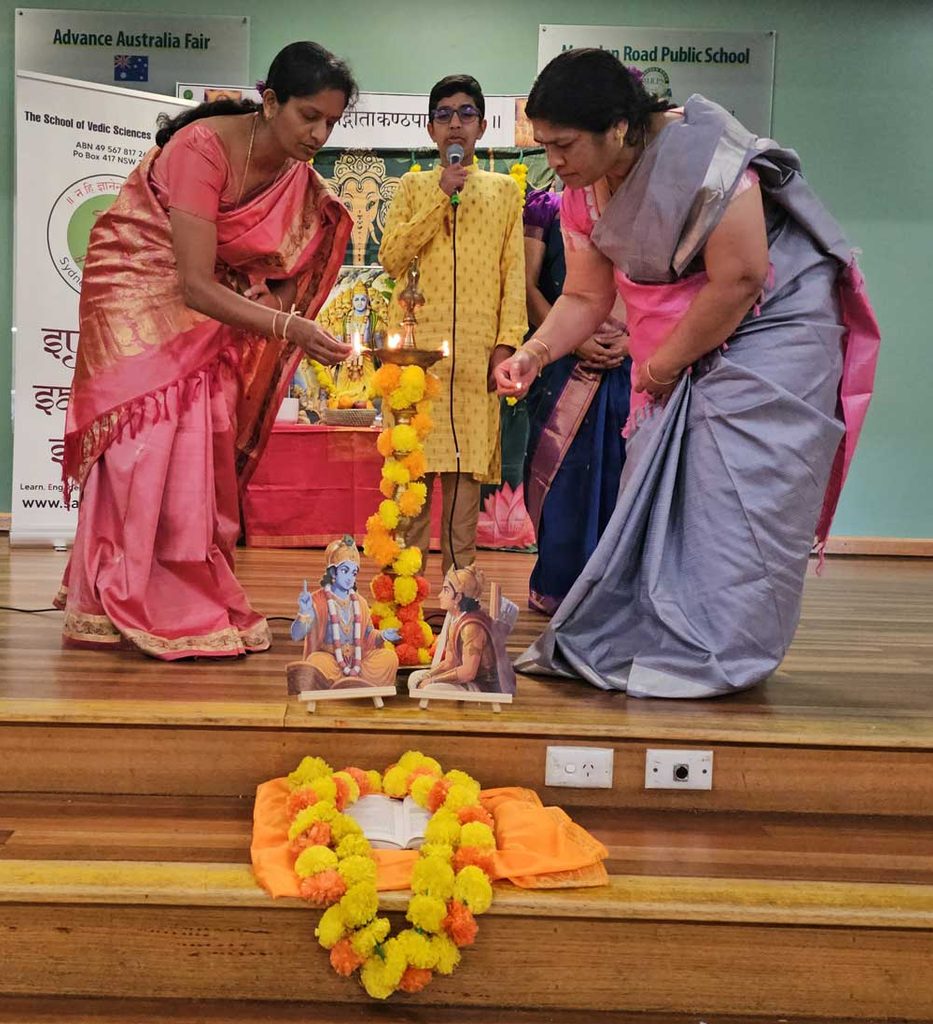
The formal inauguration continued with Ganesha Vandana and Deepa Jwalanam, the ceremonial lighting of the lamp. Students and teachers then joined in reciting the Gita Dhyanam and Gita Mahatmyam, associated with Shri Madhusudana Saraswati and Jagadguru Shri Adi Shankaracharya.
The opening created a traditional atmosphere for a program that combined scripture, Sanskrit education and the participation of the wider school community.
Nearly 200 Students Take Part
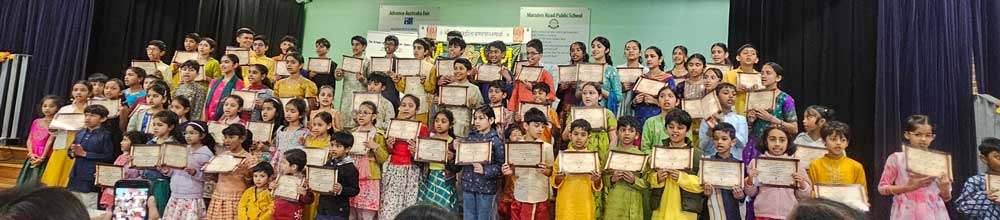
The main competition brought together close to 200 students, with participants asked to recite selected Bhagavad Gita verses according to their respective stages. Students were required to demonstrate not only memorisation but also clear Sanskrit diction and an understanding of the material.
The competition also included Subhashitams — short Sanskrit verses conveying wisdom, values and observations about life. These provided another opportunity for students to demonstrate their command of Sanskrit while engaging with teachings beyond the Bhagavad Gita itself.
With such a large number of participants, the competition continued for almost three hours. Older students also took part in a quiz that tested their knowledge of the Bhagavad Gita, adding a different dimension to the day’s learning.
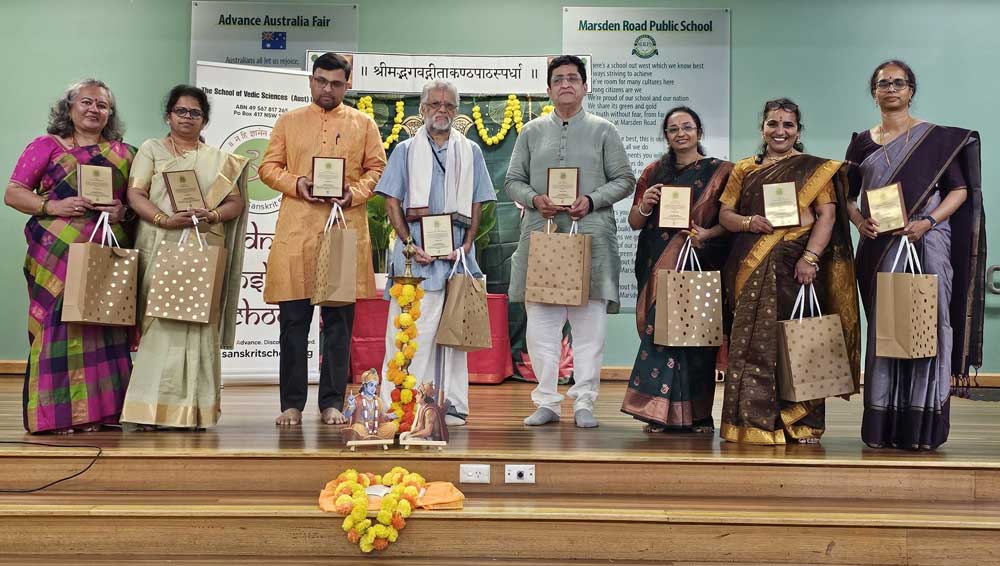
The competition was judged by Shri Jayantha Thirumalai Ramachar, Shri Santosh Kumar Valayaputtur, Shrimathi Sudha Prasad, Shrimathi Shashi Prabha Karigiri, Shrimathi Shobhanjali Ranganathan, Shrimathi Bhanu Chottera, Shrimathi Amitha Bhat, Shrimathi Nayan Shashikant and Shri Lalit Khanna.
The event’s chief guest was Charishma Kaliyanda Ji, Member of Parliament, who joined the school community for the occasion.
Students Showcase Their Artistic Talent
The program also provided a platform for students to showcase their abilities beyond Sanskrit recitation.
Aarabhi Santhosh performed the Swarajathi Rāravenu Gopabala on the flute, bringing a classical musical element to the celebration.
Saachi Malhotra presented a bhajan dedicated to Lord Krishna, offering a devotional performance for the audience.
The audience was also treated to a performance of the Shiva Tandava Stotram by Avinash, who impressed those gathered with his skills at a young age.
Keeping Cultural Roots Strong in Australia
The event concluded with the judges sharing their experiences and reflections on the students’ performances. Their remarks also recognised the contribution of parents and teachers in helping younger generations maintain connections with their cultural and spiritual heritage.
For families raising children in a multicultural Australian society, the competition represents more than an annual academic or cultural activity. It provides a setting where students can learn Sanskrit, engage with ancient texts and participate in traditions that connect them with their heritage.
The day concluded with Vande Mataram, followed by lunch and an informal gathering where students, families and teachers continued the celebrations together.
The Bhagavad Gita Competition ultimately demonstrated how an ancient text can remain part of contemporary community life. Through recitation, music, learning and shared participation, Sydney Sanskrit School students are engaging with teachings on duty, knowledge, responsibility and inner strength while developing a deeper connection with their cultural roots.
Thousands of years after Krishna’s dialogue with Arjuna, the questions explored in the Bhagavad Gita continue to resonate with people facing their own uncertainties and responsibilities. In Sydney, a new generation of students is learning those teachings not simply as verses to memorise, but as a source of wisdom they can carry into their lives.