Prime Minister Narendra Modi has etched his name into Indian history by becoming the country’s longest-serving elected Prime Minister, surpassing the record held by India’s first Prime Minister, Jawaharlal Nehru. The milestone marks a defining moment not only for Modi’s political career but also for modern India, which has undergone significant economic, technological and geopolitical transformation during his time in office.
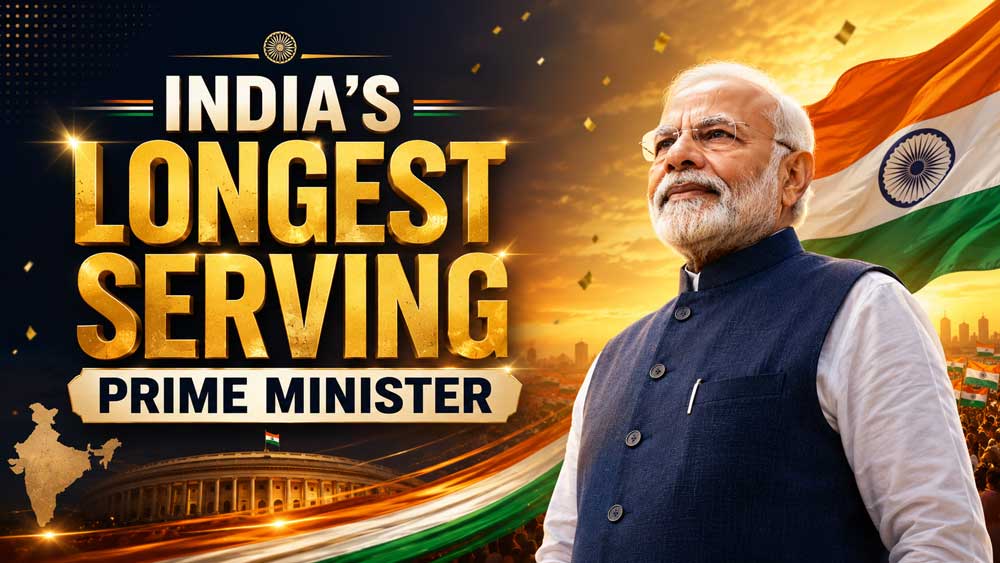
Modi first assumed office on 26 May 2014 following a decisive electoral victory that ended a decade of Congress-led government. He went on to secure even larger mandates in 2019 and 2024, becoming the first non-Congress leader to win three consecutive national elections and lead India through three uninterrupted terms as Prime Minister. In a democracy as vast and diverse as India, maintaining public support over such a prolonged period is considered a remarkable political achievement.
Born into a modest family in Gujarat, Modi’s rise to the highest elected office in the world’s largest democracy has often been described as one of the most extraordinary political journeys in modern history. From serving as Chief Minister of Gujarat to becoming one of the most recognised political leaders globally, his story has resonated with millions of Indians both at home and abroad.
जनसेवा ही सुशासन की सबसे बड़ी कसौटी है। विनम्रता, समर्पण और कर्तव्यनिष्ठा के साथ निरंतर कार्य करने वाला व्यक्ति ही जनविश्वास अर्जित करता है।
— Narendra Modi (@narendramodi) June 10, 2026
सदानुरक्तप्रकृतिः प्रजापालनतत्परः।
विनीतात्मा हि नृपतिर्भूयसी श्रियमश्नुते॥ pic.twitter.com/mn0Ax0F8hs
Over the past twelve years, India has experienced sweeping changes across multiple sectors. The Modi government has prioritised infrastructure development on an unprecedented scale, overseeing the construction of highways, expressways, airports, ports, railway corridors and metro networks across the country. Large-scale investments in public infrastructure have been aimed at supporting economic growth and improving connectivity for hundreds of millions of people.
One of the most transformative aspects of Modi’s tenure has been India’s digital revolution. Initiatives such as Digital India, Aadhaar integration, Direct Benefit Transfers and the Unified Payments Interface (UPI) have changed how government services are delivered and how citizens interact with the economy. Today, India’s digital payments ecosystem is regarded as one of the most advanced in the world and has become a model studied by several countries.
Making history, one day at a time.
— Dr. S. Jaishankar (@DrSJaishankar) June 10, 2026
Congratulations to PM @narendramodi on becoming India’s longest-serving elected Prime Minister, with 4399 days in office today.
This remarkable achievement reflects the enduring trust and confidence the people of 🇮🇳 place in PM Modi’s… pic.twitter.com/NzW6dPpi2w
Economic reforms have also played a central role during Modi’s leadership. Programs such as Make in India, Startup India, Production Linked Incentive (PLI) schemes and efforts to attract global manufacturing investment have sought to position India as a major economic powerhouse. As a result, India has emerged as one of the fastest-growing major economies and is widely expected to become the world’s third-largest economy within the coming years.
India’s global standing has expanded considerably during this period. Under Modi’s leadership, the country has strengthened strategic relationships with major powers including the United States, Australia, Japan, France and several nations across Europe, Africa and the Middle East. India has also emerged as an influential voice on issues such as climate action, supply chain resilience, energy security and the interests of developing nations.

@slrabuka today conveyed appreciation and admiration for PM Narendra Modi’s leadership and his service to India.
— Office of the Prime Minister (@fiji_opm) June 10, 2026
PM @narendramodi has served continuously for 4,399 days, making him the longest-serving Prime Minister in India’s history. pic.twitter.com/dwrWiIRWTa
The milestone has been welcomed by leaders across Australia and the Pacific region, many of whom highlighted India’s rise as a major global power. Several leaders praised Modi’s role in strengthening international partnerships and advancing regional cooperation at a time when the Indo-Pacific has become increasingly important to global security and economic stability.
Australia’s relationship with India has undergone a significant transformation during Modi’s tenure. What was once viewed primarily as a trade and education partnership has evolved into a comprehensive strategic relationship encompassing defence, critical minerals, technology, clean energy, cybersecurity and people-to-people links. The growing trust between Canberra and New Delhi is widely regarded as one of the most important developments in Indo-Pacific diplomacy.
Warm congratulations to PM @narendramodi on becoming India’s longest-serving elected Prime Minister. A true statesman who has transformed India’s economy and standing in the world. Proud of the Comprehensive Strategic Partnership we built together. Congrats my friend. 🇦🇺 🇮🇳 pic.twitter.com/liK2GEfejJ
— Hon. Scott Morrison AC (@ScoMo30) June 9, 2026
The Indian diaspora has also played a key role in strengthening these ties. Today, Australians of Indian origin represent one of the fastest-growing and most successful migrant communities in the country. Many within the diaspora view India’s growing global influence as a source of pride and see the strengthening Australia–India partnership as creating new opportunities for future generations.
Supporters of Modi point to achievements such as improved infrastructure, expanded welfare programs, increased foreign investment, digital transformation and stronger global engagement as defining features of his leadership. They argue that India today commands greater international influence and confidence than at any point in its modern history.
Congratulations to Narendra Modi on becoming India’s longest serving PM.
— Tony Abbott (@HonTonyAbbott) June 10, 2026
He hasn’t just held office, he’s dramatically improved his country, with more infrastructure, better IT, and practical things like power and sanitation extended to remote villages.
Under Modi, India has… pic.twitter.com/IxkRZBrQaW
Political analysts note that regardless of ideological perspectives, becoming India’s longest-serving elected Prime Minister is a significant democratic milestone. It reflects sustained electoral success across three national elections and demonstrates the confidence millions of voters have placed in his leadership over more than a decade.
Congratulations @narendramodi on becoming India’s longest serving Prime Minister. Thank you for your friendship with Australia and for your strong and consistent support of all forms of renewable energy including pumped hydro storage. pic.twitter.com/uZiFqFYG0Y
— Malcolm Turnbull (@TurnbullMalcolm) June 9, 2026
As India continues its journey towards becoming a leading economic, technological and geopolitical power, Narendra Modi’s latest achievement adds another historic chapter to his legacy. For many Indians around the world, including the large and growing community in Australia, the milestone represents not only a personal political accomplishment but also a reflection of India’s emergence as a nation playing an increasingly influential role on the global stage.