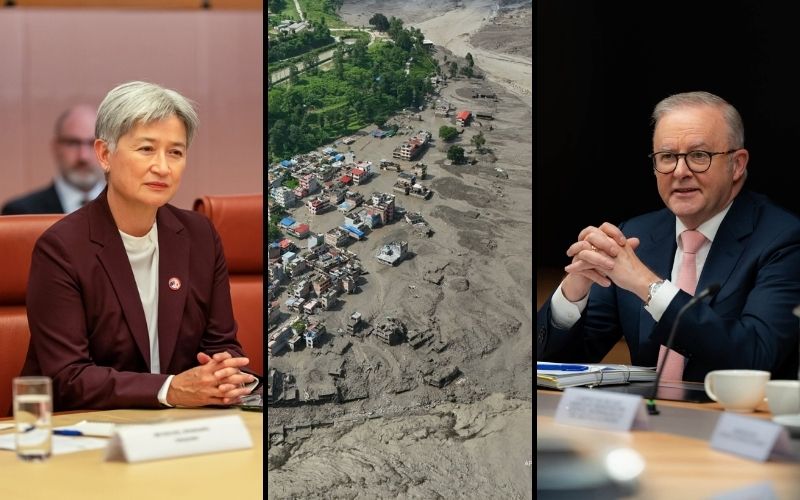
A devastating natural disaster across the Nepal-Tibet border has triggered an escalating search and humanitarian operation, with hundreds of lives lost and thousands of people still unaccounted for. Australia has increased its assistance to affected communities while authorities continue efforts to establish the whereabouts of Australians caught in the disaster.
The Australian government initially confirmed that 39 Australians were unaccounted for when it announced a $5 million humanitarian contribution on August 28. That figure has since changed following updated information from authorities, with 41 Australians currently listed as unaccounted for. The government says officials are working urgently to establish their welfare and provide assistance.
The updated figure comes despite positive news involving Sydney woman Cara Severino, who had earlier been feared missing. The 26-year-old managed to contact her parents from Gosainkunda and was reported safe. She had become stranded in a remote area with other hikers and was attempting to make the difficult journey towards Kathmandu, highlighting the communication and transport challenges facing people trapped in the region.
The disaster itself has grown dramatically since the first reports emerged. Nepalese authorities now report 579 deaths in Nepal, while seven people have been reported dead in Tibet. Almost 2,500 people are reported missing across the two affected areas, although figures remain subject to verification as rescue teams reach isolated locations and authorities reconcile different lists of people who cannot yet be contacted.
More than 93,000 people are believed to have been affected by the disaster, according to humanitarian agencies. Thousands of rescuers have been deployed across the region, with more than 3,700 people rescued in Nepal. The operation has been severely complicated by destroyed infrastructure, unreliable communications, difficult mountain terrain and continuing concerns about further flooding in areas affected by debris and unstable waterways.
The Australian government’s $5 million response is being channelled through established humanitarian organisations rather than directly through a government-to-government emergency operation. The package includes support for the World Food Programme, Australian organisations operating through the Australian Humanitarian Partnership and members of the Emergency Action Alliance, with assistance expected to cover food, shelter, water, sanitation, healthcare and other urgent needs.
Australia is also strengthening its consular response. Additional personnel have been sent to Kathmandu to assist with locating Australians and supporting those affected, while officials continue coordinating with Nepalese authorities and other partners. Foreign Minister Penny Wong has described the disaster as catastrophic and said Australian officials are urgently seeking information about the citizens whose whereabouts remain unknown.

The scale of concern among Australian families is reflected in the volume of enquiries received by the Department of Foreign Affairs and Trade. More than 450 enquiries have been made in connection with the disaster, as relatives attempt to establish whether family members and friends travelling through the affected region survived the floods. Officials are continuing to work through individual cases as communications are restored.
A significant number of Australians caught in the disaster were travelling as part of organised pilgrimage and tour groups. Many had been visiting the wider Himalayan region and travelling towards Mount Kailash, a site of deep religious significance. At least 32 of the Australians currently unaccounted for have been linked by tour operators to trips associated with the mountain, although authorities are still verifying individual identities and circumstances.
The disaster has also caused particular concern among Australia’s Indian and broader South Asian communities. Indian authorities have reported hundreds of Indian nationals among those whose whereabouts could not initially be established. Indian media reported 320 Indian nationals as uncontactable in the latest available figures, while separate reporting identified people of Indian origin among those affected. These numbers, like the wider missing tally, remain fluid.
The flooding followed an extraordinary geological and environmental event in the Himalayan region. Satellite observations and subsequent analysis indicate that a large mass of ice and rock broke away from a glacier, sending huge quantities of material and water into a river system. The resulting surge travelled downstream with enormous force, sweeping away structures, damaging transport links and leaving communities isolated.
The destruction has extended well beyond individual homes and villages. Roads, bridges, electricity infrastructure and other essential facilities have been damaged or destroyed, making conventional ground-based rescue extremely difficult. The remoteness of several affected locations means helicopters and specialist teams are playing an important role, while rescuers must also account for unstable terrain and the possibility of additional water surges.
Authorities are particularly concerned about further flood risks created by water and debris accumulating in the mountainous landscape. New or expanded lakes and blocked waterways have raised fears that additional releases could occur, potentially putting already damaged communities and rescue personnel at risk. This has forced emergency agencies to balance the urgent search for survivors with the safety of teams working in hazardous conditions.
Nepal has deployed a large security and emergency response force to the affected areas, while neighbouring countries and international organisations have offered assistance. China is also conducting rescue and recovery operations on its side of the border, while India and other countries have offered support. Nepal has indicated that it remains open to international technical assistance as the scale and complexity of the emergency become clearer.
For families in Australia, however, the central concern remains finding loved ones. The absence of reliable communications in parts of the disaster zone has made it difficult to distinguish between people who are safe but isolated and those who may have been caught directly in the floods. Authorities therefore continue to caution against drawing conclusions from unverified social-media posts or incomplete passenger and tour-group information.
The Australian government has urged Australians requiring emergency consular assistance to contact the 24-hour Consular Emergency Centre on 1300 555 135, or +61 2 6261 3305 when calling from overseas. Australian officials are continuing to work with local authorities while the search and recovery operation progresses across some of the hardest-hit parts of Nepal and the Himalayan border region.
The situation remains highly fluid, and the human toll could continue to change as rescue teams gain access to locations that have been cut off since the flooding. For the Australian, Indian and Nepalese communities watching events closely, the immediate priorities are clear: locating missing people, supporting survivors, delivering essential supplies and preventing further loss of life while the enormous recovery effort gets underway.