New Delhi: Beginning October 1, 2025, foreign nationals arriving in India will no longer be required to fill out paper disembarkation cards. Instead, the government is introducing a digital e-Arrival Card, part of a broader push to modernise immigration and reduce waiting times at airports. The move signals a transition from decades of form-filling and long queues to a click-and-go digital process.
The End of Paperwork at Immigration
For decades, the arrival experience in India began with fumbling for pens, filling in forms, and waiting in long lines at immigration counters. From October, this will change:
- e-Arrival Card: Foreign nationals must submit the form online up to 72 hours before arrival via the Indian Visa Online portal or the Su-Swagatam mobile app.
- Details required: Passport information, nationality, contact details, purpose of visit, and address in India.
- No uploads needed: Only the form must be completed; supporting documents are not required.
- Confirmation: Travelers will receive a digital acknowledgment, which they should print and carry.
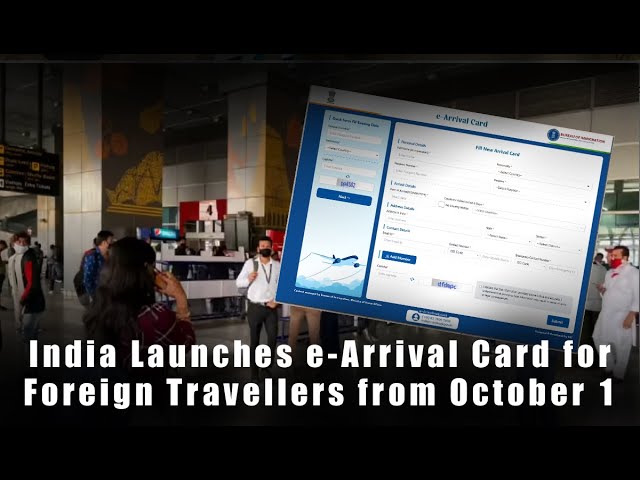
A transition period of up to six months will see physical cards remain available, though the government strongly encourages use of the digital option for faster clearance.
Exemptions continue for Indian citizens and Overseas Citizen of India (OCI) cardholders, who do not need to complete arrival cards.
Why This Change Matters
The reform is part of the Ministry of Home Affairs’ effort to:
- Cut down airport delays
- Integrate traveler information into India’s Immigration Management Systems for real-time monitoring
- Strengthen border management while improving passenger experience
Officials describe it as a small but meaningful step to make India’s airports modern, efficient, and welcoming, reflecting the country’s vision of Viksit Bharat @2047.

The Fast Track Immigration–Trusted Traveller Programme (FTI-TTP)
Alongside the e-Arrival Card, India is expanding its FTI-TTP, described as India’s answer to the US Global Entry or the UK’s Registered Traveller scheme.

How it works:
- Registered passengers use automated e-gates instead of manual counters.
- The system verifies passport, boarding pass, and biometrics (fingerprints and facial recognition) in under 30 seconds.
- Once authenticated, the gate opens automatically, completing immigration clearance.
Current rollout:
- Initially launched in Delhi (2024), the programme now covers 13 airports, including Mumbai, Chennai, Bengaluru, Hyderabad, Kochi, Kolkata, Ahmedabad, and five new airports: Lucknow, Thiruvananthapuram, Trichy, Kozhikode, and Amritsar.
- Expansion plans include 21 airports in the first phase, with Navi Mumbai and Jewar among the upcoming hubs.
Who can use it:
- Currently: Indian citizens and OCI cardholders
- Phase two: Extension to foreign nationals
Registration is free of cost (unlike similar global programmes), valid for five years or until passport expiry, and requires biometrics either at an FRRO or during first use at the airport.
So far, around 300,000 travellers have registered, with 265,000 already using the system.
Bigger Picture: India’s Travel Boom
India’s international travel is surging. Between 2014 and 2024:
- Outbound Indian travellers grew from 35.4 million to 61.2 million (a 73% rise)
- Foreign arrivals increased from 15.3 million to nearly 20 million
Traditional immigration systems struggled to keep pace, making automation essential. By replacing queues with clicks, India is addressing not only passenger convenience but also national security—pre-vetting low-risk travellers allows officers to focus on higher-risk arrivals.
Challenges Ahead
- Awareness: With only 300,000 registrations so far, uptake is modest compared to millions eligible. Linking enrolment with passport/OCI issuance may help.
- Technical reliability: E-gates must function smoothly, with backup systems in place to avoid creating new bottlenecks.
- Global expansion: Scaling to include foreign nationals will be a crucial test.
A Symbolic Shift
At the programme’s inauguration in September, Home Minister Amit Shah linked the reforms to India’s broader aspirations, drawing a symbolic parallel with Swami Vivekananda’s 1893 Chicago address. Just as Vivekananda introduced the world to India’s spiritual heritage, Shah said, modern travellers arriving through India’s airports will now encounter a technologically confident nation.