NASA has invited the Indian Space Research Organisation (ISRO) to participate in its Moon Base programme, opening a new chapter in India-US cooperation in space exploration. The invitation comes as the two countries look to expand collaboration in civil and commercial space activities, with lunar exploration and future human spaceflight emerging as important areas of partnership.
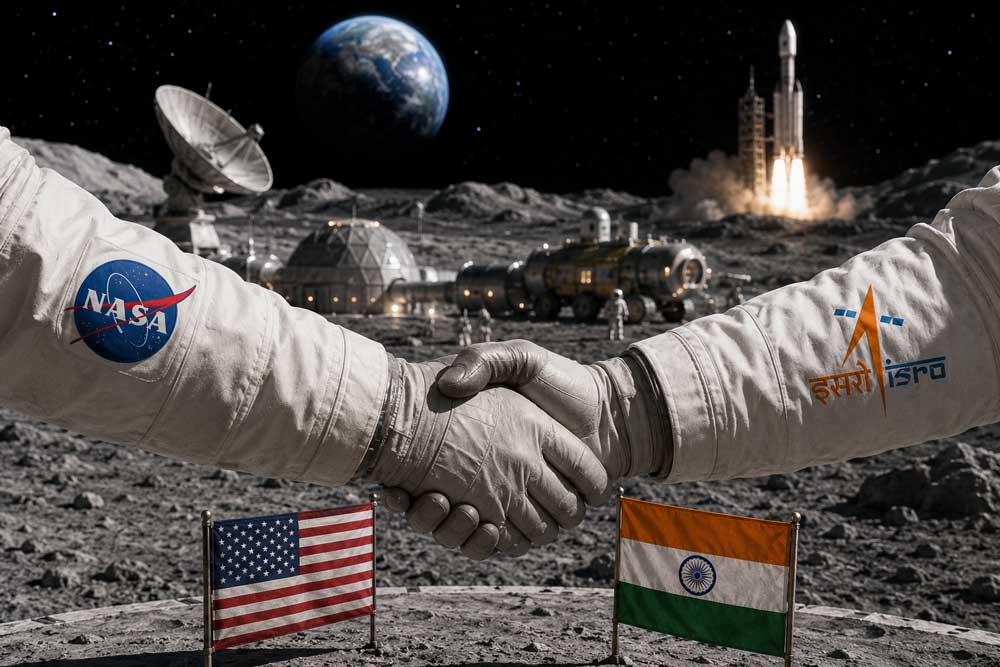
The development was reported on 11 August 2026 as officials from India and the United States discussed opportunities to deepen cooperation in space science, technology and exploration. The proposed collaboration could provide new avenues for scientific and technological exchange between the two countries as NASA progresses with plans for a sustained human presence on the Moon.
NASA’s Moon Base programme is designed as a phased effort to establish a long-term human outpost near the lunar South Pole. According to NASA, the programme will begin with robotic missions and gradually develop the technology, infrastructure, mobility, communications and other systems required for sustained operations on the lunar surface.
The invitation to ISRO is also connected to the broader Artemis Accords framework, which promotes international cooperation in peaceful exploration and use of space. NASA has said that countries participating in the framework can take part in the wider Moon Base endeavour, creating opportunities for international partners to contribute to future lunar exploration.
For India, deeper participation in lunar programmes could build on ISRO’s growing experience in space exploration. India’s Chandrayaan missions have expanded scientific understanding of the Moon, while the country’s broader space programme has increasingly developed capabilities in launch systems, spacecraft, lunar science and human spaceflight.
The latest development also follows the successful NISAR mission, a joint Earth-observation project involving NASA and ISRO that has been highlighted as an important example of the growing technological relationship between the two agencies. The broader cooperation now extends beyond Earth observation towards possibilities involving lunar science and human exploration.
NASA has been moving quickly to develop the infrastructure required for its Moon Base ambitions. The agency’s current plans include robotic lunar missions, commercial landers, lunar terrain vehicles and technologies for power, autonomous operations, communications and resource utilisation. NASA expects the first stages of Moon Base development to progress through a series of missions rather than through a single launch or project.

The programme is expected to have implications beyond space exploration itself. Long-term lunar missions require advances in robotics, artificial intelligence, communications, materials, energy systems, navigation and life-support technologies. Greater cooperation between India and the United States could therefore create opportunities for researchers, universities, technology companies and specialised industries in both countries.
NASA’s current schedule indicates that Artemis V, targeted for late 2028, is expected to be an important step in beginning construction of the Moon Base, while the agency is developing a sequence of robotic and human missions to build the capabilities required for sustained lunar operations. NASA has described the Moon Base as a stepping stone towards future human missions to Mars.
For the Indian space sector, participation in an international lunar programme could also strengthen opportunities for collaboration between ISRO, Indian research institutions and private space companies. India’s space ecosystem has expanded considerably in recent years, with greater participation from private industry alongside the country’s established government space programme.
The invitation therefore represents more than a symbolic gesture between two space agencies. It points towards a broader model of international cooperation in which countries contribute scientific knowledge, technology and expertise to increasingly ambitious missions beyond Earth. For India and the United States, the Moon could become one of the most important areas for the next stage of their strategic and scientific partnership.
As discussions continue, the precise nature of ISRO’s participation, including specific missions, technologies or responsibilities, will become clearer through future agreements and programme announcements. For now, NASA’s invitation marks a significant opportunity for India to be part of an international effort aimed at establishing a sustained human presence on the Moon and advancing the next generation of space exploration.