The Reserve Bank of Australia (RBA) has kept the official cash rate unchanged at 4.35%, maintaining its current setting at its August 2026 monetary policy meeting. The decision was broadly expected by financial markets, but the central bank’s latest comments indicate that interest rates could still rise again if inflationary pressures remain stronger than anticipated.
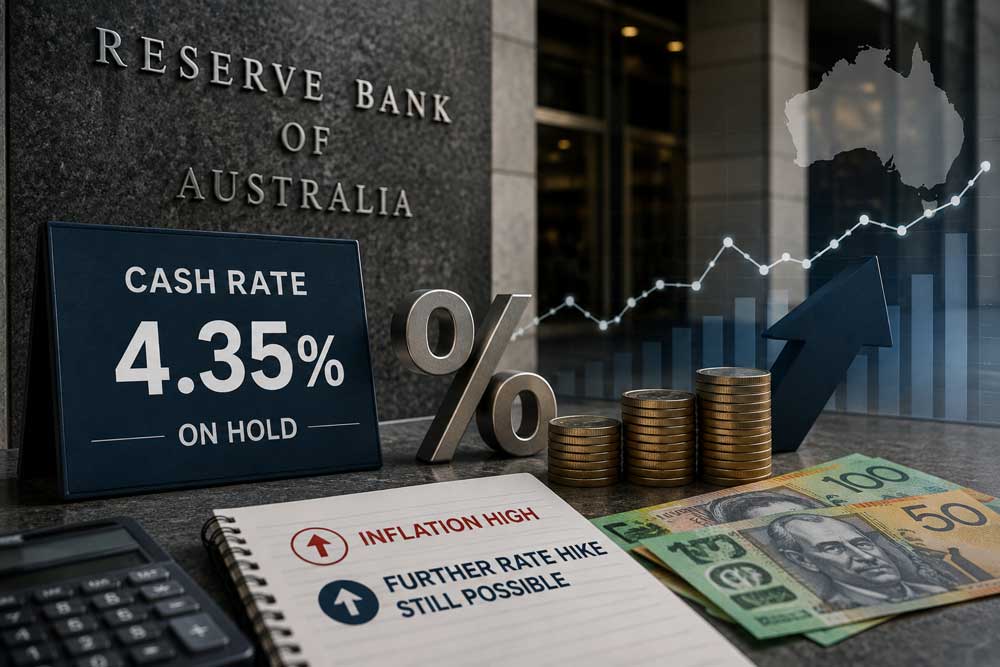
The decision comes as Australia’s inflation outlook continues to present a challenge for policymakers. The RBA’s preferred measure of underlying inflation, the trimmed mean, remains above the bank’s 2–3 per cent target range. The central bank has indicated that inflation is expected to return towards the midpoint of its target only gradually, keeping the focus firmly on price pressures.
RBA Governor Michele Bullock said the possibility of another rate increase remains open if economic conditions require it. Her comments mean that Tuesday’s decision should not necessarily be interpreted as the end of the current tightening cycle, with the Board continuing to assess incoming inflation, employment, spending and housing data before making future decisions.
The RBA’s decision also reflects a more complicated economic picture. While inflation remains elevated, there are signs that parts of the Australian economy are slowing. Housing activity has weakened in some areas, while consumer and business conditions are being closely monitored. Policymakers therefore face the challenge of bringing inflation down without unnecessarily weakening economic activity and employment.
For households with mortgages, the decision means there is no immediate additional increase in the RBA’s benchmark rate following the August meeting. However, borrowers should also be aware that the possibility of another increase has not disappeared. Variable-rate mortgage holders remain particularly sensitive to any future changes in the cash rate, while fixed-rate borrowers will continue to be affected by their individual loan arrangements.
The decision is also relevant to people considering buying a home. Higher interest rates can reduce borrowing capacity and increase repayments, while a period of unchanged rates can provide some short-term certainty for households planning their finances. At the same time, property markets are being influenced by several factors beyond interest rates, including household incomes, housing supply, employment and buyer confidence.
Inflation remains central to the RBA’s thinking. The central bank has said demand needs to remain sufficiently subdued to reduce pressure on the economy’s capacity and help inflation return sustainably to target. At the same time, policymakers are watching developments that could push prices higher, including energy costs and broader international economic uncertainty.

The latest decision is particularly important for families managing everyday living costs. Interest rates influence mortgage repayments and borrowing costs, but the broader inflation environment affects prices for groceries, services, housing and other household expenses. For many Australians, the combination of elevated living costs and relatively high borrowing rates remains an important consideration when planning household budgets.
For businesses, the interest-rate outlook also remains significant. Higher financing costs can influence investment decisions, expansion plans and consumer demand. The RBA’s continued focus on inflation means businesses are likely to keep watching upcoming economic data closely, particularly figures covering inflation, employment, wages and household spending.
The latest decision also means financial markets will continue to closely monitor the RBA’s next moves. While the August meeting resulted in no change, Governor Bullock’s comments have kept the possibility of a future increase on the table. Economists and financial markets will therefore assess each new set of economic data rather than assuming that rates will automatically remain at 4.35 per cent.
For the Indian-Australian community, the decision has relevance across households, particularly among mortgage holders, first-home buyers, renters, business owners and families planning major financial commitments. The immediate message is that the cash rate remains unchanged at 4.35 per cent, but the interest-rate outlook is not yet settled.
The RBA’s latest decision ultimately reflects a cautious approach as policymakers balance two important objectives: bringing inflation sustainably back towards the target range while supporting economic stability and employment. With another rate increase still possible if inflationary risks strengthen, Australians will be watching upcoming economic data closely for signs of where monetary policy could head next.