India and Australia are seeking to accelerate negotiations for a broader trade agreement, with senior ministers discussing ways to deepen economic cooperation across pharmaceuticals, services, investment, agricultural technology and critical minerals.
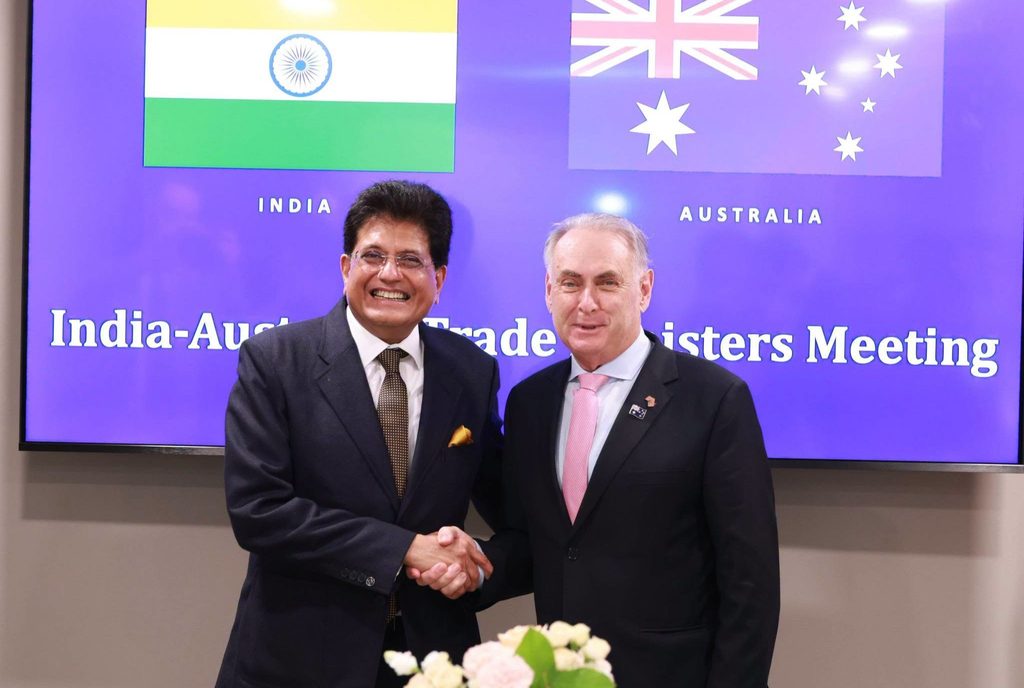
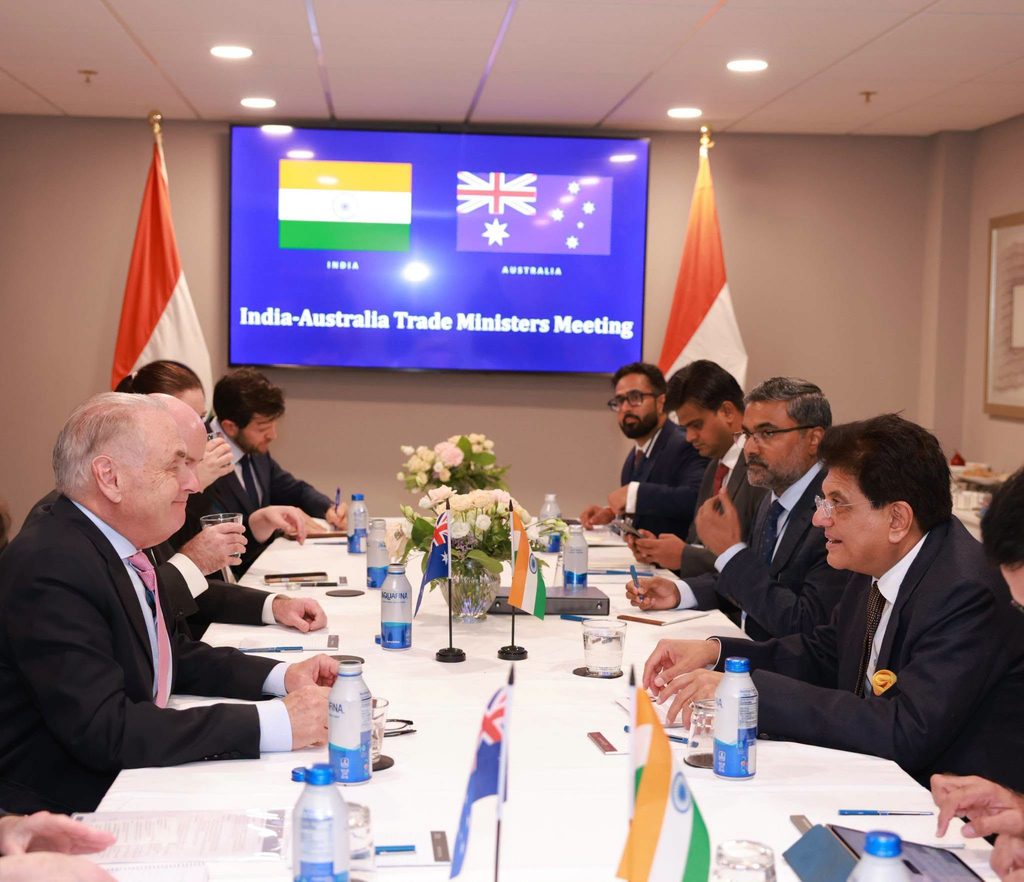
Indian Commerce and Industry Minister Piyush Goyal met Australian Trade and Tourism Minister Don Farrell on the sidelines of the G20 Trade Ministers’ Meeting in Milwaukee, United States, as both countries work to build on their existing Economic Cooperation and Trade Agreement (ECTA).
The discussions focused on moving negotiations for the proposed Comprehensive Economic Cooperation Agreement (CECA) forward. The agreement is intended to expand the scope of the current trade framework and create broader opportunities for businesses and investors in both countries.
Following the meeting, Goyal said the two ministers discussed accelerating the CECA negotiations while identifying several sectors where closer cooperation could deliver further economic opportunities. These included pharmaceuticals, services, investment, agri-tech and critical minerals.
The ministers also reviewed the implementation of ECTA and the extent to which Indian exporters are benefiting from the agreement. Goyal said the discussions included efforts to ensure Indian businesses make full use of duty-free market access available under the existing arrangement.
ECTA was signed in April 2022 and entered into force on December 29, 2022. Australia’s Department of Foreign Affairs and Trade describes the agreement as the foundation for the more ambitious CECA negotiations. Under ECTA, tariffs were eliminated or reduced on a large share of Australian exports to India, while imports from India have progressively gained expanded access to the Australian market.
The proposed CECA has been under discussion for more than a decade. Australia and India originally began negotiations for a comprehensive economic cooperation agreement in 2011, before the process was suspended in 2016. Formal negotiations resumed in 2021, eventually leading to ECTA while discussions continued towards a wider agreement.

The next stage is expected to cover areas extending beyond traditional goods trade, particularly services and investment. Education, healthcare, technology, agriculture, energy and resources are among the sectors that form an important part of the broader economic relationship between the two countries.
Critical minerals have also become an increasingly important area of bilateral economic cooperation. Australia has significant mineral resources, while India is seeking secure and diversified supplies needed for advanced manufacturing, clean-energy technologies and other strategic industries.
Investment is another major component of the negotiations. India and Australia are also working towards a bilateral investment treaty, with Goyal previously indicating that the investment agreement is being pursued alongside CECA. He has described the broader trade agreement as one that should provide balanced and mutually beneficial outcomes.
The economic relationship has expanded significantly in recent years. Australian government figures show that India was Australia’s fifth-largest trading partner, with two-way trade in goods and services reaching A$54.4 billion in the 2024–25 financial year. Australia’s investment stock in India and Indian investment in Australia have also grown, reinforcing the importance of investment provisions in future negotiations.
Services are particularly important to the relationship, with education representing a major connection between the two economies. Indian students contribute significantly to Australia’s international education sector, while Australian businesses continue to explore opportunities in India’s large and expanding services and consumer markets.
The Milwaukee discussions also came against a wider backdrop of pressure on the international trading system. Farrell travelled to the United States for the G20 Trade Ministers’ Meeting with a focus on protecting Australia’s trading interests, expanding market opportunities and supporting a rules-based global trading system.
The latest ministerial meeting follows a broader push by both governments to maintain momentum on the economic relationship. At the leadership level, Australia and India have continued discussions on trade, investment, critical minerals, technology, energy and resilient supply chains.
However, the latest talks did not establish a specific deadline for concluding CECA. The two governments still need to work through outstanding issues covering goods, services, investment and other areas before a final agreement can be reached.
For businesses in both countries, the next phase of negotiations could determine how much further market access and investment opportunities expand beyond the benefits already created by ECTA. The Milwaukee meeting signals continued government-level efforts to move those negotiations forward.