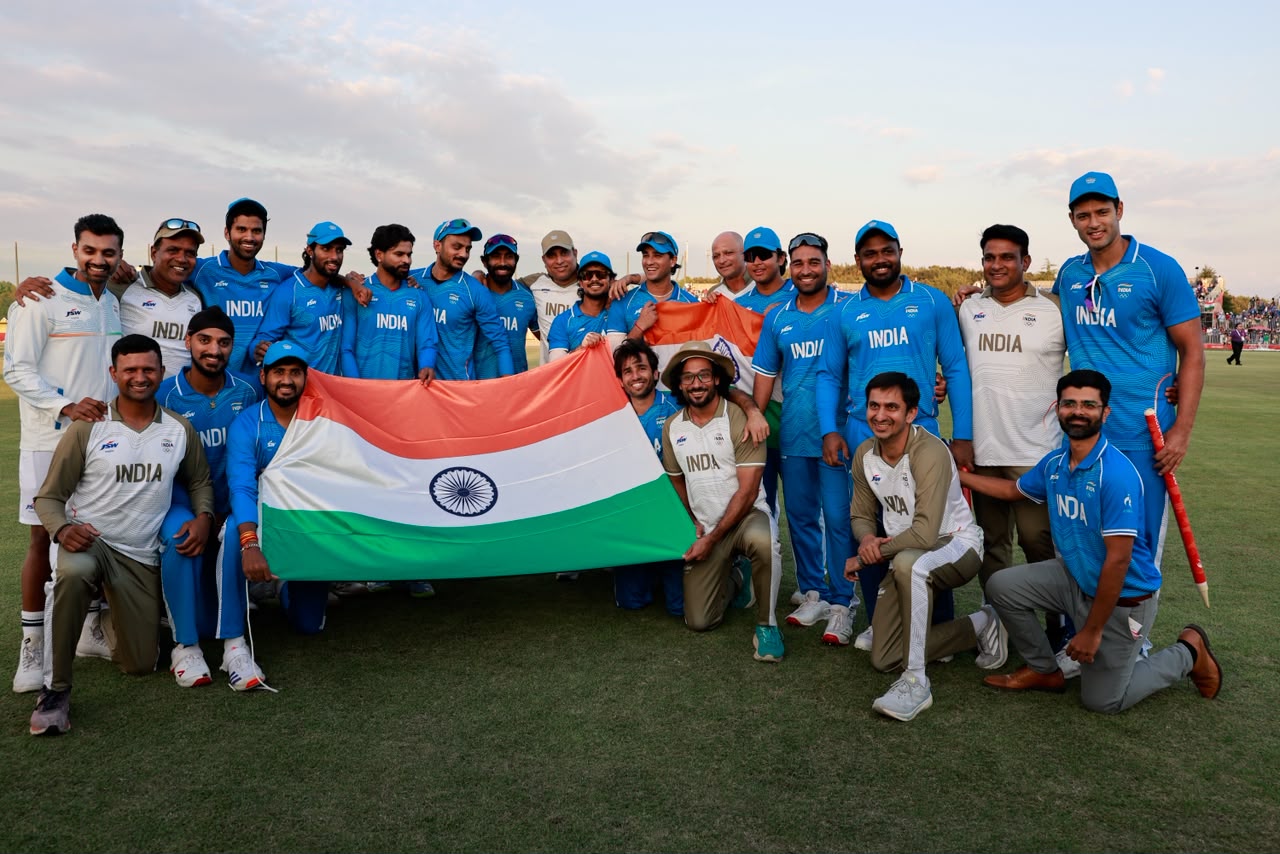
India secured the men’s cricket gold medal at the 2026 Asian Games after defeating Pakistan by 19 runs in a high-scoring T20 final at Korogi Sports Park in Nisshin, Japan, on Saturday, 3 October.
Batting first after captain Shreyas Iyer won the toss and elected to bat, India posted 211 for six from their 20 overs. Pakistan fought back during the chase and remained in contention for much of the innings, but India’s bowling attack held its nerve at crucial moments to restrict Pakistan to 192 for six.
The victory gave India the men’s Asian Games cricket title and completed a gold-medal double in the sport at the 2026 Games. India’s women had already won the women’s T20 gold medal after beating Sri Lanka by 147 runs in the final on 22 September.
Abhishek Sharma Sets the Tone
India’s innings began aggressively, with Abhishek Sharma taking control during the powerplay. The left-handed opener struck 61 from only 28 deliveries, producing three fours and seven sixes as India raced to a strong start despite losing Vaibhav Sooryavanshi and Sanju Samson early.
Abhishek reached his half-century from just 20 balls and appeared capable of producing an even bigger score before Arafat Minhas ended his innings in the eighth over. His attacking contribution nevertheless provided India with the early momentum needed on a surface where Pakistan’s spinners were able to create problems.
Vaibhav Sooryavanshi contributed 15 from nine balls before being dismissed by Saim Ayub, while Sanju Samson made two. Shreyas Iyer and Ishan Kishan then attempted to rebuild the innings after India lost early wickets.
Kishan scored 20 from 18 deliveries before being bowled by Minhas, while Iyer made 21 from 24 balls before falling to Abrar Ahmed. India subsequently reached 137 for five in the 15th over, leaving Pakistan with an opportunity to restrict the total.

Tilak Varma Changes the Momentum
Just when Pakistan appeared to have regained control, Tilak Varma transformed the final stages of India’s innings.
Varma accelerated dramatically, scoring an unbeaten 51 from only 22 deliveries. His innings included three fours and four sixes, with his half-century arriving from 21 balls. Shivam Dube provided further momentum at the other end, hitting 27 from 15 deliveries.
The pair added 62 runs in 31 deliveries for the sixth wicket, helping India score 46 runs during the final three overs. India finished on 211 for six, their highest total of the tournament and a substantial target for Pakistan to chase in the gold-medal match.
Pakistan’s bowling attack had initially managed to slow India after the explosive powerplay, but the late assault from Varma and Dube shifted the match again. Minhas finished with two wickets for 25 runs, while Ahmed Daniyal also claimed two wickets but conceded 43 runs from his three overs.
Pakistan’s Chase Starts Under Pressure
Pakistan needed 212 to claim the gold medal, but India made an immediate impact with the ball.
Washington Sundar and Axar Patel helped restrict Pakistan during the early stages, with Pakistan reaching only 39 for two during the powerplay. Sahibzada Farhan was dismissed for 10, while Usman Khan departed for three.
Maaz Sadaqat then scored 23 from 18 deliveries, but Axar Patel struck again to remove him. Pakistan were placed under increasing pressure as India maintained control of the required run rate.
However, Hasan Nawaz kept Pakistan’s hopes alive with an outstanding innings. He attacked the Indian bowling and formed an important partnership with Saim Ayub, bringing Pakistan back into contention after a difficult start.
Hasan Nawaz Leads Pakistan’s Fightback
Nawaz produced the standout individual performance for Pakistan, scoring 96 from 51 deliveries. His innings provided the main source of resistance during the chase and prevented India from closing out the match comfortably.
Nawaz and Saim Ayub added 87 runs from 48 balls for the fourth wicket, putting pressure back on India. With Pakistan still within reach of the target, Indian captain Shreyas Iyer turned to his principal bowlers in an effort to break the partnership.
The breakthrough eventually came through Shivam Dube, who dismissed Ayub for 29 from 22 deliveries. Pakistan then lost Abdul Samad for five, leaving Nawaz with an increasingly difficult task of completing the chase largely without sustained support at the other end.
Jasprit Bumrah also played an important role during the middle and closing stages, helping India restrict Pakistan’s scoring rate. Axar Patel’s control with the ball added further pressure as Pakistan struggled to maintain the required pace.
India Hold Their Nerve in the Final Overs
Pakistan entered the final stages needing a rapidly increasing number of runs. Nawaz continued attacking, but India’s bowlers repeatedly prevented Pakistan from finding the boundaries required to close the gap.
Nawaz was eventually dismissed on the final ball of the match, ending Pakistan’s chase at 192 for six. India therefore completed a 19-run victory and secured the Asian Games men’s cricket gold medal.
The result also meant that Pakistan finished with the silver medal, while Sri Lanka claimed bronze after defeating Bangladesh by 63 runs in the third-place match.
A Gold-Medal Cricket Double for India
India’s triumph in the men’s final followed another successful campaign by the women’s team earlier in the competition. The Harmanpreet Kaur-led women’s side defeated Sri Lanka by 147 runs in the final on 22 September, defending the Asian Games title they had won at Hangzhou.
The women’s victory was followed by the men’s success in Nisshin, giving India gold medals in both Asian Games cricket competitions in 2026. Reuters described the achievement as a cricket gold-medal double for India.
The men’s campaign had been interrupted by rain earlier in the tournament. India’s quarter-final against Afghanistan was abandoned without a ball being bowled, with India advancing on the basis of their higher seeding under the tournament regulations. Pakistan’s quarter-final against Hong Kong was also washed out.
India then produced a dominant performance against Sri Lanka in the semi-final, scoring 169 for seven before dismissing Sri Lanka for only 45. Ishan Kishan played a major role with an unbeaten 80 from 46 balls, while India’s bowlers dismantled the Sri Lankan batting order.
Pakistan reached the final by defeating Bangladesh in a rain-reduced semi-final. Bangladesh made 111 for seven from 13 overs before Pakistan chased the revised target, with Abdul Samad and Hasan Nawaz making important contributions.
A Final Defined by Batting Power and Key Bowling Moments
The gold-medal match ultimately turned on two contrasting phases. India’s explosive start through Abhishek Sharma gave them early momentum, while Pakistan’s spinners brought the scoring rate under control during the middle overs.
India then recovered through Tilak Varma and Shivam Dube, whose late acceleration pushed the total beyond 200. Pakistan responded through Hasan Nawaz, whose 96 kept the contest alive deep into the second innings.
India’s ability to take wickets at key stages eventually proved decisive. Once Ayub was removed and Pakistan lost further wickets around Nawaz, the required scoring rate became increasingly difficult to maintain.
The 211-run total also became the highest score of the men’s cricket tournament at the 2026 Asian Games, adding another statistical milestone to India’s gold-medal campaign.
For India, the result delivered another Asian Games cricket title and a second consecutive men’s gold after the team’s triumph at Hangzhou. For Pakistan, the silver medal marked the end of a campaign in which rain had already disrupted their route through the tournament before they reached the final.
The Nisshin final therefore ended with India holding the gold medal after a 19-run victory, but the match also produced individual performances that stood out on both sides: Abhishek Sharma’s 61 from 28, Tilak Varma’s unbeaten 51 from 22, and Hasan Nawaz’s determined 96 from 51 formed the defining batting contributions of the contest.