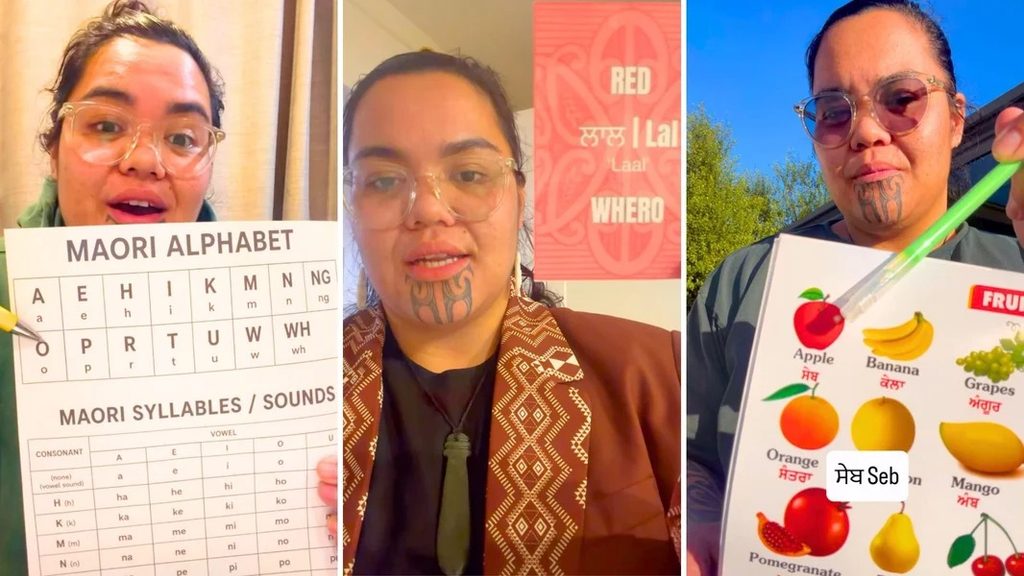
A young Māori mother in New Zealand is taking an unusual but deeply personal approach to helping her two-year-old daughter understand her Punjabi heritage: she is learning the language alongside her. Krystal, who works in real estate, teaches kapa haka and runs a beauty business, began studying Punjabi in June while also strengthening her knowledge of te reo Māori.
The decision grew from an everyday family experience. Krystal realised she was unable to understand conversations between her daughter and the child’s Punjabi-speaking father. Rather than allowing the language gap to become a barrier, she decided to learn Punjabi herself and create more opportunities for the language to be spoken within their home.
Her approach has turned language learning into a shared activity between mother and daughter. Krystal has been documenting their progress through videos featuring simple vocabulary, numbers, colours and everyday expressions in English, Māori and Punjabi. Her daughter is already beginning to respond with Punjabi words, including counting from one to three and identifying different colours.
To make the process accessible for her young child, Krystal has created learning cards and uses Punjabi alphabet materials and books sourced from India. She says the effort has produced encouraging results, particularly when communicating with her daughter about basic concepts. For the family, the lessons have become more than language exercises, creating a regular connection with the child’s paternal culture.
The experience has also encouraged Krystal to develop her own understanding of Punjabi culture. She previously found communication difficult when her partner’s Punjabi-speaking parents visited New Zealand. That experience reinforced her decision to learn enough of the language to communicate more independently, although she acknowledges that understanding rapid Punjabi conversations remains a challenge.
Her cultural exploration has extended beyond vocabulary. Krystal has visited a gurdwara and was particularly struck by the concept of sewa, commonly understood as selfless service. She connected that practice with the collective care and community values she has experienced within Māori settings, finding similarities in the importance placed on supporting others and maintaining strong community bonds.
Krystal’s public language-learning journey has attracted considerable attention online, with many people responding positively to her efforts. Some have questioned why a Māori woman would choose to learn Punjabi, but she has remained firm in her belief that her daughter should have access to both sides of her identity. Her motivation is centred on giving her child the opportunity to know and use her father’s language.

The story also highlights a broader reality for families with multiple cultural backgrounds. Language can become one of the strongest ways for children to understand where their families come from, communicate with relatives and develop a sense of belonging. For parents raising children across cultural traditions, learning a language themselves can also become a way of participating directly in that part of their child’s identity.
For Krystal and her daughter, Punjabi is therefore becoming part of an everyday family experience rather than something limited to formal lessons or occasional cultural events. Alongside te reo Māori and English, the language is creating another channel through which the young girl can connect with her family history and relationships.
Krystal hopes that sharing the experience will encourage other multicultural families in New Zealand and elsewhere to embrace every part of their heritage. Her journey demonstrates how a parent’s willingness to learn can help open a door for the next generation, turning language into a bridge between cultures, family members and generations.